
Suitable battery storage can mitigate grid congestion

How does Windey assess the commercial outlook of the battery energy storage market in Vietnam over the next 3-5 years, particularly in terms of regulatory clarity and revenue mechanisms?
Windey takes a long-term view and recognises battery energy storage as a key enabler of Vietnam’s energy transition. As renewable capacity grows, the system’s need for flexibility, through peak shaving, frequency regulation, and capacity support, will increase, creating strong market potential for storage.
While regulatory frameworks and revenue mechanisms for storage are still evolving, experience from Vietnam’s solar and wind sectors suggests that policies, including capacity payments, spot market participation, and ancillary services, are likely to become clearer over the next 3-5 years, supporting commercial viability.
Leveraging its local experience, Windey is confident in Vietnam’s market prospects and is committed to collaborating with local partners to advance energy storage deployment and mature business models for long-term, mutually beneficial growth.
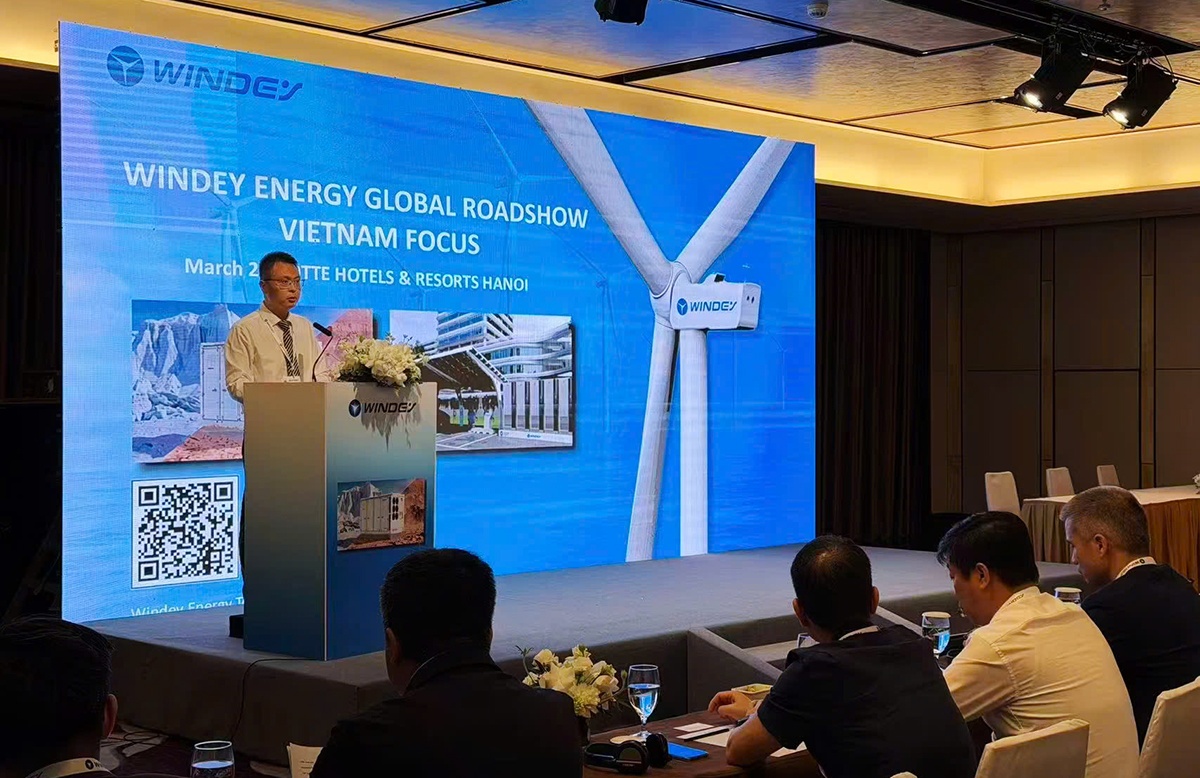 |
| Lu Jian, deputy general manager at Windey Innovolts |
As more international players enter Vietnam’s energy storage sector, what differentiates Windey’s solutions in terms of cost competitiveness, technology maturity, and project execution capability?
Amid growing international participation in Vietnam’s energy storage market, Windey leverages its deep technical expertise and system integration capabilities to deliver clear advantages in these areas.
With over 50 years in wind power and extensive experience in grid planning, connection, and protection, Windey designs storage systems that ensure both grid compatibility and long-term operational reliability.
The company takes an application-driven approach, aligning solutions with renewable integration, storage, and microgrid scenarios to optimise performance and lifecycle costs.
Supported by a strong local team, Windey provides end-to-end services from design to operation and maintenance, enhancing efficiency and ensuring professional, responsive support. By combining technology, scenario-based design, and integrated services, Windey is well-positioned to deliver competitive energy storage solutions for Vietnam’s energy transition.
In the absence of a clear revenue mechanism for standalone battery energy storage systems in Vietnam, what bankable business model does Windey consider viable today?
In Vietnam, where auxiliary service pricing and capacity payment mechanisms are not yet fully established, standalone storage projects face challenges in achieving bankable returns solely through price arbitrage in the short term.
Windey sees standalone storage as only one segment of the broader market. In the near term, more viable models focus on applications with clear revenue streams, such as commercial and industrial storage, renewable integration, and microgrids, leveraging multiple value streams to create relatively stable cash flows.
Over the medium to long term, as market mechanisms mature, the business case for standalone storage is expected to become clearer, improving returns.
Vietnam has experienced significant renewable curtailment due to grid congestion. To what extent can battery storage realistically solve this if transmission expansion lags behind generational growth?
Curtailment of wind and solar power is a common, temporary challenge in rapidly growing renewable markets, arising from the mismatch between generation and grid transmission capacity. Technically, this can be addressed through multiple approaches, including grid expansion, optimised dispatch, and deployment of flexible resources.
Drawing on Windey’s 50+ years of experience and global best practices, battery energy storage is currently one of the most practical and effective solutions. By smoothing renewable output, performing peak shaving, and enabling local consumption, storage can help mitigate curtailment caused by grid congestion.
What policy milestones or regulatory clarity would Windey need to see within the next 12–24 months to scale up its storage portfolio in Vietnam, and what does your own technical roadmap look like?
While clear planning and regulatory frameworks are undoubtedly important for the energy transition, we also believe that commercial drivers will offer investors a broader perspective. Windey remains committed to maintaining an open approach, both in terms of technology and cooperation models, and we look forward to continuing active discussions with investors.
Windey applies stringent standards across product design, supply chain management, and after-sales services. Safety is our foremost priority in energy storage systems. Building on that foundation, we collaborate with top-tier industry partners and leverage our proprietary cloud platform and the Internet of Things technologies to make power supply more transparent and better aligned with our customers’ operational needs.
How does Windey design storage solutions to balance reliability, cost efficiency, and scalability; and what role does battery storage play in ensuring stable power input for electrolysis systems?
Microgrid system design is a rigorous discipline. We take into account multiple factors, load characteristics, local natural resources, construction conditions, tariff mechanisms, and customer usage patterns, and conduct extensive system simulations and iterations.
On the basis of ensuring power security and system stability, we aim to achieve the optimal technical configuration for a lifespan of 20 to 25 years. Energy storage, while important, is just one component within our broader system design approach.
Electrochemical storage and hydrogen share the same fundamental nature, they are both different forms of energy, each with its own strengths, weaknesses, and application scenarios. From a technical perspective, the study of power consumption characteristics (load profiles) is a key focus.
Our energy storage systems serve as an integral part of the microgrid framework, providing stable power input to support Windey’s green hydrogen, ammonia, and methanol business. In China, we already have a green methanol project under construction, with an annual capacity of 120,000 tonnes, scheduled to begin production by the end of 2027.
What the stars mean:
★ Poor ★ ★ Promising ★★★ Good ★★★★ Very good ★★★★★ Exceptional
 Tag:
Tag:Related Contents




Latest News


More News
- JBIC considers new financing options for Vietnam’s energy projects (October 03, 2026 | 08:00)
- Vestas to supply 16 turbines for two new Vietnam wind farms (October 01, 2026 | 07:00)
- Inter-sectoral cooperation on Montreal protocol (September 30, 2026 | 17:20)
- EV battery recycling rate proposed at 8 per cent from 2029 (September 29, 2026 | 16:00)
- Bankability remains hurdle for Vietnam's JETP projects (September 29, 2026 | 12:08)
- Binh Minh Plastics extends clean water project to border communities (September 29, 2026 | 10:57)
- Coca-Cola Vietnam expands packaging collection programme (September 25, 2026 | 08:15)
- Pacifico Energy secures sea survey licence for offshore wind project in Lam Dong (September 24, 2026 | 18:02)
- Vietnam secures $221 million in UN development programmes for 2027-2031 (September 23, 2026 | 17:39)
- Carlsberg Vietnam shows how resource efficiency can shape green industrial growth (September 18, 2026 | 09:03)


Latest News




 Mobile Version