


Students showcase innovations for sustainable agriculture

The Food and Agriculture Organisation of the United Nations (FAO) in Vietnam and Thai Nguyen University of Agriculture and Forestry (TUAF) co-hosted the 'Youth Innovations for a Better Food Future' event on October 31 at the TUAF campus. The event formed part of the World Food Day 2025 commemorations and marked FAO’s 80th anniversary, highlighting the vital role of youth-driven solutions in building sustainable and resilient food systems.
Bringing together young people, experts, policymakers, and international organisations, the forum fostered collaboration and idea-sharing to advance a more sustainable agrifood system amid growing global food security challenges.
"Young people and students play a pioneering role in driving innovation in agriculture, reducing food loss and waste, and building a more sustainable food system," said rector of TUAF, Assoc. Prof., Dr. Nguyen Hung Quang during his opening remarks. "I encourage our students to nurture their creativity, embrace green entrepreneurship, and apply new technologies to tackle global challenges in food security and climate change."
'We deeply appreciate the FAO and our national and international partners for their strong collaboration with TUAF in research, training, and advancing green agriculture,' he added.
On the occasion of the FAO’s 80th anniversary, Quang extended warm congratulations and reaffirmed the university’s commitment to continued partnership. He also encouraged students and young researchers to keep contributing their knowledge, creativity, and innovative spirit to help build a more sustainable future for all.
The event kicked off with a summary of key findings from the FAO report on the status of youth in global agrifood systems, released in July. The report highlighted both the potential and the challenges faced by young people, affirming that their engagement is essential for the transformation of food systems.
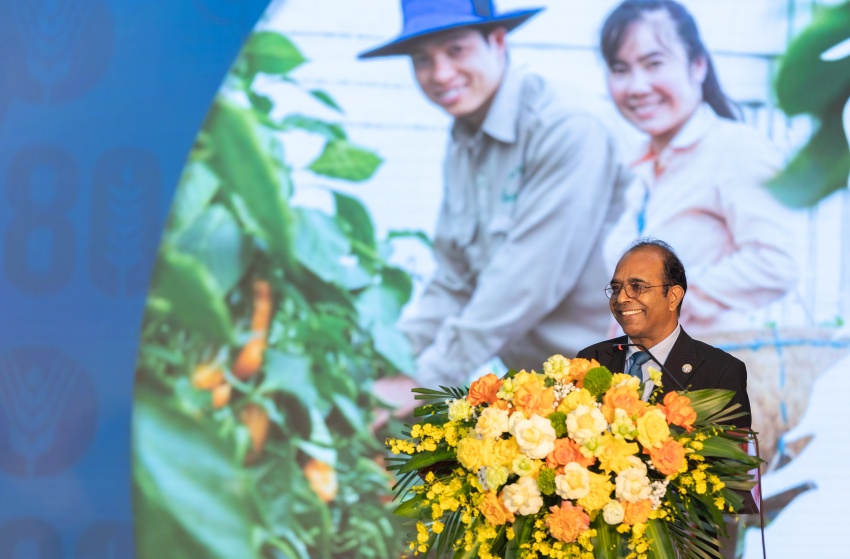 |
| FAO representative in Vietnam, Vinod Ahuja. Photo: FAO |
In his welcoming address, FAO representative in Vietnam, Vinod Ahuja, said “Innovation will not come from global institutions or government ministries. It will come from fresh ideas by young people who dare to think differently. It will come from students in classrooms and laboratories, from entrepreneurs who are designing new business models, from communities experimenting with better ways to store, share, and save food. What starts as a small project in a university can scale up to transform entire systems.”
A key highlight was the intergenerational dialogue session, where youth and senior experts engaged in a thoughtful exchange about the challenges and opportunities within the agrifood sector. Discussion topics ranged from technology application and the reduction of food loss and waste, to enhancing climate resilience.
The event also featured the final round of a student innovation competition, where six teams presented ideas aimed at reducing food loss and waste. Their creative proposals tackled environmental challenges while opening new entrepreneurial opportunities for young participants.
What the stars mean:
★ Poor ★ ★ Promising ★★★ Good ★★★★ Very good ★★★★★ Exceptional
Latest News


More News
- Pandora signs solar energy MoU with VSSES (March 17, 2026 | 09:29)
- 200 participants trained on circular economy (March 12, 2026 | 11:36)
- Unlocking sustainable finance for Vietnamese enterprises (March 10, 2026 | 17:48)
- Workshop calls for natural capital to anchor Vietnam’s economic policy (March 05, 2026 | 15:24)
- ACCA urges firms not to delay sustainability reporting over data gaps (March 05, 2026 | 14:59)
- SJ Group plants 10,000 trees in Hanoi sustainability drive (March 05, 2026 | 11:01)
- Levanta acquires 80 per cent stake in 50MW Gia Lai wind farm (March 03, 2026 | 11:58)
- E-vehicle infrastructure financing for high growth (February 20, 2026 | 15:09)
- Green finance and circular economy as drivers of growth (February 18, 2026 | 20:35)
- EVN awards EPC contract for Quang Trach II LNG project (February 10, 2026 | 09:00)








 Mobile Version