
Real estate gets a grip on turbulence

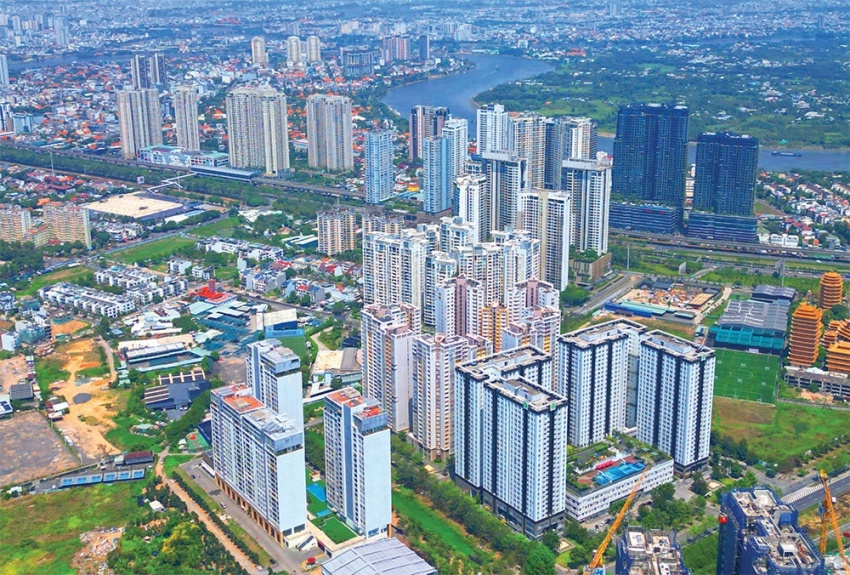 |
| A-Infrastructure advances have created conditions for developers to offer large-scale urban projects Photo: Le Toan |
Whether resilience, long regarded as one of Vietnam’s defining strengths, can continue to help the real estate market was an overarching theme at the Meet The Experts conference held last week in Ho Chi Minh City.
According to Neil MacGregor, CEO of Savills Vietnam, 2026 started full of positivity with the government focused on continued high economic growth at the beginning of a new 5-year political cycle.
“Indeed, the residential market in Hanoi in 2025 had been booming and we’re all excited in Ho Chi Minh City about the series of new launches and approvals are to come. Tourism numbers have seen record performance and there is strong belief in continued growth,” MacGregor said. “But despite this strong momentum, unfortunately global events have rather taken over, and we are faced with rising oil prices, renewed inflationary pressures and a high-interest rate environment.”
Phan Ngoc Minh, head of Economic Sector, Corporate and Institutional Banking Group at Techcombank, said that one of the biggest challenges facing Vietnam’s real estate market remains access to capital and financing costs, as ongoing global geopolitical tensions continue to place pressure on interest rates and exchange rates.
“High interest rates may persist due to three main factors: inflationary pressure from energy prices, the imbalance between short-term funding sources and long-term credit demand, and a more cautious lending approach by banks,” Minh said. “If oil prices remain around $100 per barrel, inflation could rise to 5-6 per cent, narrowing room for monetary policy adjustments. Meanwhile, around 80 per cent of current deposits are short-term, while funding demand for infrastructure and real estate is inherently long-term.”
He added that deposit growth last year reached only 15.4 per cent, significantly below credit growth of more than 19 per cent, further sustaining upward pressure on interest rates. In a high-risk environment, banks are prioritising capital allocation to sectors with more stable cash flows, meaning real estate, particularly hospitality property, is likely to continue facing credit access difficulties over the next 12–24 month.
Creating best conditions
Son Nam Nguyen, chairman and founder of Tanzanite International, the developer of Meliá Ho Tram Beach Resort, said that although the current environment has created caution, these are not unfamiliar challenges for developers.
“The market has already gone through a major pandemic, tariff disruptions, geopolitical conflict in the Middle East, high interest rates, inflation, and banking sector pressures. Such cycles of instability tend to recur every few years. What matters is that if we can navigate these short-term disruptions, the next five years could become a transformational period for Vietnam,” Son said.
Meanwhile Richard Leech, deputy CEO of Phu Long, said that while foreign investment into manufacturing remains an important driver of Vietnam’s economy, infrastructure is the more decisive factor from a real estate perspective.
“Infrastructure development has created the conditions for developers to deliver large-scale urban projects, while also improving accessibility so that people can buy homes and live in these communities,” Leech said.
Angus Liew, chairman of Gamuda Land Vietnam, said that the strongest growth driver at present comes from the Vietnamese government’s determination to pursue double-digit GDP growth, which has reinforced confidence among long-term investors in real estate and infrastructure.
Explaining how Gamuda Land has maintained positive performance in recent years, he said the key lies in its “dual-engine growth” strategy. “Alongside large-scale township developments, which require a long time to mature and generate returns, we simultaneously develop quick turnaround projects designed to be completed within five to seven years,” Liew said.
According to Liew, this combination helps maintain balance: when market conditions are favourable, quick turnaround projects generate efficient cash flow, while during slower cycles, long-term township developments provide a more stable foundation.
The next market phase
Most developers at the event remain optimistic about market prospects over the next five years. Lucas Loh, group CEO of Nam Long Group, said that optimism is grounded in the fact that current housing supply still falls short of meeting the growing residential needs of people in Vietnam. With infrastructure investment continuing at pace and the economy maintaining growth momentum, short-term disturbances such as oil prices, interest rates, and financial volatility are unlikely to alter the market’s long-term trajectory.
“Over the next five years, housing demand is expected to gradually shift from central Ho Chi Minh City to surrounding satellite urban areas, as buyers increasingly favour integrated townships offering comprehensive amenities and a complete living environment. Genuine end-user demand will remain the key foundation supporting market resilience despite the challenges the property sector has faced in recent years and continues to face today,” he said.
He also argued that real estate is increasingly becoming a capital-intensive industry, where competitiveness depends heavily on financial management, capital balancing, and cash-flow control. “Bank credit remains important, but the capital market needs to play a larger role, especially as bond issuance still faces constraints in procedures, maturities, and use-of-proceeds regulations. In the longer term, we expect Real Estate Investment Trust to emerge in Vietnam, while a market upgrade could attract an additional $5 billion in foreign capital for listed companies,” he added.
Gamuda Land, meanwhile, will continue pursuing smart urban development through open urban infrastructure systems designed to integrate new technologies over time.
According to Gamuda chairman Liew, a smart city should not be defined by specific technologies, as technology can quickly become outdated while real estate projects typically take years to complete. This is why the developer focuses on building open infrastructure capable of adapting to future technological integration.
“Sustainability means acting as a steward of the ecosystem, reflected in regular biodiversity audits at projects such as Celadon City and Gamuda City, where biodiversity levels have continued to improve after completion, a result the company views as an important indicator of smart urban development,” Liew said.
Meanwhile Leech from Phu Long Corporation said that the company’s priority markets remain Hanoi and Ho Chi Minh City, as urban development space in both cities continues to expand.
“In Ho Chi Minh City, the southern area, particularly Nha Be commune, is viewed as highly promising thanks to strong infrastructure investment, while the eastern part of the city continues to attract interest despite higher price levels,” Leech said. “We are also focusing on areas along metro corridors, especially those linked to Ho Chi Minh City metro line 5, in line with its strategy of developing projects connected to large-scale public transport infrastructure.”
In the resort segment, Phu Long Corporation also holds a significant land bank on Phu Quoc, which it sees as a market with considerable growth potential ahead
On the financial market, Minh of Techcombank said that in the short term, the top priority remains risk management, as this is currently the most pressing issue for both the financial system and the real estate market.
However, looking ahead over the next five years, capital pressure on the property sector is expected to intensify as a significant share of the economy’s funding will be absorbed by large-scale infrastructure projects. This means the need to develop additional financing channels for real estate will become increasingly urgent.
“Alongside bank credit, the market needs to strengthen the role of the bond market, equity capital markets, and other alternative financial instruments. Without expanding these funding channels, capital available for real estate development will struggle to meet growth demand in the coming period,” Minh said.
What the stars mean:
★ Poor ★ ★ Promising ★★★ Good ★★★★ Very good ★★★★★ Exceptional
 Tag:
Tag:Related Contents



Latest News
More News
- Enterprises honoured as Outstanding Provider of Green Industrial Solutions (October 06, 2026 | 18:03)
- MIK Group launches House of MIK in Ho Chi Minh City (October 03, 2026 | 17:00)
- Vietnam hospitality shifts towards integrated mixed-use developments (October 03, 2026 | 10:00)
- Stavian IP accelerates its modern expansion (October 02, 2026 | 14:00)
- ESG for future-ready industrial success (October 02, 2026 | 09:00)
- Green Future Awards honour five leading industrial park developers (October 01, 2026 | 22:20)
- Green transition leaders honoured at Green Future Awards 2026 (October 01, 2026 | 22:10)
- Six developers honoured as Emerging Green Industrial Property Developers (October 01, 2026 | 22:00)
- Why logistics will define the next phase of growth (October 01, 2026 | 09:00)
- Urban Development Law takes effect on October 1 (September 30, 2026 | 17:49)








 Mobile Version