
IREX and HAMADA partner to develop solar panel recycling facility

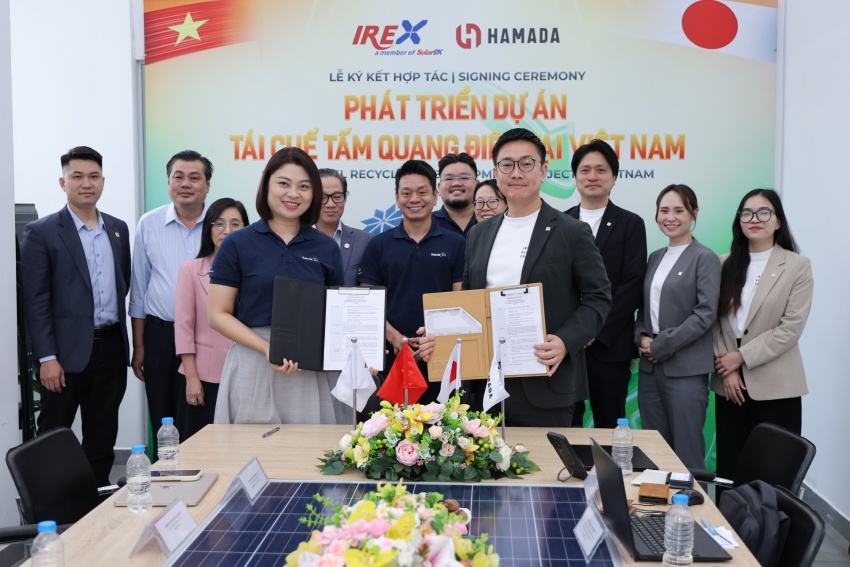 |
Dinh Hong Ky, chairman of the Ho Chi Minh City Green Business Association told VIR that the cooperation agreement between IREX Energy JSC (a member of SolarBK) and Japan’s Hamada Co., Ltd., signed on March 26 at IREX’s factory, is being viewed not simply as a project launch, but as a marker of changing priorities in Vietnam’s renewable energy sector.
“The development of recycling models in renewable energy not only reduces environmental impact, but also enhances the competitiveness of Vietnamese enterprises as environmental, social, and governance (ESG) standards become increasingly important,” he said.
Under the agreement, the two sides plan to establish a joint venture to develop a solar panel recycling facility in Vietnam, with an initial processing capacity of around 40,000 modules per year. The facility will focus on collecting, classifying, and recovering materials such as glass, aluminium frames, and photovoltaic cells from decommissioned panels.
The cooperation agreement between IREX Energy JSC (a member of SolarBK) and Japan’s Hamada Co., Ltd., signed on March 26 at IREX’s factory, is being viewed not simply as a project launch, but as a marker of changing priorities in Vietnam’s renewable energy sector.
“The lifecycle management of solar panels is becoming an increasingly important global issue,” said Nguyen Duong Tuan, general director of SolarBK. “This cooperation is not only a technological partnership, but also a foundation for developing a circular economy model in Vietnam’s solar industry.”
The partnership combines complementary capabilities. IREX contributes its experience in solar manufacturing and market operations, while Hamada brings advanced recycling technologies developed in Japan, alongside a decade-long track record in solar panel recycling.
Founded in 1973, Hamada began researching solar panel recycling technologies in 2015 and launched its recycling business in 2017. Its experience reflects Japan’s own trajectory, where early solar adoption has now led to growing pressure to manage end-of-life panels.
“With over a decade of experience in solar panel recycling, we understand that effective solutions require coordination across the entire value chain,” said Takehisa Nagata, COO of Hamada. “Vietnam will face similar challenges as its solar market matures, and early action is key.”
Indeed, Japan’s current efforts to scale recycling infrastructure offer a preview of what lies ahead for Vietnam. By acting before disposal volumes peak, the country has the opportunity to avoid the environmental and logistical pressures that often accompany delayed responses.
Beyond environmental considerations, the development of recycling capabilities is increasingly linked to competitiveness.
As global markets tighten ESG requirements, manufacturers are under growing pressure to demonstrate responsible lifecycle management. For Vietnamese solar producers–many of whom export to markets such as the US and Europe–this could become a decisive factor.
At the core of this shift is the concept of a circular economy, where products are designed to be reused, repaired, or recycled rather than discarded. For the solar industry, this means recovering valuable materials from end-of-life panels and reintegrating them into production or other industrial applications.
If effectively implemented, such models can reduce dependence on raw materials, lower carbon footprints, and strengthen supply chain resilience.
IREX, established in 2012, represents a growing cohort of Vietnamese companies seeking to move beyond assembly and deployment towards higher-value activities. Backed by SolarBK’s long-standing research in renewable energy, the company has expanded into multiple international markets and achieved globally recognised certifications.
Its move into recycling signals a broader ambition to participate across the full lifecycle of solar energy, from production to end-of-life management.
More broadly, the venture reflects an evolving pattern in Vietnam–Japan cooperation, where partnerships are increasingly focused on sustainability and advanced technologies. By combining local market knowledge with international expertise, such collaborations can accelerate the development of emerging sectors.
Although still at an early stage, the IREX–Hamada initiative could have implications beyond its immediate scope. As one of the first solar panel recycling projects in Vietnam, it may help shape technical standards, inform regulatory frameworks, and attract further investment into the circular economy.
What the stars mean:
★ Poor ★ ★ Promising ★★★ Good ★★★★ Very good ★★★★★ Exceptional
 Tag:
Tag:Related Contents






Latest News

More News
- Vietnam’s registered FDI surpasses $50 billion in nine months (October 07, 2026 | 10:30)
- Samsung Electro-Mechanics to add $1.85 billion semiconductor investment in Thai Nguyen (October 06, 2026 | 18:23)
- Electronics funding will be won via a capable ecosystem: SGS (October 06, 2026 | 09:00)
- LNG power plant projects risk falling behind schedule (October 03, 2026 | 09:00)
- Pandora opens world’s largest fine jewellery crafting facility (October 02, 2026 | 22:21)
- An Phat 5 Industrial Park positions for new wave of investment in northern Vietnam (October 02, 2026 | 09:00)
- Hanoi to launch portal to ease hurdles for tech businesses (October 01, 2026 | 09:00)
- Foreign investors to be widened for market access (September 30, 2026 | 17:54)
- Phu Quoc Airport planning adjusted to serve APEC 2027 (September 30, 2026 | 17:35)
- Nearly 200 foreign-invested enterprises in Vietnam to pay global minimum tax (September 30, 2026 | 17:26)


Latest News




 Mobile Version