

Ho Chi Minh City gradually shaping financial centre

Speaking at a press briefing on the city’s socioeconomic situation held on April 2 in Ho Chi Minh City, Richard D. McClellan, CEO of the Vietnam International Financial Centre (VIFC) in Ho Chi Minh City, said that according to the latest results of the Global Financial Centres Index, Ho Chi Minh City climbed 11 places to rank 84th globally.
 |
More notably, the city has been identified as one of the financial centres expected to gain significant importance over the next 2-3 years.
“This is a positive signal, indicating that Vietnam in general and Ho Chi Minh City in particular are being mentioned more frequently in international financial forums. However, these results should be viewed with caution and grounded in practical substance,” McClellan said.
“Global Financial Centres Index (GFCI) should be understood as an indication of emerging momentum and improving international recognition, rather than proof that Ho Chi Minh City has already become a fully developed international financial centre. The ranking reflects market acknowledgement of the city’s initial progress, but the road ahead remains long,” he added.
However, Ho Chi Minh City’s rise in the GFCI is not incidental, but driven by three main factors over recent times. First, there has been consistent policy direction at the national level. The Party and National Assembly have demonstrated a clear commitment to developing an international financial centre, sending a strong message to both domestic and international stakeholders that this is a long-term strategic priority for Vietnam.
Second, the institutional roadmap is gradually taking shape. The legal framework, governance structure, and licensing mechanisms for the financial centre are being developed in line with international standards, laying the groundwork for future operations.
Third, international engagement is expanding steadily. Vietnam is proactively engaging with global financial institutions, investors, and strategic partners, thereby enhancing visibility and building confidence in international markets.
According to McClellan, the GFCI essentially reflects how international recognition is gradually following Vietnam’s sound policy direction and sustained integration efforts. However, while the ranking result is encouraging, it should be clearly recognised that this remains an early stage of development. The key task now is to translate that momentum into tangible progress.
“Three priority areas should be addressed in the next phase: establishing a transparent, predictable, and credible legal framework; ensuring capital mobility and financial integration; and developing financial markets and the broader ecosystem, including capital markets, asset management, private assets, fintech, and innovation,” he added.
However, rankings such as the GFCI will continue to fluctuate in the coming years, particularly during the early stages of development, and this is entirely normal.
More importantly, the GFCI is an outcome indicator rather than a predictive one. It reflects how the market community evaluates a financial centre after progress has already been recognised, rather than serving as a short-term target to pursue.
Therefore, the real objective is not to improve rankings within a few months or a year, but to build a financial centre that international investors actively choose as a base for presence and operations. If institutions are firmly established, capital flows smoothly, and markets develop in substance, rankings will improve naturally over time.
“The latest GFCI results are an encouraging signal for Ho Chi Minh City and for Vietnam. While this remains a relative benchmark, it clearly reflects growing international interest and recognition. But that result also brings a clear responsibility going forward. The task now is to convert that interest into real investment, to build robust institutions, and to develop a system that is credible, competitive, and genuinely connected to the world,” McClellan said.
 | VIFC launches aviation finance hub to tap regional market growth Vietnam is stepping up efforts to develop specialised aviation finance capabilities as part of its broader ambition to become a regional financial hub. A new initiative aims to connect global aircraft manufacturers, financiers, and airlines through Ho Chi Minh City. |
 | Academic-policy network planned to support VIFC development Vietnam is working to establish a nationally recognised academic-policy forum in finance, aimed at strengthening policy advisory capacity and supporting the development of its International Financial Centre. |
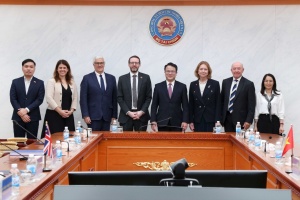 | Vietnam seeks UK expertise to advance IFC vision Vietnam is turning to UK expertise as it advances plans to develop international financial centres in Ho Chi Minh City and Danang, with a focus on strengthening its legal framework and investor appeal. |
 | Building an IFC via global experience Angela Knight, chair of the Astana Financial Services Authority and former UK Economic Secretary to the Treasury, talked with VIR’s Thanh Dat about how to build hubs and offered insights from experience, including lessons from Astana and other global IFCs. |
What the stars mean:
★ Poor ★ ★ Promising ★★★ Good ★★★★ Very good ★★★★★ Exceptional
 Tag:
Tag:Related Contents




Latest News


More News
- Vietnam’s registered FDI surpasses $50 billion in nine months (October 07, 2026 | 10:30)
- Samsung Electro-Mechanics to add $1.85 billion semiconductor investment in Thai Nguyen (October 06, 2026 | 18:23)
- Electronics funding will be won via a capable ecosystem: SGS (October 06, 2026 | 09:00)
- LNG power plant projects risk falling behind schedule (October 03, 2026 | 09:00)
- Pandora opens world’s largest fine jewellery crafting facility (October 02, 2026 | 22:21)
- An Phat 5 Industrial Park positions for new wave of investment in northern Vietnam (October 02, 2026 | 09:00)
- Hanoi to launch portal to ease hurdles for tech businesses (October 01, 2026 | 09:00)
- Foreign investors to be widened for market access (September 30, 2026 | 17:54)
- Phu Quoc Airport planning adjusted to serve APEC 2027 (September 30, 2026 | 17:35)
- Nearly 200 foreign-invested enterprises in Vietnam to pay global minimum tax (September 30, 2026 | 17:26)


Latest News




 Mobile Version