

High-value exports drive Vietnam’s push towards robust 2025 expansion

 |
| Nguyen Thu Oanh, head of the Department of Service and Price Statistics, National Statistics Office |
Vietnam’s total export value in the first 10 months of 2025 has almost matched the full-year figure for 2024. What factors have driven this growth?
Last year, Vietnam’s merchandise export value reached $405.53 billion, up 14.3 per cent on-year. Despite a more challenging global context this year, particularly the tariff trade war among major economies, the country still posted exports of $391 billion in the first 10 months of 2025, up more than 16 per cent on-year and almost equivalent to the full-year figure for 2024.
Since the beginning of the year, monthly exports have averaged more than $39 billion. If this momentum holds, export value will surpass the 2024 figure by mid-November.
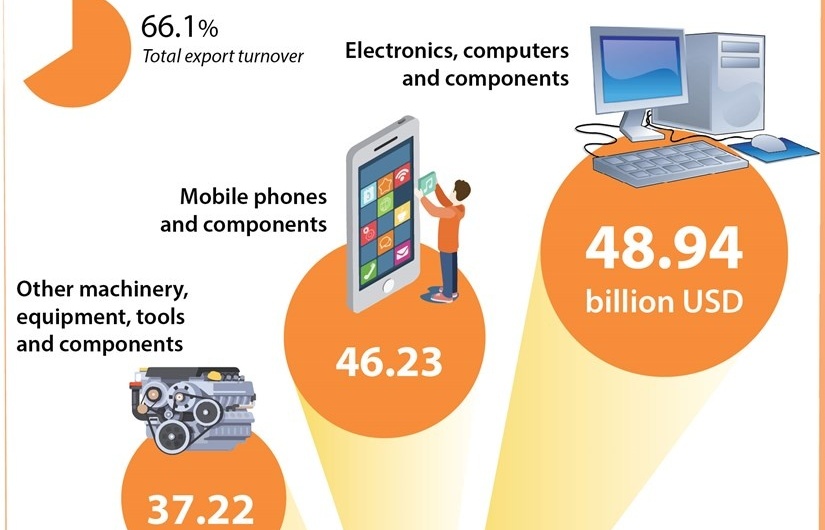
So far, 36 export items have seen value surpassing $1 billion (four more than September), accounting for more than 94 per cent of total exports. Among them, seven items have exceeded $10 billion, representing 67.9 per cent.
The trade surplus stands at $19.56 billion, an increase of $2.6 billion from the previous month, helping reinforce macroeconomic stability and bolster national foreign exchange reserves.
Overall, the import-export performance over the first 10 months of 2025 not only highlights the adaptability of Vietnamese businesses but also reflects the effectiveness of open-door and deep-integration policies, contributing to GDP growth and strengthening the country’s external economic position.
Amid a global backdrop of slow growth, prolonged geopolitical tensions, and rising protectionism, Vietnam’s trade sector has maintained a remarkable recovery, emerging as one of the bright spots of the economy.
Vietnam remains heavily dependent on imported inputs. What does the current import trend indicate about domestic production?
Because domestic production has not yet fully mastered technologies and the possession of key industrial inputs, imports still play an important role.
In the first 10 months of this year, Vietnam’s import value reached $371.4 billion, up 18.6 per cent, reflecting a recovery in production.
Capital goods and production materials accounted for 93.8 per cent of total imports, suggesting that enterprises are stepping up investment, adopting new technologies, and increasing imports of raw materials, machinery, and equipment for production.
This trend underscores an economy recovering along a production-and-export trajectory, with the processing and manufacturing sector continuing to serve as the main growth driver for both imports and the broader economy.
Another positive development is the continued expansion and diversification of Vietnam’s import-export markets, with rising turnover in key destinations such as the United States, the EU, South Korea, Japan, China, and ASEAN. Effective utilisation of free trade agreements (FTAs) has helped Vietnamese products boost competitiveness and maintain strong growth despite a difficult global environment.
With 17 FTAs in effect, how have these agreements shaped Vietnam’s trade performance?
The 17 FTAs Vietnam has signed, especially the Regional Comprehensive Economic Partnership, EVFTA, and Comprehensive and Progressive Agreement for Trans-Pacific Partnership, are delivering increasingly clear benefits by expanding export markets and reducing tariff barriers. These agreements not only stimulate exports but also create opportunities for Vietnam to import advanced technologies and modern production equipment from partner countries.
In 2024, Vietnam signed or completed several additional international trade agreements, further enhancing market access. These agreements support export growth and open up new investment opportunities across domestic industries.
To stay competitive globally, Vietnam is accelerating improvements in logistics infrastructure and promoting technology adoption in trade operations. These measures are crucial to reducing costs and improving the efficiency of cross-border commerce.
Exporters and importers are increasingly applying digital technologies in warehouse management, transport operations, and customs procedures, thereby improving efficiency and shortening clearance times. Innovations such as automated customs systems, AI, and big data help businesses access market information more quickly, manage supply chains more effectively, and optimise operations.
Sustaining high import-export growth also requires robust government support. The government has continued expediting trade promotions and supporting exporters through measures such as subsidising participation in trade fairs and assisting in market development. Additionally, tax incentives, credit support, and workforce training in the trade sector have contributed to improving performance across the industry.
Instead of focusing on lower-value sectors such as textiles and footwear, Vietnam is shifting towards higher-value products, particularly electronics, computers, and components. Do you consider this a positive transition?
From 2016 to 2025, the electronics, computers, and components sector has risen to become one of the key pillars of Vietnam’s economy, contributing significantly to bolstering export value and creating jobs for millions of workers.
In the first 10 months of 2025, export value in electronics, computers, and components topped all categories, approximating $87.3 billion, while imports hit a record $123.15 billion.
These figures underscore the expanding scale and growing influence of the electronics industry within the national trade structure, while also highlighting the considerable challenge posed by heavy reliance on imported components, raw materials, and foreign-invested enterprises (FDI).
Since 2016, import-export turnover in electronics, computers, and components has more than tripled. In 2016, exports totalled $18.5 billion and imports $27.8 billion; by 2024, those numbers had climbed to $68 billion and more than $110 billion, respectively. The sector’s average annual growth rate of 18.6 per cent far surpasses the national average of 10.2 per cent.
This rapid expansion has been driven by strong inflows of FDI into Vietnam, particularly from leading global electronics corporations such as Samsung, LG, Intel, Foxconn, Canon, and Goertek. Their investments have helped transform Vietnam into one of ASEAN’s major electronics manufacturing and assembly hubs, thereby shaping regional supply chains.
 | Vietnamese shrimp export value must be increased The goal of reaching $10 billion in shrimp exports next year requires a massive push from shrimp farmers and businesses. Le Dinh Huynh, general secretary of the Vietnam Sustainable and Clean Shrimp Alliance, discussed insights on how to increase the value of shrimp products for export through the eco-shrimp model with VIR’s Hoang Oanh. |
 | Shrimp exporters plan strategies to boost year-end growth Vietnamese shrimp exporters are devising competitive pricing strategies and long-term risk-hedging contracts to achieve their year-end growth targets in the last four months, the peak season for the seafood industry. |
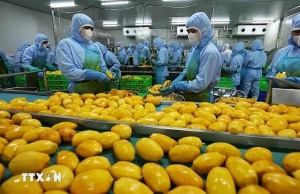 | Vietnam eyes 8 billion USD in fruit, vegetable export value in 2025 Vietnam's fruit and vegetable sector aims to achieve 8 billion USD in export revenue in 2025, building on significant market expansion and sound growth, according to the Vietnam Fruits and Vegetables Association (VINAFRUIT). |
What the stars mean:
★ Poor ★ ★ Promising ★★★ Good ★★★★ Very good ★★★★★ Exceptional
 Tag:
Tag:
Related Contents
Latest News





More News
- Sojitz in Vietnam: 40 years from individual projects to a business cluster 'KATAMARI' (October 08, 2026 | 09:00)
- Coteccons targets 'Quality Growth' with 25 per cent dividend plan (October 07, 2026 | 13:00)
- Vietnam Education Forum opens UK Education Mission's Hanoi visit (October 07, 2026 | 12:27)
- Tax authorities deactivate TINs of nearly 180,000 businesses (October 07, 2026 | 12:08)
- World Bank raises Vietnam's 2026 GDP growth forecast to 7.4 per cent (October 07, 2026 | 11:41)
- Vietstock 2026 to spotlight livestock innovation and green transition (October 07, 2026 | 09:00)
- Vietnam’s GDP grows over 9 per cent in first nine months (October 05, 2026 | 18:45)
- Vietnam earns $56.3 billion from agro-forestry-fishery exports (October 05, 2026 | 18:32)
- DSV balances resilience and decarbonisation in supply chains (October 05, 2026 | 18:20)
- Electronics exports reach $175.4 billion in the first nine months (October 05, 2026 | 18:12)



Latest News




 Mobile Version