
Forum focuses on financial solutions for ESG in real estate

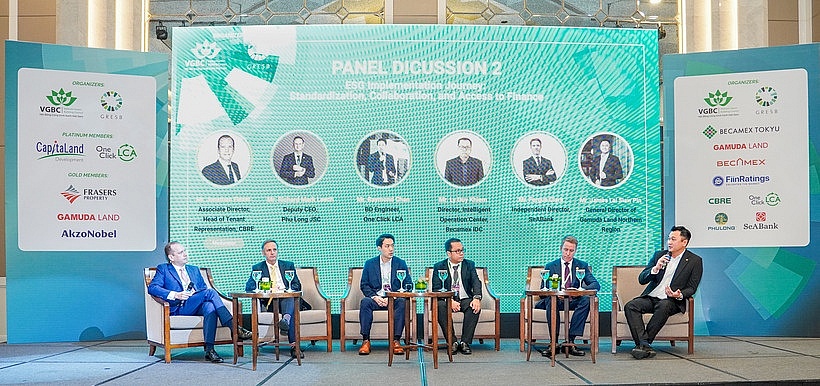 |
| A panel discussion at the event |
The event, organised by the Vietnam Green Building Council (VGBC) and GRESB (Global ESG Benchmarking) aimed to lay the foundation for a practical environmental, social, and governance (ESG) financial framework and investment tools tailored for the Vietnamese real estate sector.
Globally, ESG has evolved far beyond a corporate slogan. It is now a defining standard for project quality and investment potential. Major investors and financial institutions, including GRESB, IFC, ADB, and global funds from Europe, the US, and Japan, are using ESG criteria to screen and prioritise funding.
Assessing ESG implementation in real estate across Asia-Pacific, Jonathan Flexer, associate director and head of tenant representation at CBRE, said that occupiers push back net-zero timelines. Authorities in many Asia-Pacific markets have set the goal of achieving net-zero emissions by 2050 under the Paris Agreement. Many occupiers have set ambitious targets of 2030, but some have reviewed and adjusted their targets.
"Corporate commitment to net zero is still strong, despite some scaling back," he said. As of the end of 2024, 45 per cent of Global Fortune 500 companies had a net-zero target compared to 8 per cent in 2020. "Despite the challenge, committing to goals implies corporations will accelerate their efforts to achieve decarbonisation."
Vietnam has seen significant growth in ESG certifications, with 657 projects already certified, and more than 16 million sq.m GFA certified, covering landed housing, warehousing, factories, hotels, apartments, and traditional office space.
"To ensure further progress is made towards net-zero emissions, commercial real estate stakeholders will need to deploy other measures to accelerate the transformation of the entire lifecycle of real estate assets," Flexer said, and pointed out five major decarbonisation strategies for landlords and occupiers to consider, including energy efficiency, electrification, renewable energy, sustainable building practices, and carbon offsetting.
"Government collaboration, technology advancement, and the availability of green financing will be some of the key success factors for this transition," he emphasised.
Nguyen Hoa Cuong, vice president of the Institute for Policy and Strategy, said that Vietnamese enterprises have recognised the importance of sustainable development.
Specifically, the UOB Business Outlook 2023 survey covering more than 4,000 small- and medium-sized enterprises in the ASEAN region and China showed that 94 per cent of Vietnamese enterprises recognised the importance of sustainable development. Vietnam and Thailand are considered the two leading countries in applying sustainability, with 51 per cent having started sustainable activities.
Vietnam has started integrating ESG principles into its national strategies. The National Green Growth Strategy (2021–2030) identifies ESG as a cornerstone for transforming the economic model, and Decision No.167/QĐ-TTg emphasises the role of businesses and the financial market in greening the economy.
"However, enterprises still face many difficulties in implementing ESG, such as limited awareness," Cuong said. A survey covering 1,019 enterprises by the Agency for Enterprise Development (under the former Ministry of Planning and Investment) in 2024 reported that 39 per cent of respondents had never heard of ESG and 62 per cent were not clear about Vietnam's regulations and policies related to ESG. Businesses in banking and finance and real estate led in building strategies and implementing ESG plans.
"Besides it, financial constraints also significantly hinder the implementation of ESG for businesses; corporate governance structures are still limited; and the reliability of information data is not good," he added.
Raymond Chan, an engineer at One Click LCA, said that buildings are responsible for 39 per cent of global carbon emissions, including 28 per cent from operational emissions, and 11 per cent from materials and construction. Cities will grow to 230 billion sq.m by 2060. New construction, renovation, and infrastructure will generate 100-200 gigatonnes of embodied carbon. That's like building New York City every 34 days until 2060.
"Life-cycle assessment provides the bigger picture, including specific quantity and amounts. This should be done as early as possible, so the decarbonisation potential halves after each project stage, including strategy, concept, design, and build," Chan emphasised.
With lifespans stretching over decades, real estate projects must embed ESG from the design and construction stages to remain future-proof. ESG enhances asset value and improves residents' quality of life and corporate reputation.
Vietnam must develop a national ESG standard for real estate, one that can guide project evaluation, investment decision-making, and green finance access. A well-defined ESG framework will enable the government to implement targeted incentives, while helping businesses unlock domestic and international green capital.
Nguyen Tung Anh, senior manager of FiinRatings' Economics and Credit Research, said, "To attract green capital, businesses first need a green finance framework, which is a set of rules and standards for companies issuing green bonds/ loans, ensuring that the bonds/ loans are used for environmentally beneficial projects and meet green standards."
He pointed out four standard components of a green finance framework are use of proceeds, reporting, process for project evaluation and selection, and management of proceeds.
According to the IFC, Vietnam will require $753 billion by 2030 for climate-resilient infrastructure, much of which could come from the private sector if ESG policies were more robust.
At the forum, experts provided a platform for open dialogue among policymakers, financiers, and real estate leaders to co-develop a credible, actionable ESG roadmap. The event aimed to bring ESG closer to national policymaking and foster a “triangle cooperation” model between the state, financial institutions, and enterprises, driving the real estate market towards quality, sustainability, and the nation’s net-zero goal.
The VGBC presented lessons from Australia regarding sustainable finance in real estate and recommendations for Vietnam. Drawing from Australia’s success, anchored on government ESG criteria, ESG-linked lending, and institutional investor demand, the VGBC called for a national ESG framework, dedicated green finance products, and improved ESG data systems.
Vietnam must develop a national ESG standard for real estate, one that can guide project evaluation, investment decision-making, and green finance access. A well-defined ESG framework will enable the government to implement targeted incentives, while helping businesses unlock domestic and international green capital.
 Diamond Lotus Riverside is awarded Lotus Provisional Certification by VGBC Diamond Lotus Riverside is awarded Lotus Provisional Certification by VGBC |
 Vietnamese real estate goes global Vietnamese real estate goes global |
 Strengthen partnership and efforts to promote zero energy buildings in Vietnam Strengthen partnership and efforts to promote zero energy buildings in Vietnam |
What the stars mean:
★ Poor ★ ★ Promising ★★★ Good ★★★★ Very good ★★★★★ Exceptional
 Tag:
Tag:Related Contents





Latest News



More News
- Malaysian tycoon SkyWorld brings sustainable homes to Vietnam (April 23, 2026 | 08:00)
- Green real estate labels mask deeper capital market divides (April 20, 2026 | 08:00)
- Ministry of Construction drafts criteria to assess urban climate resilience (April 14, 2026 | 17:05)
- Hyundai HT to expand smart home and building in Vietnam (April 01, 2026 | 13:20)
- New urbanisation cycle set to define Vietnam's next decade of growth (March 17, 2026 | 21:00)
- Vietnam enters global Top 10 markets for LEED-certified buildings (March 09, 2026 | 13:45)
- Kusto Home brings value-centric vision to Hanoi's shifting luxury market (February 27, 2026 | 08:00)
- Vietnam breaks into Top 10 countries and regions for LEED outside the US (February 05, 2026 | 17:56)
- Green finance offers 'passport' for Vietnamese construction, building materials firms (December 15, 2025 | 08:00)
- AkzoNobel showcases the future of sustainable façade architecture (December 04, 2025 | 18:30)






 Mobile Version