
Finance sector was key pillar of 2025 growth

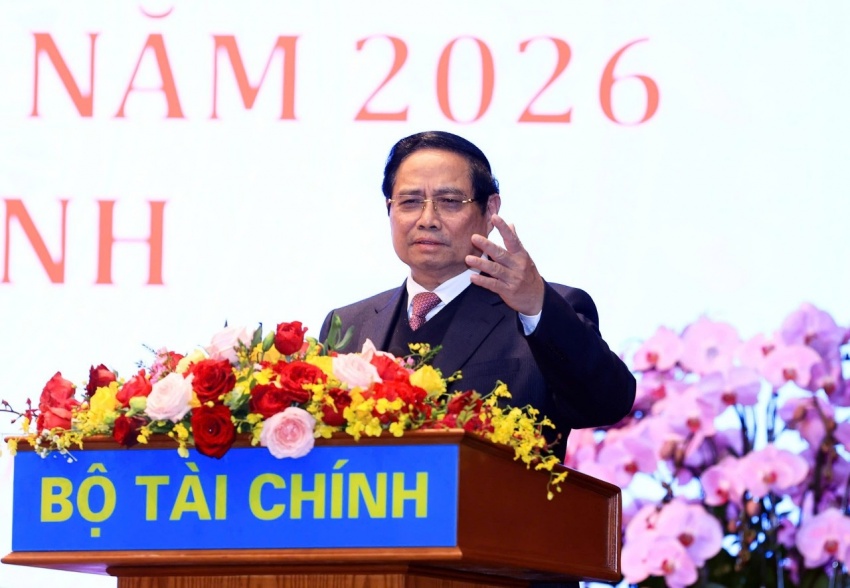 |
| Prime Minister Pham Minh Chinh |
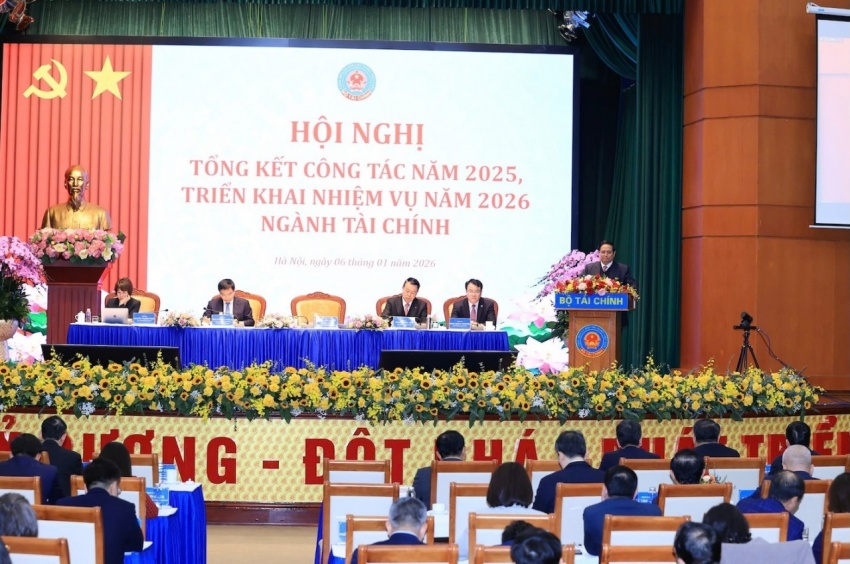
Speaking at a Ministry of Finance (MoF) conference reviewing its 2025 performance and setting tasks for 2026 on January 6, Prime Minister Pham Minh Chinh said the finance sector made a decisive contribution to Vietnam’s socioeconomic achievements in 2025, citing macroeconomic stability, effective inflation control, and the safeguarding of major economic balances.
The PM highlighted the finance sector’s crucial role, captured in 32 key phrases: accurate advice, streamlined apparatus, improved institutions, budget surplus, business innovation, macro stability, people’s wellbeing, and national development.
On accurate advice, he said the sector had demonstrated its role as a strategic advisory body in macroeconomic management, going beyond basic budget administration to become a central coordinator of national development resources, promptly advising the government on flexible growth scenarios.
As a result, GDP growth was estimated at 8.02 per cent, exceeding early-year projections and lifting the economy to a new regional position. The economy grew to $514 billion, with per-person income at $5,026. The sector also advised on innovative Politburo resolutions, including Resolution No.68-NQ/TW, and policies on international financial centres and free trade zones.
Streamlined apparatus reflected a historic organisational reform. In line with the lean – compact – strong principle, the sector implemented Resolution No.18-NQ/TW, merging the MoF, the Ministry of Planning and Investment, the State Capital Management Committee, and Vietnam Social Security into a unified structure. More than 3,600 units were cut (a 37 per cent reduction), staffing fell by over 10 per cent compared to 2021, while efficiency rose sharply. The system processed a record 230,000 documents without disruption. "This is clear evidence of a readiness to innovate for national interests," the PM said.
On improved institutions, the PM pointed to the shift from a control-oriented framework to a development-enabling one. 11 laws were passed in 2025, seven core resolutions were issued to guide national development, and more than 468 fully online public services were delivered and linked to the national population database under Project 06 on digital transformation, cutting and simplifying over 30 per cent of business conditions.
"Timely legal preparation for an international financial centre and pilot digital asset markets has helped Vietnam align with global financial trends, alongside stronger decentralisation and a buoyant stock market," said Chinh.
Budget surplus was achieved through record revenues, collected fully and on time, largely from domestic production and business activities, up more than 34 per cent against estimates, while spending reached just over 94 per cent of the plan. Higher revenues and savings created additional resources for defence, social welfare, and development investment.
Regarding business innovation, the PM noted that 564 projects were launched or completed with a total investment of VND5.14 quadrillion ($216 billion), over 70 per cent contributed by the private sector. Businesses accounted for 86 per cent of domestic revenues, with several, including private firms, joining global value chains. Foreign investment disbursement hit a record high.
Macro stability was maintained across exchange rates, interest rates, growth, inflation, and trade. This underpinned people’s wellbeing, with rising living standards, vibrant cultural, sports, and tourism activities, and strong social security outcomes highly regarded internationally. Significant resources were allocated to eliminate substandard housing and implement major social campaigns.
The finance sector also proactively arranged tens of trillions of VND from contingency and reserve funds to support seeds, livestock, and lump-sum pension and allowance payments for flood-affected communities.
"These policies reflected empathy and partnership between the state and citizens, fostering a broad social consensus," the PM said.
As a result, the country continued to modernise: economic scale, trade, and per-person income rose sharply, while infrastructure, from expressways to ports and airports, expanded rapidly. "The finance sector has proven itself a loyal 'gatekeeper', a sharp 'brain', and a driver of development," he added.
 |
Alongside these achievements, the PM urged candour on shortcomings. Public investment disbursement remains a persistent obstruction; private sector development and state-owned enterprise restructuring have yet to meet expectations; macroeconomic management faces mounting external pressures; and initial challenges remain in organisational restructuring and the two-tier local government model.
Looking to 2026, PM Chinh called for renewed innovation to support the goal of double-digit growth, setting out a six-part guiding motto: “aspiration for strength, pioneering institutions, effective governance, digital leadership, breakthrough revenues and spending, and sustainable finance.”
"The finance sector must think big and long-term, remove obstacles for individuals and businesses, govern flexibly and effectively, and lead in digital transformation and data development, especially in taxation and fees. Revenues must be collected fully and promptly, interests balanced, risks shared, and spending disciplined. National finance must be sustainable, with focused investment," he said.
Priority tasks include promoting innovative thinking and institutional reform to strengthen the sector’s role as the government’s macroeconomic coordinator, shifting from a control-oriented approach to one focused on facilitation, and turning institutions from constraints into sources of competitiveness. The finance sector was also tasked with advising on a reasonably expansionary, well-targeted fiscal policy to safeguard financial security while mobilising resources for major projects, including the North–South high-speed railway and standard-gauge rail links with China.
The PM also urged faster disbursement of public investment and strategic infrastructure, calling on the sector to ensure full allocation and disbursement by the end of January, with no projects delayed due to funding shortfalls.
 | Vietnam GDP posts second-strongest growth since 2011 Vietnam’s economy delivered one of its strongest growth performances in more than a decade last year, with momentum building steadily through the quarters and peaking at year-end. |
 | Stock market starts 2026 with growth and governance in focus Vietnam’s stock market began its first trading session of 2026 on a confident note, with policymakers underscoring its role as a key pillar for rapid yet sustainable economic growth in the next phase of national development. |
 | Finance sector lays firm groundwork for 2026 after major reform The Ministry of Finance (MoF) held a conference on January 6 to review its 2025 performance and outline tasks for 2026. |
What the stars mean:
★ Poor ★ ★ Promising ★★★ Good ★★★★ Very good ★★★★★ Exceptional
 Tag:
Tag:Related Contents


Latest News



More News
- Eximbank to strengthen corporate governance structure (October 16, 2026 | 11:32)
- Citi honours 13 banks with 2025 STP Awards (October 15, 2026 | 16:01)
- Green transition requires realistic roadmap (October 14, 2026 | 17:31)
- VIR workshop explores credit policy and carbon market development (October 14, 2026 | 11:22)
- Stronger carbon market needed to unlock climate finance (October 14, 2026 | 11:00)
- Carbon market opens new avenues for green finance (October 14, 2026 | 10:00)
- VPBank and Western Union enhance digital remittance experience (October 13, 2026 | 15:44)
- Eximbank’s next chapter: Richa Goswami on purpose, relevance and trust (October 13, 2026 | 10:52)
- Vietnam and Luxembourg sign MoU to strengthen financial cooperation (October 13, 2026 | 10:20)
- Vietnam seeks stronger cooperation with Fitch Ratings to improve sovereign credit rating (October 13, 2026 | 10:07)



Latest News






 Mobile Version