
Banking sector targets double-digit growth

State lender Agribank has announced its 2026 business plan, setting a pre-tax profit target of approximately $1.3 billion, up more than 10 per cent on-year, underscoring its strong growth ambitions.
 |
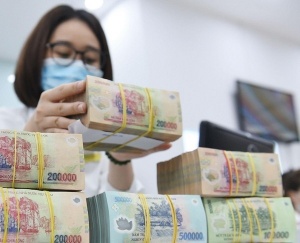
| Many banks target 10-20 per cent on-year profit growth in 2026. |
Specifically, outstanding loans to the economy are projected to surge 12-15 per cent, in line with credit growth quotas assigned by the State Bank of Vietnam (SBV).
The non-performing loan (NPL) ratio will be controlled at below 1.5 per cent compared to the state regulated ratio below 3 per cent, while the ratio of potentially irrecoverable debts will be kept under 1.3 per cent.
In 2025, Agribank posted positive results, with estimated pre-tax profit approximating $1.2 billion, the highest in five years since implementing its bad debt restructuring plan for 2021-2025.
As of the end of 2025, the bank’s total assets exceeded $104 billion, while total outstanding loans reached nearly $80 billion.
Under the restructuring plan, its NPL ratio as of December 31, 2025 fell sharply to 1.21 per cent, while the on-balance-sheet NPL ratio stood at 1.14 per cent.
BIDV has also outlined key 2026 targets, including credit growth of 15–16 per cent and maintaining an NPL ratio at or below 1.5 per cent. The bank aims for a 10 per cent increase in pre-tax profit.
At the close of 2025, BIDV retained its position as the largest bank by asset size, with total assets approximating $130 billion, marking 20 per cent growth compared to 2024. With this scale, BIDV continues to be the largest joint-stock bank in Vietnam by total asset value.
In terms of business performance, BIDV’s consolidated pre-tax profit exceeded $1.4 billion. Notably, its subsidiaries and affiliates made significant contributions, posting pre-tax profits of around $59.6 million and $58.8 million, respectively.
In 2025, BIDV effectively fulfilled its role in capital provision to the economy, with outstanding credit reaching $92 billion, up 15.2 per cent, while maintaining sound credit quality with an NPL ratio of 1.2 per cent.
Analysts at Vietcombank Securities (VCBS) suggest BIDV’s credit growth in 2026 will reach 17.9 per cent, driven primarily by retail and small- and medium-sized business segments.
Total operating income is forecast at approximately $4.19 billion, surging 19 per cent on-year, while profit is expected to increase 21 per cent to around $1.64 billion.
Despite the optimistic outlook, the market in 2026 is expected to see clear divergence. State-owned banks are projected to see profit improvements thanks to solid asset quality, though growth rates may remain moderate as they shoulder responsibilities aligned with economic stabilisation objectives.
Among private-sector lenders, VPBank’s management has approved its standalone and consolidated business plans for 2026.
On a consolidated basis, the bank targets pre-tax profit of approximately $1.65 billion, up 35 per cent from 2025, with customer deposits expected to rise 40 per cent.
Other targets include total asset value reaching $65.2 billion, up 29 per cent on-year. For subsidiaries, consumer finance arm FE Credit aims for pre-tax profit of approximately $47.2 million, up 93 per cent compared to 2025. Meanwhile, VPBank targets pre-tax profit of about $258 million, a 44 per cent jump.
With these plans, VPBank is the first private bank to set a consolidated annual profit target exceeding VND40 trillion ($1.6 billion).
On a standalone basis, VPBank aims for its parent bank’s pre-tax profit of $1.37 billion, up 30 per cent on-year, with standalone total assets approximating $60 billion, representing 27 per cent growth.
It also targets keeping its NPL ratio below 2.5 per cent.
At an investor conference on February 2, Luu Trung Thai, chairman of MB Bank, shared that the bank expects to expand operations significantly this year, targeting credit and capital mobilisation growth of around 35 per cent.
“In terms of financial performance, MB projects profit growth of 15-20 per cent, reaching approximately $1.58 billion. Member companies are expected to serve as key growth drivers, contributing roughly 12-13 per cent of the group’s total profit,” he said.
It also plans to launch promising new business lines, including gold trading, and is preparing platforms to participate in the digital asset market.
MB aims to keep the group-wide NPL ratio below 1.5 per cent, with the parent bank’s ratio under 1 per cent.
Speaking at an investor meeting on January 21, Alexandre Macaire, CFO of Techcombank, said the bank had been granted a 12 per cent credit growth quota. However, the full-year 2026 credit limit is expected to be significantly higher, supported by the bank’s strong asset quality and business performance.
In addition, Techcombank will continue leveraging the capital markets, bond market and syndicated loans to diversify funding sources, thereby maintaining liquidity stability.
VCBS forecasts that total banking sector profits will grow by 20 per cent in 2026, surpassing the broader market average. This signals that the industry has moved beyond its most challenging phase and is returning to a sustainable growth trajectory.
The projected expansion will be supported by three key factors: expectations of improved net interest margins, stronger control over credit costs, and a recovery in borrowing demand as the economy regains momentum.
Large private-sector banks are anticipated to lead the growth cycle, benefiting from policies that propel private sector development and stimulate domestic consumption.
 | Banks resume cash dividends as financial health rebounds Several banks have resumed cash dividend payments, signalling a rebound in financial health after years of restrictions, with total disbursements reaching nearly $1.7 billion so far this year. |
 | Banks set for selective hiring in 2026 Vietnam’s banking sector is entering 2026 with a more targeted approach to hiring, reflecting improving business conditions and evolving operational demands. Recruitment plans point to steady expansion rather than broad-based workforce growth. |
 | Banking sector faces data governance hurdles in AI transition As Vietnam’s banking sector reaches a turning point, with fragmented data systems evolving into a foundation for AI adoption, Dao Hong Giang, executive vice president and director of Finance–Banking at FPT IS, speaks with VIR’s Nhue Man about new institutional and infrastructure breakthroughs. |
What the stars mean:
★ Poor ★ ★ Promising ★★★ Good ★★★★ Very good ★★★★★ Exceptional
 Tag:
Tag:Related Contents









Latest News





More News
- Nam A Bank named in top 10 largest listed banks in Southeast Asia (October 13, 2026 | 09:46)
- Citi appoints Michael Zezas as global head of research (October 12, 2026 | 17:23)
- From carbon value to greener capital (October 12, 2026 | 09:15)
- From cost advantage to ecosystem strength (October 12, 2026 | 09:00)
- Corporate treasury on the cusp of AI transformation (October 12, 2026 | 08:00)
- Vietnam strengthens global credit standing with R&I upgrade to BBB (October 09, 2026 | 16:56)
- From risk to reputation: Jason Ho on what makes a bank worthy of trust (October 08, 2026 | 14:00)
- Building Vietnam’s next chapter of FDI growth (October 08, 2026 | 12:15)
- Policy loans open new paths for people rebuilding their lives (October 07, 2026 | 17:24)
- FTSE upgrade opens door to $2 billion in passive fund inflows (October 07, 2026 | 12:12)









 Mobile Version