
Businesses propose fresh growth drivers for second-half GDP expansion

At the government’s June meeting and the nationwide online conference between the government and local authorities on July 4, the business community put forward a range of proposals to support GDP growth in the second half.
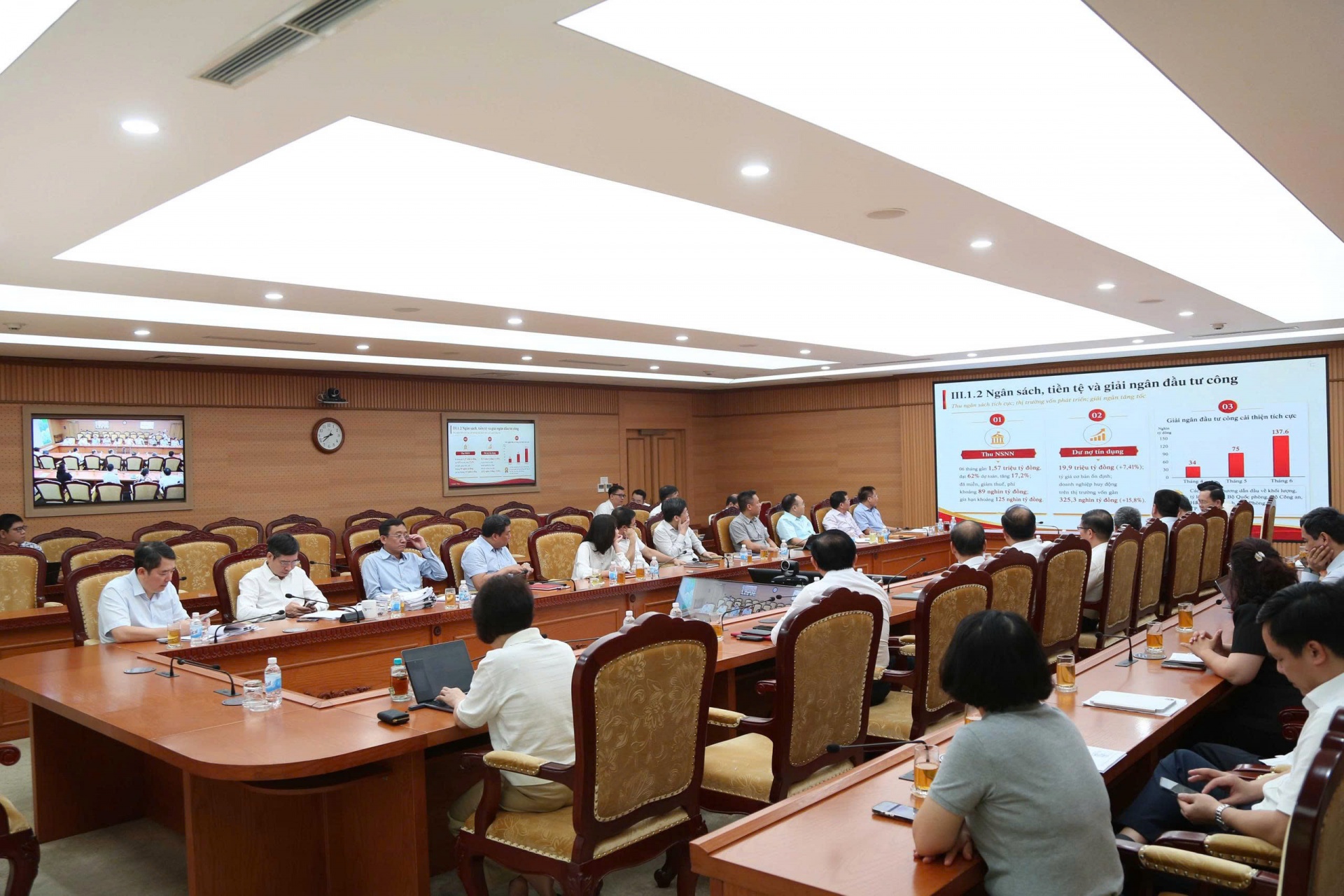 |
| Delegates attend the online conference at the Ministry of Finance’s conference venue. Photo: Duc Minh |
Nguyen Van Than, chairman of Vietnam Association of Small and Medium-sized Enterprises, said that achieving the 11.7 per cent growth target for the second half of the year, to offset the first-half performance, would require stronger support measures for the business sector.
“It is important to make a comprehensive revision of the Law on Support for Small and Medium-sized Enterprises, including renaming it the Law on Development of Small and Medium-sized Enterprises. After nearly a decade of implementation, Vietnam’s business community had grown significantly, while many provisions of the current law had yet to be updated to reflect practical realities,” he said.
He also recommended introducing a minimum level for small- and medium-sized enterprise (SME) participation in public investment projects.
To implement Resolution No.10-NQ/TW on developing the foreign-invested economic sector, Than proposed that the government submit a pilot resolution on a regulatory sandbox – a controlled legal testing framework – to encourage cooperation between strategic foreign investors and Vietnamese enterprises in priority industries, including electronics, semiconductors, automobiles and components, and high-tech supporting industries.
“The objective of the sandbox is not to create another broad-based support programme, but to develop model partnerships between foreign-invested enterprises and Vietnamese businesses, particularly SMEs, with clearly defined performance indicators for evaluation, refinement and wider replication. FDI majors such as Intel, Coca-Cola, Samsung and LG all operate global supply networks. Once Vietnamese businesses meet the standards required by these corporations, opportunities will extend beyond becoming Vietnamese-based suppliers to participating in global value chains,” Than said.
He also proposed allowing the Vietnam Association of Small and Medium-sized Enterprises to establish a specialised digital bank serving SMEs and household businesses.
Ho Sy Hung, chairman of the Vietnam Chamber of Commerce and Industry (VCCI), reaffirmed the organisation’s commitment to working alongside the government to improve the business environment, accelerating investment projects supporting production, and deepening integration into global value chains.
“At the same time, to contribute to the country’s development in the coming period, VCCI will continue to serve as a bridge between the government and the business community, thereby helping resolve practical issues quickly as they arise,” he said.
The VCCI chairman said confidence and optimism within the business community had increased markedly and were well-founded, as demonstrated by concrete figures rather than sentiment alone.
“If all costs associated with documentation, paperwork, administrative reforms and improvements to the business environment are quantified, the estimated savings exceed $900 million. For businesses, every day of reduced administrative procedures means one less day of production costs and greater opportunities to compete more effectively,” Hung said.
Deputy Prime Minister Nguyen Van Thang stressed that although growth remained strong, with GDP estimated to have expanded by 8.39 per cent in the second quarter of 2026, bringing first-half GDP growth to 8.18 per cent on-year, many targets had yet to be achieved. In particular, numerous localities remained well below their GDP growth targets and disbursement goals.
“Some localities have achieved noteworthy results, while many others have fallen short of expectations. This indicates that implementation capacity in certain localities remains limited,” said the DPM.
According to DPM Thang, actual growth was still around 1.5 percentage points below the first-half target.
“With greater efforts, it is entirely possible to narrow that gap. For example, if the public investment disbursement rate across the system exceeds 50 per cent, economic growth could receive an additional contribution of around 0.4 percentage points. That would reduce the gap with the target to approximately 1 percentage point,” he said
He added that sustaining high economic growth required sufficient capital at reasonable costs. Monetary and fiscal policies therefore needed to be coordinated more effectively to ensure adequate resources for production, business activities and the state’s priority sectors.
“In addition, ministries and sectors must respond more quickly and decisively in policymaking to remove obstacles facing businesses, citizens and local authorities,” he said.
 | Sweeping changes spotlight new financial growth drivers Vietnam is entering a pivotal phase where sweeping reforms, surging urbanisation, and new asset classes are reshaping its financial markets. |
 | Vietnam eyes new growth drivers as fiscal policy takes centre stage Vietnam retains strong growth potential but must pivot to innovation-led drivers, with fiscal policy and capital markets set to play a larger role as monetary policy space narrows. |
 | Unlocking growth drivers for the southern economic region Improving transportation infrastructure and institutional frameworks could help the southern economic region form three strong development pillars, expand growth space, and generate spillover effects for neighbouring areas. |
What the stars mean:
★ Poor ★ ★ Promising ★★★ Good ★★★★ Very good ★★★★★ Exceptional
 Tag:
Tag:
Related Contents





Latest News






More News
- EuroCham confidence index holds at 78.3 despite operational hurdles (October 16, 2026 | 17:27)
- Shrimp and rice firms face rising standards in export markets (October 16, 2026 | 09:00)
- SCG and Prime Group add value to the ecosystem (October 15, 2026 | 15:55)
- Project readiness key to unlocking green finance (October 15, 2026 | 12:35)
- Sovereign AI and human oversight key to secure digital government (October 15, 2026 | 12:32)
- MEXC Ventures partners with Corelia Academy: Bringing digital asset education closer to Vietnamese students (October 15, 2026 | 09:00)
- Global design expertise meets a more sophisticated Vietnam market (October 15, 2026 | 09:00)
- Vietnam growth nears double digits, UOB raises forecast (October 14, 2026 | 17:39)
- Smart factories need skills, finance and trust to scale (October 14, 2026 | 17:33)
- Sanofi-Aventis Vietnam appoints new head of Vaccines and country lead (October 12, 2026 | 17:21)




Latest News






 Mobile Version