
Bad debt growth at listed banks slows, but asset-quality risks persist

As of the end of the second quarter of 2026, Group 5 loans, which are loans giving rise to loss, at 27 listed banks stood at $6.99 billion, up 3.7 per cent from the end of 2025.
The growth rate of Group 5 loans was significantly lower than the 17.5 per cent increase in total non-performing loans (NPLs).
However, this loan group still accounted for a dominant 56 per cent of total NPLs, while Group 2 loans, which are loans needing attention, and off-balance-sheet debt inched up, indicating that asset-quality pressure remains.
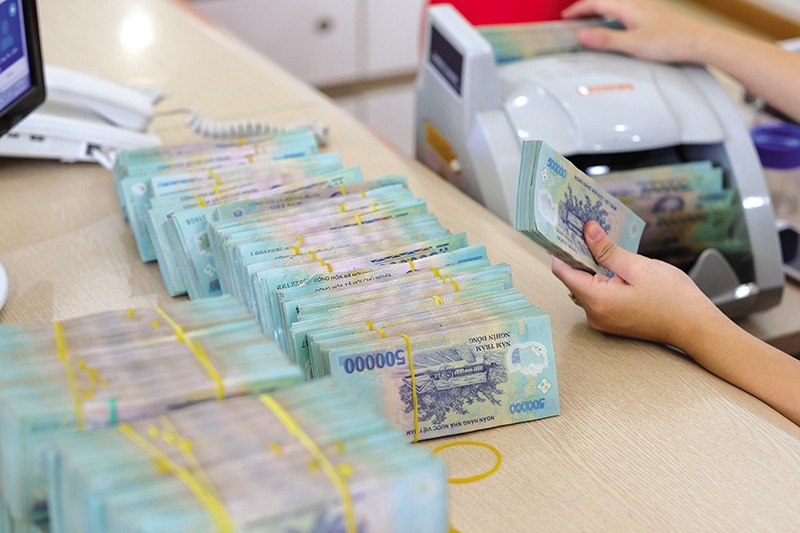 |
On the positive side, 11 banks in the observation group reduced their Group 5 loans from the end of 2025.
The sharpest decline was recorded by VietBank, down 48.5 per cent to $44.3 million, while Saigonbank posted a 31.3 per cent decrease to $13.4 million.
VietinBank, representing the large-bank segment, also recorded a significant 21.3 per cent decline in Group 5 loans from the end of 2025, to $624.4 million.
Several banks posted declines of less than 10 per cent. VIB and Eximbank, for instance, reduced their Group 5 loans by 9.7 per cent and 8.8 per cent, respectively, bringing the balances down to $229.7 million and $126.9 million.
PGBank and Vietcombank both recorded declines of 4.2 per cent, to $23.5 million and $333 million, respectively; ACB cut its Group 5 loans by 3.3 per cent to $198.7 million.
Meanwhile, the improvement at Techcombank and ABBank was relatively modest, with their Group 5 loans declining by 0.9 per cent and 0.1 per cent, respectively, to $235.4 million and $22.7 million.
In addition, the settlement of Group 5 loans also contributed significantly to the improvement in loan quality.
The most notable case was VietBank, where total Group 3-5 NPLs fell 27 per cent to $89.6 million at the end of Q2.
At Saigonbank, total NPLs edged down 1.3 per cent to $25.6 million, supported by a sharp 31.3 per cent decline in Group 5 loans to $13.4 million.
In terms of composition, VPBank was one of the few banks where Group 5 loans accounted for less than 30 per cent of total NPLs, at 25.7 per cent.
The decline in Group 5 loans at some banks may have resulted from debt recovery, the disposal of collateral, the use of loan-loss provisions to write off debts.
However, such declines do not necessarily mean that the risks have been eliminated, as some debts may be transferred off the balance sheet after being written off against provisions.
According to Rong Viet Securities (VDSC), system-wide on-balance-sheet NPLs rose to around $12.4 billion at the end of Q2, 2026, up 6 per cent compared to Q1.
However, Group 2 loans rose to more than $8.48 billion, pushing the Group 2 loan ratio from 1.23 per cent in Q1 to 1.37 per cent at the end of Q2.
VDSC said the continued high level of net non-performing loan (NPL) formation in Q2 was a consequence of lending rates rising relatively rapidly.
According to VDSC, the increase in Group 2 loans deserves attention as this loan group might serve as an early indicator of NPLs over the following one to two quarters, amid the fact that most banks' provisioning buffers have yet to be strengthened proportionately.
“Asset quality is sending fairly negative signals in the first half of 2026. This is a consequence of lending rates rising relatively rapidly, with yields on loans increasing by around 1-2 percentage points over the past three quarters, directly affecting borrowers' repayment capacity, particularly in the retail segment,” said Do Thanh Tung, manager at VDSC's Research Centre.
Meanwhile, Guotai Junan Securities Vietnam (GTJA) also noted that Group 2 loans were rising faster than NPLs and represented an early warning signal that should be closely monitored.
A total of 15 out of 27 banks recorded an increase in their Group 2 loan ratios in Q2, potentially signalling that credit risks are expanding before fully translating into on-balance-sheet NPLs.
Nevertheless, according to GTJA, Law No.96/2025/QH15, which took effect on October 15, 2025, added the right to seize collateral securing bad debts when the prescribed conditions are met. Decree No.304/2025/ND-CP, which took effect on December 1, 2025, sets out detailed conditions for collateral eligible for seizure.
These regulations strengthen the enforceability of creditors' rights and shorten part of the process for resolving debts secured by collateral, providing greater benefits to banks with legacy NPLs and collateral backed by sound legal documentation and good liquidity.
However, the pace of recovery will still depend on the individual assets involved and the actual required procedures.
 | VAMC auctions $60 million bad debt as NPL resolution hurdles remain Vietnam's asset management authority is auctioning a $60 million bad debt portfolio, highlighting persistent challenges in resolving non-performing loans and the need for legal clarity to attract investors. |
 | Banks build bigger buffers as bad debt pressure returns Banks are sharply increasing loan-loss provisions as rising bad debts, weaker cash flows and mounting property market risks force lenders to prioritise financial resilience over short-term profit. |
 | Banks face growing bad debt risks amid rising funding costs Banks are facing rising bad debt risks as non-performing and special-mention loans increase, while thinner provisioning buffers and higher funding costs threaten to put pressure on asset quality. |
 | Experts offer solutions on more substantive lending cuts As banks face mounting funding costs, liquidity pressures and bad debts, experts have offered solutions to make lending rate cuts more substantive while ensuring credit reaches key growth sectors. |
What the stars mean:
★ Poor ★ ★ Promising ★★★ Good ★★★★ Very good ★★★★★ Exceptional
 Tag:
Tag:
Related Contents






Latest News





More News
- Banks face three-way test as AI reshapes digital finance (October 22, 2026 | 16:21)
- Techcombank posts strongest quarter on record (October 22, 2026 | 12:10)
- Digital asset exchange awaits completion of operational requirements (October 21, 2026 | 14:57)
- TPBank secures $50 million from DEG for green and SME lending (October 21, 2026 | 14:43)
- Citi set for record year across ASEAN Investment Banking (October 19, 2026 | 17:49)
- Vietnam and Switzerland to deepen financial cooperation (October 19, 2026 | 13:24)
- Carbon finance hinges on viable ventures (October 19, 2026 | 09:59)
- AI to transform the future of finance (October 19, 2026 | 09:04)
- Government proposes relaxing IPO conditions (October 19, 2026 | 08:00)
- Citi warns of intensifying competition for capital amid higher rates (October 16, 2026 | 16:54)



Latest News





 Mobile Version