
Vietnam's life insurance sector eyes growth amid widening protection gap

According to industry experts, Vietnam has never had as many favourable conditions for life insurance as it does today: one of the world’s fastest-ageing populations, one of Southeast Asia’s fastest-growing middle classes, rising healthcare costs, and a rising incidence of critical illnesses among younger people.
At present, around 90 million potential customers remain without life insurance coverage, while by 2034, the country is expected to enter an aged-population phase.
However, at a seminar on life insurance market development on August 25 in Hanoi, Pham Thu Phuong, deputy director general of Insurance Supervisory Authority under the Ministry of Finance, noted that life insurance penetration in Vietnam currently stands at only 11-12 per cent of the population.
“This means that around 90 million Vietnamese people remain without this form of financial protection, compared with penetration rates of 50-80 per cent in Singapore, Malaysia, and Thailand,” she said.
 |
| Photo: baodautu.vn |
In addition, the insurance industry’s premium-to-GDP ratio is only around 2-2.5 per cent, significantly below the regional average of 3.5 per cent and the 7-10 per cent recorded in developed countries.
Vietnam’s life insurance market recorded average premium revenue growth of 20 per cent a year during 2018-2022, before losing momentum from 2023 onwards.
According to regulators as well as industry experts, the market’s slowdown and its failure to regain its previous growth momentum stem partly from a crisis of confidence that was caused not by the products themselves, but by the manner in which they were sold.
Other contributing factors include consumers’ limited understanding of the fundamental protection purpose of insurance, a significant information gap between insurers and customers in long-term and complex life insurance contracts, and the lingering consequences of policy cancellations resulting from inadequate or inappropriate advice.
Another ‘bottleneck’ that has caused customers and insurers to repeatedly fall out of step in terms of expectations was highlighted by economic and financial expert Ngo Tri Long at the aforementioned event: insurance benefit illustrations are not yet sufficiently clear or adequately explained to customers.
According to Long, an insurance benefit illustration is much like a construction estimate for a house: it is based on a set of calculations, but it is not a fixed figure.
The problem is that many customers cannot distinguish between benefits that are guaranteed and those that depend on investment returns and business performance, both of which may fluctuate over time.
“Therefore, insurance buyers need to read a benefit illustration on three levels: the amount they are guaranteed to receive; the amount that is merely projected; and how the benefits could change if market conditions deteriorate. Without this filter, a long-term financial assumption can easily be mistaken for a promise. When actual outcomes fail to meet expectations, trust can collapse with them,” said Long.
Meanwhile, according to Ngo Trung Dung, deputy secretary general of Vietnam Insurance Association, inadequate initial advice is at the root of the crisis of confidence.
Dung noted that when customers surrender a life insurance policy within the first one or two years, the surrender value is almost zero, while it remains very low in subsequent years.
“Therefore, rather than surrendering their policies, customers facing financial difficulties may be able to reduce the sum assured, borrow against the accumulated account value, or switch to a more suitable product. These options, however, remain unfamiliar to many customers, potentially because they have not received sufficiently comprehensive advice,” Dung said.
He also added that current legal framework has tightened regulations on policy surrender to better protect customers.
These include a 21-day ‘consideration’ period during which customers can cancel their policies and receive a refund; clearly defined limits on health disclosures; and a requirement to record and retain for five years the entire advisory process for investment-linked insurance products.
“Regulators have studied and incorporated some of the world’s strictest rules on insurance management and supervision into the Law on Insurance Business. This is very positive for the development of the market,” he said.
From the business perspective, Le Huong Ly, chief corporate and external affairs officer at Prudential Vietnam, stated that transparency is no longer a slogan but has become part of the operating infrastructure of an insurance company.
“Prudential, for instance, has digitised the entire customer journey while also applying AI to review recorded advisory sessions and check whether agents have presented all three interest-rate scenarios - positive, moderate and negative - rather than presenting an overly optimistic picture,” Ly said.
From the perspective of the state regulator, Phuong from the Insurance Supervisory Authority expects insurance companies to continue changing their management and operational mindset, shifting from ‘rapid growth’ to ‘quality development’.
This includes restructuring insurance products toward greater product diversity to improve accessibility for all segments of the population, particularly vulnerable groups such as low-income people and the elderly, while simplifying product structures to ensure that premiums are reasonable and commensurate with insurers’ benefit obligations.
According to Dr. Nguyen Thanh Vinh of the National Economics University, one way for the life insurance industry to address its growth challenge is to step up efforts to tap the institutional customer segment - businesses that use employee welfare funds to purchase insurance for their employees.
“This approach helps reduce acquisition costs and results in more sustainable policies compared with those held by individual customers. At the same time, the market needs low-premium products with simple terms and conditions, targeting low-income groups - a segment that life insurance has barely reached so far,” he said.
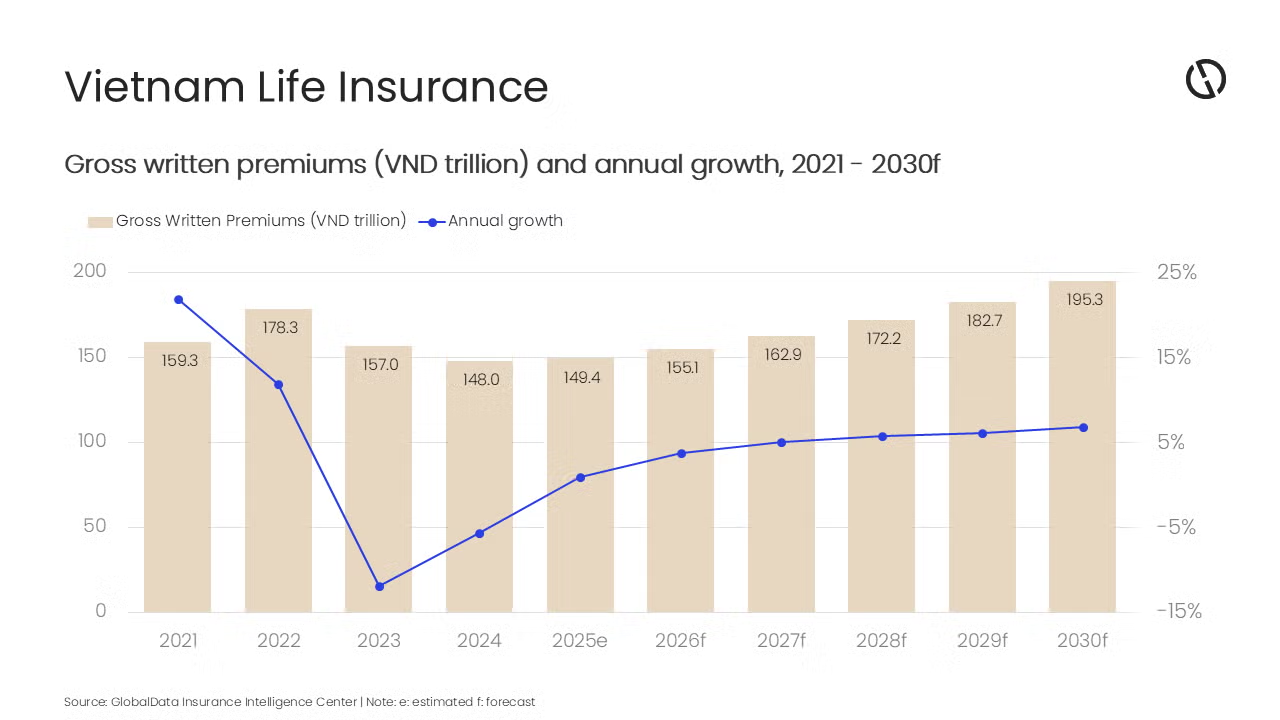 | Vietnam's life insurance industry to surpass $7 billion by 2030 Vietnam's life insurance industry is projected to grow at a compound annual growth rate of 5.9 per cent, increasing from $6 billion in 2026 to $7.2 billion by 2030 in terms of gross written premium, according to a report by GlobalData on April 15. |
 | Life insurance market heats up despite slowing new sales Vietnam’s life insurance market posted a double-digit decline in new business premiums in early 2026, but rising competition from emerging insurers is rapidly reshaping market share dynamics. |
 | AM Best maintains stable outlook on Vietnam's non-life insurance sector AM Best is maintaining its stable outlook on Vietnam's non-life insurance segment, citing robust demand, technology adoption, and healthy macroeconomic factors. |
 | Insurtech reshapes Vietnam’s insurance sector Insurtech is emerging as a key pillar of Vietnam’s digital insurance sector as demand for digital financial services continues to accelerate. |
What the stars mean:
★ Poor ★ ★ Promising ★★★ Good ★★★★ Very good ★★★★★ Exceptional
 Tag:
Tag:
Related Contents













More News
- Tasco and PVI Insurance forge multi-sector partnership (August 27, 2026 | 16:40)
- Uneven profit growth highlights diverging fortunes across insurers (August 26, 2026 | 15:57)
- Insurer FWD sees Vietnam as key market in Asian growth strategy (August 26, 2026 | 15:50)
- Insurtech reshapes Vietnam’s insurance sector (August 10, 2026 | 08:32)
- Insurance's next frontier lies beyond AI (August 01, 2026 | 09:00)
- Insurance struggles to keep pace with electric vehicle boom (July 28, 2026 | 17:27)
- AM Best maintains stable outlook on Vietnam's non-life insurance sector (July 27, 2026 | 11:59)
- Non-life insurers rebound on strong first-half results (July 24, 2026 | 16:24)
- Hanoi Re named “Best (Re)Insurer” as record profits and ratings upgrade mark 15th anniversary (July 24, 2026 | 09:00)
- NNX opens first insurance centre in Hanoi (July 08, 2026 | 16:17)



Latest News







 Mobile Version