


Vietnam GDP projected to grow 7.4 per cent in 2026

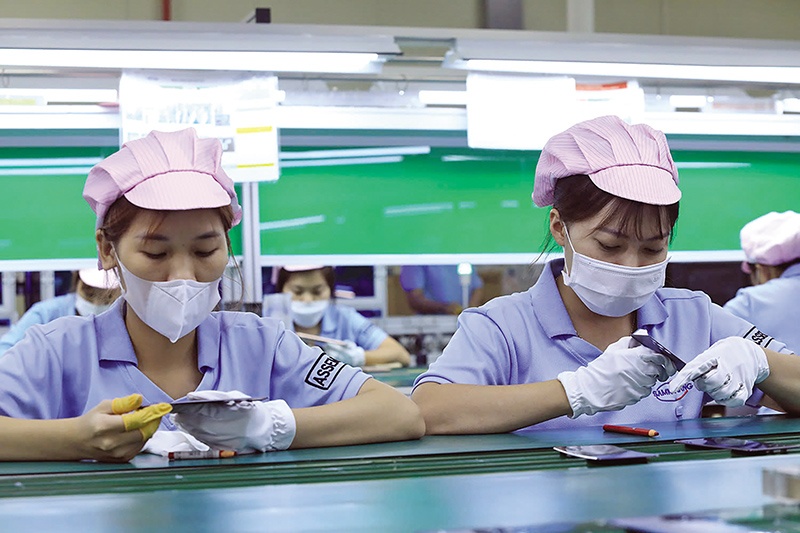 |
According to the General Statistics Office, in the first quarter of 2026, Vietnam's GDP growth expanded an estimated 7.83 per cent from a year ago. This represents a solid increase from the 7.07 per cent GDP growth recorded during the same period in 2025.
However, the GSO noted that as the impact of the Middle East conflict will become more pronounced in the second quarter of 2026. With rising pressure on economic growth, this requires timely and effective solutions from both the government and businesses to navigate these global challenges.
Vietnam's economic growth is showing resilience amid the ongoing conflict in the Middle East and disruptions to the global energy supply impacting the region.
The ASEAN+3 economies, consisting of the 10 ASEAN member states, with China, Japan, and South Korea, are projected to grow 4 per cent in both 2026 and 2027, according to the ASEAN+3 Macroeconomic Research Office (AMRO).
“The ASEAN+3 region entered 2026 from a position of strength, but the Middle East conflict has shifted the balance of risks to the downside,” said AMRO chief economist Dong He. “That said, the region is better placed than in earlier episodes to navigate an energy shock – its economies are more energy-efficient and less oil-dependent, entered this period with low inflation, and most retain meaningful policy space to respond.”
The region expanded by 4.3 per cent in 2025, well above the 3.8 per cent projected in the immediate aftermath of the April 2025 tariff shock. Economic activity remained supported by firm domestic demand, robust exports – boosted by AI-driven semiconductor demand – sustained investment, and strengthening intraregional economic linkages. Amid higher global energy prices, AREO 2026 forecasts headline inflation to rise from 0.9 per cent in 2025 to 1.4 per cent in 2026 and 1.5 per cent in 2027.
The impact of the Middle East conflict on the region, including Vietnam, will hinge on its duration. If prolonged, the shock could become more widespread and persistent, extending beyond energy markets to affect industrial inputs, logistics, food prices, tourism, and remittances. Its effects are also likely to vary across member economies depending on their exposure to imported energy and key commodities, available buffers, and domestic policy space.
“As the global economy is battered by one shock after another, preserving policy flexibility is critical to preventing worse outcomes such as stagflation. Central banks should maintain orderly market conditions and financial stability, and act decisively should supply shocks lead to sustained inflation. On the fiscal side, governments should prioritise targeted support for vulnerable groups, while avoiding broad-based measures that could fuel inflation or undermine fiscal sustainability,” Dong He said.
AMRO's report also highlights a fundamental structural transformation underpinning the region’s resilience. Over the past two decades, ASEAN+3 has become more regionally anchored, with denser and more interconnected production networks and a decisive shift towards intraregional sources of demand. The share of the region’s value-added exports to the US has declined from about one-third to 20 per cent, while the share absorbed within the region has risen to nearly 30 per cent.
ASEAN+3 is now the world’s largest market, accounting for 28 per cent of global final demand.
“The long-standing view of the region as the world’s factory – producing primarily for external demand outside the region – is increasingly outdated,” said He. “Deepening regional cooperation, accelerating the green transition, and maintaining open trade and investment flows will be essential to sustaining this structural transformation and strengthening resilience.”
 | AMRO forecasts 7.6 per cent GDP growth for Vietnam in 2026 Vietnam is expected to remain one of the region’s stronger growth performers, outpacing the broader ASEAN+3 bloc. |
 | ASEAN countries exposed by Middle East oil dependence ASEAN countries are vulnerable to supply chain disruptions due to their heavy dependence on crude oil imports from the Middle East. |
 | Manufacturers see strongest rise in selling prices in 15 years The war in the Middle East caused a marked acceleration in the rate of input cost inflation in the Vietnamese manufacturing sector during March, with selling prices subsequently rising at the fastest pace in almost 15 years. |
What the stars mean:
★ Poor ★ ★ Promising ★★★ Good ★★★★ Very good ★★★★★ Exceptional
 Tag:
Tag:Related Contents




Latest News




More News
- Sojitz in Vietnam: 40 years from individual projects to a business cluster 'KATAMARI' (October 08, 2026 | 09:00)
- Coteccons targets 'Quality Growth' with 25 per cent dividend plan (October 07, 2026 | 13:00)
- Vietnam Education Forum opens UK Education Mission's Hanoi visit (October 07, 2026 | 12:27)
- Tax authorities deactivate TINs of nearly 180,000 businesses (October 07, 2026 | 12:08)
- World Bank raises Vietnam's 2026 GDP growth forecast to 7.4 per cent (October 07, 2026 | 11:41)
- Vietstock 2026 to spotlight livestock innovation and green transition (October 07, 2026 | 09:00)
- Vietnam’s GDP grows over 9 per cent in first nine months (October 05, 2026 | 18:45)
- Vietnam earns $56.3 billion from agro-forestry-fishery exports (October 05, 2026 | 18:32)
- DSV balances resilience and decarbonisation in supply chains (October 05, 2026 | 18:20)
- Electronics exports reach $175.4 billion in the first nine months (October 05, 2026 | 18:12)


Latest News




 Mobile Version