


US education seen as gateway to Vietnam’s tech future

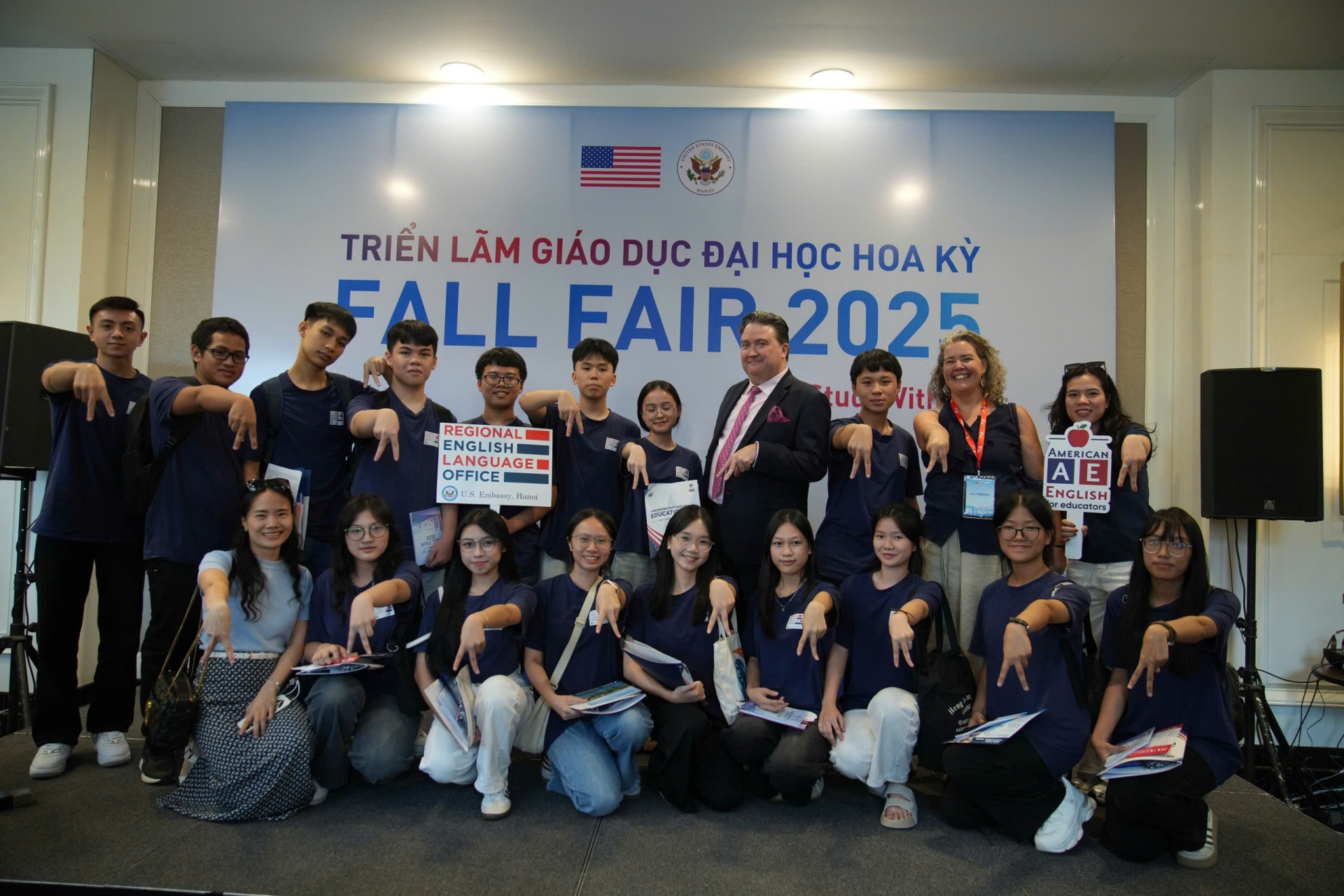
Speaking at the Fall 2025 US Higher Education Fair on September 24 in Hanoi, US Ambassador Marc E. Knapper said the strong presence of Vietnamese students in US colleges reflects families’ confidence in American education.
“When we talk about Vietnam building an ecosystem for high-tech manufacturing, high-tech investment, we talk about a Vietnam that has a workforce to do this, I think an American education is key to this,” Knapper told VIR.
According to data from the 2024 Open Doors Report released by the Institute of International Education (IIE), more than 22,000 Vietnamese students studied in US higher education institutions in the 2023-2024 academic year, with nearly half pursuing science, technology, engineering, and mathematics (STEM).
 |
US college representatives said this trend aligns closely with Vietnam’s workforce development needs, especially in sectors like semiconductors, AI, and advanced manufacturing.
Jeremy Kestle, the assistant director of international admissions at the University of Idaho, said Vietnamese students are increasingly drawn to programmes that link directly to high-tech job opportunities.
“There’s still a lot of opportunity in the US to gain skills in a university environment and also to do internships and job opportunities at some of the biggest companies in the world. And I don’t think that’s going to change,” Kestle said in an interview with VIR at the event.
At the University of Idaho, cooperative education courses allow international students to gain credit and income while working with leading employers.
“A lot of our students have gone to do co-op programmes in the Seattle area for big companies like Amazon or Boeing or Starbucks, or down in the California area and Silicon Valley for the tech companies there as well,” he said.
Engineering is a field with particularly strong prospects, Kestle added, pointing to workforce demand in semiconductors.
Community colleges are also positioning themselves as affordable entry points to US higher education.
Katelyn James, the international student admissions and advising specialist of the College of Central Florida, said the institution offers “2+2” pathways, with associate science courses designed for students wanting to enter the workforce immediately, and associate arts degrees guaranteeing transfer into partner universities such as the University of Florida and the University of Central Florida.
“These routes provide both internship opportunities and flexibility for Vietnamese students seeking cost-effective ways to reach leading US universities,” she said in an interview with VIR.
Affordability, James added, remains a major attraction. Tuition at the College of Central Florida is about $10,500 per year, significantly lower than study costs in the UK or Canada.
“I believe that the United States is affordable still,” she said, noting that the support network offered by advisors and student services helps international students expand their connections.
For many Vietnamese families, questions about visas remain central. Recent changes to the H-1B programme for skilled workers have generated global attention, but Ambassador Knapper stressed that study visas remain unaffected.
“For us, the bottom line is ensuring that Vietnamese students who want to study in the US are able to get the kind of visa they need to study,” he said.
Student visa applicants, he added, should demonstrate seriousness and commitment through their academic record and clear study goals.
The US Embassy and EducationUSA provide free resources on study opportunities, scholarships, and the visa process, while initiatives such as Fulbright continue to support academic exchange.
Ambassador Knapper said Vietnamese students are valued not only for their academic potential but also for their dedication. He described them as diligent, sincere and motivated by a sense of responsibility to their families and their country. “It’s key for our two countries’ relationship to ensure that we continue to have strong education ties,” he said.
As Vietnam deepens its ties with the United States under the Comprehensive Strategic Partnership, education is emerging as a central pillar. With more students pursuing STEM fields abroad, US universities are positioning themselves as partners in training the engineers and innovators who will shape Vietnam’s economic future.
 | US-backed partnership to help with higher education reform in Vietnam The Partnership for Higher Education Reform (PHER), which involves some Vietnamese and US universities, was launched on August 1 with a view to improving the academic quality, governance, and market relevance of Vietnam’s higher education institutions. |
 | Vietnam develops open educational resources for higher education Deputy Prime Minister Tran Hong Ha has signed Decision No. 1117/QD-TTg approving a programme to develop open educational resources for higher education. |
 | Thirteen Vietnamese universities listed in THE Impact Rankings 2024 Thirteen Vietnamese universities have been listed in the Impact Rankings 2024 released by the Times Higher Education (THE) on June 12. |
What the stars mean:
★ Poor ★ ★ Promising ★★★ Good ★★★★ Very good ★★★★★ Exceptional
 Tag:
Tag:



Latest News

More News
- Greenfeed rolls out early-life nutrition solution for piglets (September 25, 2026 | 17:00)
- BSR signs crude oil purchase framework agreement with ExxonMobil Asia Pacific (September 25, 2026 | 14:05)
- Amazon Kuiper licensed for private satellite telecommunications network in Vietnam (September 24, 2026 | 18:21)
- VIFC-HCMC facilitates $325 million in international capital for Vietnam’s education development (September 24, 2026 | 18:08)
- VinSpeed and Siemens Mobility sign contract on high-speed rail development (September 23, 2026 | 17:43)
- Vietnam-US trade talks near final outcome (September 23, 2026 | 08:45)
- Vietnam’s trade tops $825 billion by mid-September (September 22, 2026 | 10:52)
- Vietnam and China discuss policies to support private-sector growth (September 21, 2026 | 16:42)
- PHARMEDI VIETNAM 2026 opens in HCMC with first international conference (September 21, 2026 | 16:18)
- MEXC Foundation expand its community engagement with Mid-Autumn Festival initiatives (September 18, 2026 | 09:00)





 Mobile Version