
Redefining Vietnam’s growth model for the era of innovation

At an international press conference on the 14th National Party Congress held on January 14, Nguyen Xuan Thang, Politburo member, director of the Ho Chi Minh National Academy of Politics, and chairman of the Central Theoretical Council, stated that Vietnam can no longer rely on growth driven by input-based resources or low-value comparative advantages such as cheap labour and land resources.
“The most fundamental drivers are science and technology, productivity, and the application of technology in new areas such as the digital economy, green economy and circular economy, allowing Vietnam to leapfrog as a latecomer into sectors like semiconductors, AI and cloud computing. We have even considered developing ultra-quantum technologies, rather than continuing along traditional paths,” he said.
To realise the goals of a new era, draft documents submitted to the 14th National Party Congress underscore the need for thinking across all areas of socioeconomic development, national defence, security, foreign affairs, Party building and the political system. A particularly critical focus is the establishment of a new growth model.
 |
While earlier periods focused mainly on structural transformation and shifting growth from extensive to intensive modes, the draft documents for the 14th Party Congress elevate the issue to a higher level: creating an entirely new growth model capable of adapting to major global transformations and meeting the country’s development demands in the coming period.
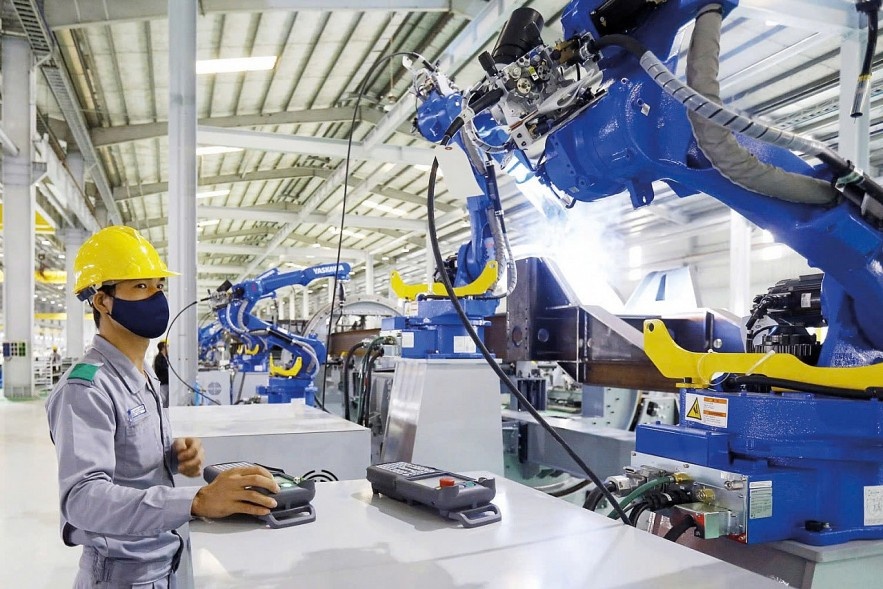
Under this approach, the new growth model is built on clearly defined pillars in which science and technology, innovation, and digital transformation are identified as the primary drivers and the core of the country’s development strategy.
For the first time, the private sector is explicitly declared as one of the most important driving forces of the economy, alongside the development of suitable personnel and the effective leveraging of deep international integration.
To translate these objectives into reality, the draft documents clearly outline specific requirements and tasks.
Traditional growth drivers - land, natural resources, labour, exports, domestic markets and investment - together with total factor productivity (TFP), must be mobilised in a coordinated manner within a framework of innovation, industrialisation, modernisation and digital transformation.
A notable new element is the assessment that, based on current development conditions, Vietnam has sufficient room to target double-digit economic growth in the next term.
In light of the draft documents, achieving this ambition requires several key conditions. First, the investment-to-GDP ratio must exceed 40 per cent. Previously, Vietnam maintained an investment ratio of around 30-35 per cent of GDP, largely concentrated in traditional growth drivers.
The new model calls for scaling up effective investment, expanding green finance channels, technology bonds and innovation-oriented venture capital funds. Improving investment efficiency will require stricter project selection, greater automation and digitalisation in production processes, and rigorous project management.
Second, to sustain double-digit GDP growth, labour productivity must increase by approximately 8.5 per cent per year, a substantial leap from the current rate of 5-6 per cent.
This will require intensive training of digital engineers, research and development (R&D) specialists and high-tech project managers, as well as the establishment of strong linkages among research institutes, universities and enterprises to narrow skills gaps.
Third, TFP must contribute more than 5.6 percentage points to overall growth. As a measure reflecting the efficiency of capital and labour use and the impact of innovation, raising TFP necessitates building a robust innovation startup ecosystem, encouraging enterprises to invest in R&D, strengthening participation in global value chains and enhancing intellectual property protection.
Fourth, economic restructuring should focus on foundational and core industries, strategic sectors, green industries, high-tech agriculture, high-quality services and the digital economy.
From the design stage onward, each sector and project must meet low-emission standards and incorporate smart governance.
A supportive policy framework - encompassing R&D tax incentives, preferential credit, venture capital funds and administrative reforms to shorten licensing procedures - will serve as a critical catalyst for the successful implementation of the new growth model.
 | Vietnam should transform growth model towards efficiency: experts Vietnam needs to speed up transformation towards an efficiency and innovation-driven growth model to meet requirements of sustainable and inclusive development, experts have said. |
 | IFC to support Vietnam's transition to a low-carbon economic growth model The International Finance Corporation (IFC) – a member of the World Bank Group – announced on May 11 that it will support Vietnam to transit to a low-carbon economic growth model. |
 | Private sector expected to support the green growth model in Vietnam Last year Vietnam made a remarkable commitment to achieve net-zero carbon emissions by 2050. Patrick Lenain, senior associate of the Swiss-based Council on Economic Policies, shares some recommendations to encourage the private sector’s role in this ambitious target. |
What the stars mean:
★ Poor ★ ★ Promising ★★★ Good ★★★★ Very good ★★★★★ Exceptional
 Tag:
Tag:
Related Contents



Latest News






More News
- KN Holdings honoured for ESG efforts in Vietnam (October 18, 2026 | 11:00)
- APEA 2026 Vietnam honours 65 outstanding leaders and enterprises (October 17, 2026 | 10:00)
- MEXC highlights AI-driven trading and broader market access at TOKEN2049 (October 17, 2026 | 09:00)
- EuroCham confidence index holds at 78.3 despite operational hurdles (October 16, 2026 | 17:27)
- Shrimp and rice firms face rising standards in export markets (October 16, 2026 | 09:00)
- SCG and Prime Group add value to the ecosystem (October 15, 2026 | 15:55)
- Project readiness key to unlocking green finance (October 15, 2026 | 12:35)
- Sovereign AI and human oversight key to secure digital government (October 15, 2026 | 12:32)
- MEXC Ventures partners with Corelia Academy: Bringing digital asset education closer to Vietnamese students (October 15, 2026 | 09:00)
- Global design expertise meets a more sophisticated Vietnam market (October 15, 2026 | 09:00)









 Mobile Version