
Private groups aided through new policies

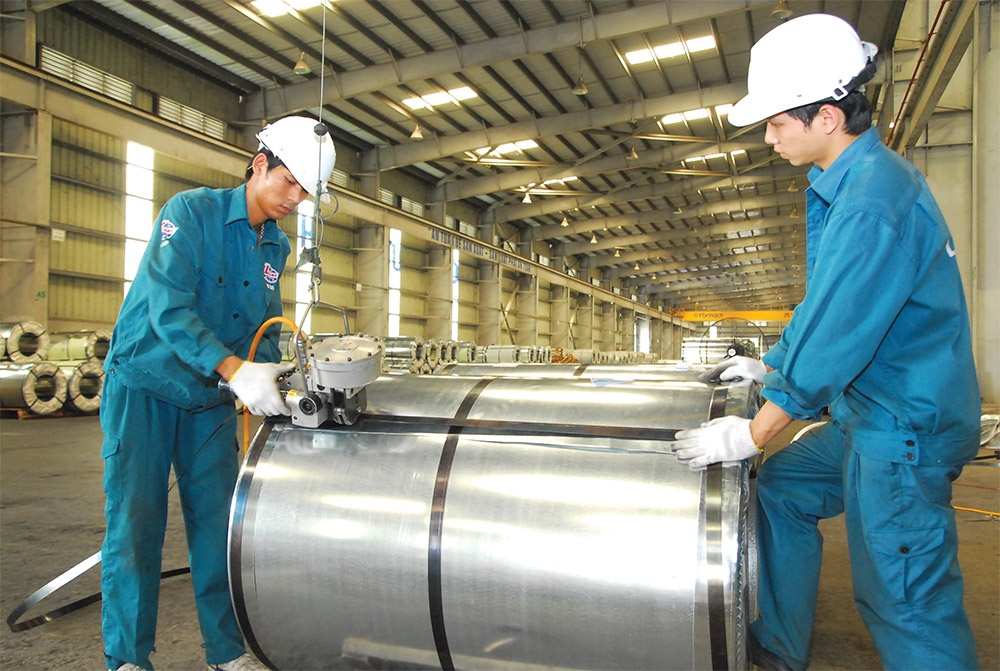 |
| Some companies will be offered reduction of certain fees over a period of years, photo Le Toan |
This month, the government is expected to issue a decree to guide implementation of May’s Resolution No.198/2025/QH15 on policies for private sector development.
The draft decree, currently compiled by the Ministry of Finance, aims to support privately owned enterprises (POEs), especially those in the high-tech sector, small and medium-sized enterprises, and innovative startups. Under the draft decree, private sector development is crucial for fostering economic growth and driving innovation.
In Vietnam, the government has implemented various measures to support POEs, including land rental assistance, financial support, tax incentives, and support for research and development.
The government has asked for review and elimination of unnecessary business conditions and overlapping regulations that have been hindering the development of POEs by the end of the year.
“At least 30 per cent of administrative procedure processing time, legal compliance costs, and business conditions must be reduced at the year’s end, and this must continue to be cut sharply in the following years,” Resolution 198 stated.
Under the draft decree, a land rental incentive is to be offered to high-tech and innovative POEs. Specifically, they are provided a minimum 30 per cent reduction in land rental fees for the first five years of leasing land from investors in industrial zones, clusters, and technology parks.
This support is then reimbursed by the government to the investors according to regulations. Provinces have the authority to determine the level of reduction in land rental fees.
Additionally, enterprises can receive support in renting state-owned properties that are unused or underutilised. The government sets out the principles and criteria for this support, and provincial people’s committees determine the categories of properties available for rent, the level of support, and the rental process. All information must be posted in localities’ e-portals.
Financial support is also provided to enterprises, including a 2 per cent annual interest rate subsidy on loans for environmentally friendly projects that adhere to environmental, social, and governance standards.
Tax incentives are another form of support, with two-year exemption of corporate income tax (CIT), and a 50 per cent reduction of CIT in the subsequent four years for incomes earned from innovative firms’ activities, innovation investment fund management companies.
There will also be an exemption of CIT and personal income tax (PIT) for incomes earned from the transfer of shares, capital contributions, capital contribution rights, rights to purchase shares, and rights to purchase capital contributions in innovative startup enterprises.
Enterprises shall also be exempted from PIT for two years and 50 per cent reduction of PIT for the subsequent four years for income from salaries of experts and scientists received from innovative startups, research centres, innovation centres, and intermediary organisations supporting such startups.
Furthermore, there will also be CIT exemption tax for smaller businesses for three years from the date of being granted the first business registration certificate.
Currently, Vietnam has nearly one million enterprises and five business households. POEs are creating around half of GDP, over 30 per cent of the state budget, more than 40 million jobs, and over 80 per cent of total labourers in the economy. POEs also account for 60 per cent of total development investment capital.
The government has set a target to have a total enterprise number of two million in 2030, with efforts to be made for POEs to create 58 per cent of GDP, 40 per cent of state budget revenue, and 85 per cent of labourers.
Ta Van Ha, National Assembly (NA) deputy representing the south-central province of Quang Nam, said besides incentives, businesses are now in critical need for policy stability.
“Newborn enterprises are facing massive difficulties in all conditions, while policies remain unstable with constant changes,” Ha said. “Normally, it could take from up to 15 years or even longer for a startup to grow successfully. When an enterprise is newly established with some investment, policies change again, meaning that the enterprise must do everything from scratch, meaning a great waste in resources, efforts, and money.”
Khuong Thi Mai, NA deputy representing the northern province of Nam Dinh, also said it is needed to eliminate unnecessary business conditions, inappropriate overlapping regulations that obstruct the development of private businesses
“It is also proposed that there be more regulations on abolishing conditional business lines, investment procedures, policies, and certificates. It is needed to only retain incentives and conditional business lines – it is because investors are currently still managing each individual project through procedures for accepting such policies,” Mai said, adding that it is necessary to strongly reform the implementation stage, especially admin procedures related to land, environment, and construction.
In the first five months of this year, the number of enterprises newly established and resuming operations came in at 111,800, up 11.3 per cent as compared to the same period last year. This includes nearly 66,800 newly established businesses, up only 0.6 per cent on-year. On average, each month saw nearly 22,400 of enterprises newly founded and resuming operations.
Last year, over 157,200 newly established enterprises last year with total registered capital of nearly $61.9 billion. The total number of newly established enterprises and those resuming operation hit over 233,400 – up 7.1 per cent on-year. Total registered capital added to the economy in 2024 was $81.03 billion, up 3.6 per cent on-year.
What the stars mean:
★ Poor ★ ★ Promising ★★★ Good ★★★★ Very good ★★★★★ Exceptional
 Tag:
Tag:
Related Contents





Latest News





More News
- French experts share AI and digital governance insights in Hanoi (October 11, 2026 | 08:00)
- Digital government push focuses on data connectivity and AI (October 10, 2026 | 08:00)
- Ho Chi Minh City holds dialogue with businesses to address operational hurdles (October 09, 2026 | 17:27)
- AI beginning to reshape recruitment criteria (October 09, 2026 | 16:49)
- Electronics firms boost raw material reserves sevenfold amid supply concerns (October 09, 2026 | 08:00)
- NSRP navigates global energy supply volatility (October 08, 2026 | 16:59)
- Minitab launches campaign to combat illegal software use in Vietnam (October 08, 2026 | 15:54)
- Raising construction materials supply chain standards amid green transition (October 08, 2026 | 14:00)
- Samsung Vietnam to deepen cooperation with local manufacturers (October 08, 2026 | 12:00)
- Sojitz in Vietnam: 40 years from individual projects to a business cluster 'KATAMARI' (October 08, 2026 | 09:00)







 Mobile Version