
Vietnam sets ambitious dairy growth targets

Deputy Prime Minister Bui Thanh Son signed Decision No.309/QD-TTg on February 23, approving the Dairy Industry Development Strategy through 2030 and beyond.
The strategy aims to build a sustainably developed local dairy processing industry with a complete dairy value chain, spanning from dairy herd development and increased raw fresh milk output to the processing of high value-added finished products.
The dairy sector is expected to meet the increasingly high demand of the domestic market while participating deeply in regional and global dairy value and supply chains.
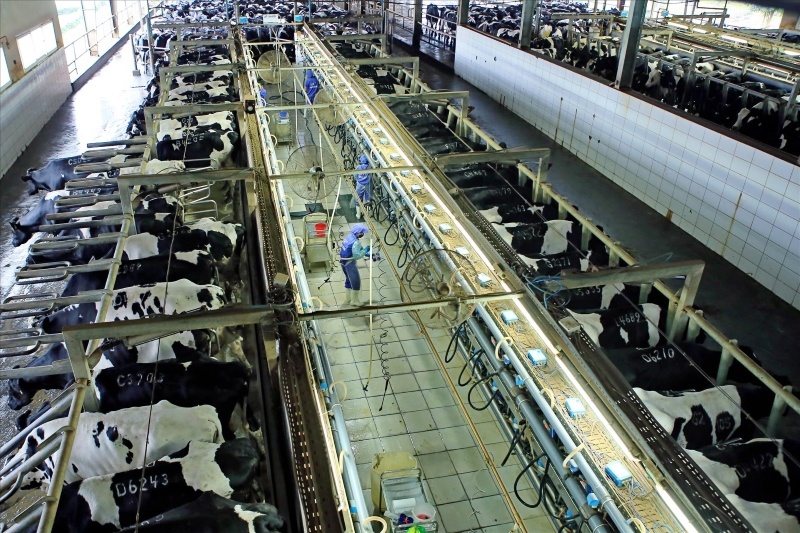 |
| TH Group's dairy farm complex in Nghe An province. |
By 2030, the dairy industry is targeted to achieve an average annual growth rate of approximately 12-14 per cent; processed liquid milk output is projected to reach about 4.2 billion litres per year.
Domestic raw fresh milk production is expected to reach approximately 2.6 billion litres per year, meeting around 60-65 per cent of the raw material demand of the domestic dairy processing industry.
Powdered milk is projected to grow by about 7-8 per cent per year, with output reaching approximately 245,000 tonnes annually. Consumption of milk and dairy products is targeted at around 40 litres per person per year by 2030.
By 2045, the dairy industry’s average annual growth rate is expected to reach 5-6 per cent, while processed liquid milk output is projected to rise to approximately 9.7 billion litres.
Domestic raw milk production by 2045 is expected to reach around 8 billion litres annually, meeting approximately 80-85 per cent of the raw material demand of the domestic dairy processing sector.
Powdered milk is projected to grow by 3-4 per cent per year, with output reaching about 415,000 tonnes annually.
Consumption of milk and dairy products is targeted to reach approximately 100 litres per person per year by 2045.
To achieve these goals, the strategy outlines dairy herd development to enhance domestic raw milk supply, with priority given to building disease-safe and food-safe dairy farming chains in accordance with international standards.
It also aims to increase domestically processed raw milk output to gradually reduce dependence on imported dairy products and processing materials, while encouraging product diversification in parallel with improvements in quality, design, and packaging
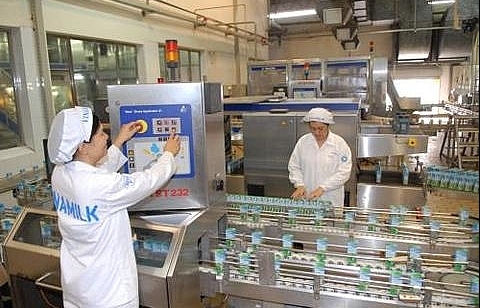
For businesses, the strategy calls for continued expansion of dairy herd scale, increased raw milk output, and enhanced processing capacity through upgrading existing projects and applying modern technologies and highly automated production lines.
Priority is given to investment in fully integrated value chain projects, from dairy farming to processed dairy products.
The plan also promotes close links between enterprises, raw milk producers, and processing companies under cooperation models to enhance production capacity, competitiveness, and brand value of local products.
The plan aims to encourage market research in combination with research into the production of additives, ingredients, and flavourings, aiming to develop new products aligned with consumer preferences and global trends.
The strategy emphasises the development of high value-added product lines, including milk and dairy derivatives, as well as infant formula and products tailored to different life stages such as children, the elderly, and consumers with special nutritional needs.
It also calls for innovation in market access methods and strengthened online marketing via internet platforms and social media to maximise the effectiveness of distribution channels.
The strategy will also encourage green production models, encouraging enterprises to adopt environmentally friendly production processes and develop products in line with green growth principles, aiming towards sustainable production and consumption while contributing to environmental protection and greenhouse gas emission reduction.
In 2025, total revenue of the entire dairy industry is estimated at $5.3 billion, up about 1 per cent compared to 2024. Imports of milk and dairy products surged to approximately $1.26 billion, marking a 23.3 per cent jump on-year. Meanwhile, milk and dairy product exports remained a bright spot, with total export value reaching $354.1 million, up 18.6 per cent on-year.
 | Ushering in prestige for the Vietnamese milk industry With her dream of producing the best milk for Vietnamese people, Thai Huong – general director of privately-owned BAC A BANK and founder of TH Group – succeeded in building one of Asia’s largest dairy cow and fresh milk production farms within only a few years, helping to change the nature of Vietnam’s dairy industry and bringing fresh products to the wider world. |
 | Improving technologies for a modern milk industry Investing in cut-edge technologies is not only the race of milk producers but also an essential factor for the outstanding development of companies in the 4.0 era. |
 | Dairy groups take on greener vision Being more environmentally minded in terms of both products and supply chains could be a gateway to help dairy businesses get closer to consumers as well as expand export markets. |
What the stars mean:
★ Poor ★ ★ Promising ★★★ Good ★★★★ Very good ★★★★★ Exceptional
 Tag:
Tag:
Latest News



More News
- Sojitz in Vietnam: 40 years from individual projects to a business cluster 'KATAMARI' (October 08, 2026 | 09:00)
- Coteccons targets 'Quality Growth' with 25 per cent dividend plan (October 07, 2026 | 13:00)
- Vietnam Education Forum opens UK Education Mission's Hanoi visit (October 07, 2026 | 12:27)
- Tax authorities deactivate TINs of nearly 180,000 businesses (October 07, 2026 | 12:08)
- World Bank raises Vietnam's 2026 GDP growth forecast to 7.4 per cent (October 07, 2026 | 11:41)
- Vietstock 2026 to spotlight livestock innovation and green transition (October 07, 2026 | 09:00)
- Vietnam’s GDP grows over 9 per cent in first nine months (October 05, 2026 | 18:45)
- Vietnam earns $56.3 billion from agro-forestry-fishery exports (October 05, 2026 | 18:32)
- DSV balances resilience and decarbonisation in supply chains (October 05, 2026 | 18:20)
- Electronics exports reach $175.4 billion in the first nine months (October 05, 2026 | 18:12)



Latest News




 Mobile Version