
Maritime Financial Centre expects to attract $300 billion annually

At the Finance Forum 2026 held on May 20 in Ho Chi Minh City, Nguyen Huu Huan, deputy chairman of the executive board of the International Financial Centre Vietnam in Ho Chi Minh City (VIFC-HCMC) said the total value of goods flowing through the seaport system in Ho Chi Minh City was estimated to exceed $1 trillion annually.
"Despite possessing major transshipment port clusters, around 80–90 per cent of financial transactions related to these cargo flows are still being conducted in Singapore and Hong Kong," he said.
To address this market gap, a maritime financial ecosystem is set to be launched, including a maritime financial exchange operating under a “port-to-finance” model. Under this framework, all data related to cargo, shipping contracts, electronic bills of lading, and payment flows will be standardised into financial data.
Based on these data streams, Huan added, stable cash flows generated from cargo handling and warehousing services can then be structured into infrastructure bonds, investment funds, or securitised products to attract long-term international capital, while also enabling green port projects to access environmental, social, and governance financing more easily.
"This strategic initiative aims to transform Ho Chi Minh City from a city that merely operates ports and collects cargo handling fees into a capital transshipment hub for Vietnam’s broader maritime economy. The ecosystem has already attracted participation from a number of major financial institutions and logistics corporations, including Gemadept, Saigon Port, HDBank, alongside various international enterprises," he said.
The VIFC also established the Aviation Financial Centre in February this year and has so far mobilised around $6.1 billion in committed capital from Boeing, Airbus, and several financial institutions in Dubai.
A fintech hub has also been launched with the participation of major corporations such as MoMo, NAPAS, Ant International, and Bank of China.
One of the most notable mechanisms is the regulatory sandbox, a controlled testing framework for new financial models, prioritising areas such as cross-border payments and tokenisation.
At the same time, the VIFC-HCMC is also moving towards establishing an international stock exchange and has signed cooperation agreements with Nasdaq and London Stock Exchange to develop trading systems and cross-listing mechanisms.
“Our goal is for Vietnamese enterprises to be able to raise international capital directly in Ho Chi Minh City, while domestic investors can also trade international stocks such as Google, Amazon, or Microsoft,” Huan said.
According to Dr. Can Van Luc, member of the National Financial and Monetary Policy Advisory Council, the development of an IFC is a necessary step as Vietnam seeks additional resources to sustain high economic growth in the coming years.
To achieve growth of around 10 per cent, Vietnam will need to mobilise approximately $280 billion in total social investment capital annually. Ho Chi Minh City alone is estimated to require around $50–60 billion each year. Meanwhile, bank credit currently still accounts for more than half of the economy’s total capital supply.
“The capital market, including equities, bonds, and investment funds, currently contributes only around 14–15 per cent. This ratio needs to double in the coming years to reduce pressure on the banking system,” Luc said.
Notably, Luc highlighted tokenisation as a potential new capital mobilisation channel in the coming years.
“Under this model, large-value assets such as real estate worth VND10 billion ($384,000) could be divided into smaller ownership units, enabling multiple investors to participate,” Luc said.
However, alongside opportunities for capital mobilisation, the development of an IFC will also impose higher requirements on both businesses and the workforce.
“Working within the IFC ecosystem will require strong English proficiency, professional working standards, and a solid understanding of international legal frameworks. At the same time, enterprises will need to enhance governance capabilities and innovation capacity, particularly as the proportion of Vietnamese businesses investing in research and development for new products currently stands at only around 9 per cent, significantly lower than the global average of approximately 28 per cent,” Luc said.
According to Nguyen Ngoc Hoa, chairman of the Ho Chi Minh City Business Association, supporting enterprises in capitalising on opportunities arising from the IFC is one of the organisation’s key priorities in the coming period.
The IFC is also expected to support small- and medium-sized enterprises in raising capital, with a targeted mobilisation scale of around $769,000 per year. However, to participate businesses will need to meet stringent requirements relating to corporate governance, financial transparency, and operational capability.
“Even if favourable mechanisms are put in place, enterprises that fail to adequately prepare or lack the capacity to participate could miss significant opportunities during the next development phase,” Hoa said.
Studies by the World Bank and the Asian Development Bank estimate that Vietnam currently requires around $15–17 billion annually for climate adaptation and sustainable infrastructure development projects. However, the state budget can currently meet only around 30–35 per cent of, with the remainder needed from the private sector.
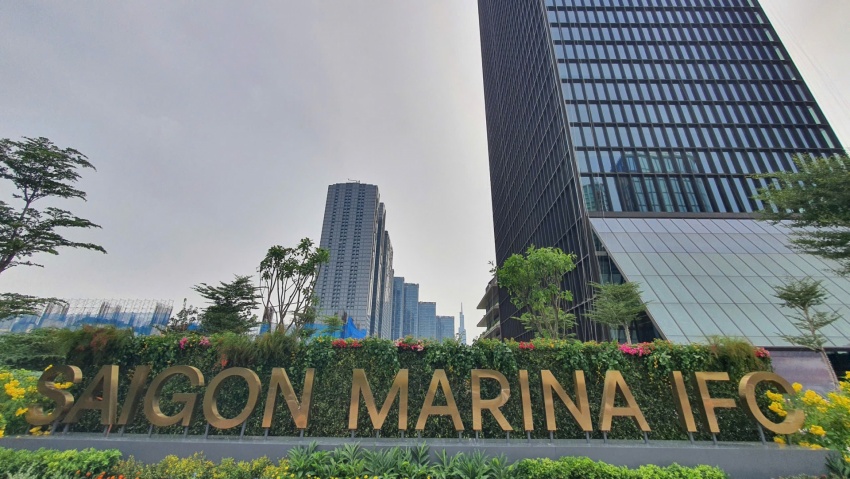 |
| Saigon Marina International Financial Centre, a VIFC-HCMC project. Photo: Le Toan |
 | Ant International, IFC and GCash launch sustainability financing scorecard The fintech company, World Bank institution and Philippine payment platform introduced metrics enabling small business access to green capital. |
 | VIFC in Ho Chi Minh City attracts $19 billion in commitments More than $19 billion in committed capital is awaiting regulatory approval to be disbursed into Ho Chi Minh City's International Financial Centre. |
 | Saigon Marina IFC serves as lighthouse amid river of heritage Commemorating the anniversary of the liberation of the south and national reunification on April 30, the Saigon sky was illuminated by a spectacular fireworks display. |
What the stars mean:
★ Poor ★ ★ Promising ★★★ Good ★★★★ Very good ★★★★★ Exceptional
 Tag:
Tag:Related Contents

Latest News
More News
- Vietnam’s registered FDI surpasses $50 billion in nine months (October 07, 2026 | 10:30)
- Samsung Electro-Mechanics to add $1.85 billion semiconductor investment in Thai Nguyen (October 06, 2026 | 18:23)
- Electronics funding will be won via a capable ecosystem: SGS (October 06, 2026 | 09:00)
- LNG power plant projects risk falling behind schedule (October 03, 2026 | 09:00)
- Pandora opens world’s largest fine jewellery crafting facility (October 02, 2026 | 22:21)
- An Phat 5 Industrial Park positions for new wave of investment in northern Vietnam (October 02, 2026 | 09:00)
- Hanoi to launch portal to ease hurdles for tech businesses (October 01, 2026 | 09:00)
- Foreign investors to be widened for market access (September 30, 2026 | 17:54)
- Phu Quoc Airport planning adjusted to serve APEC 2027 (September 30, 2026 | 17:35)
- Nearly 200 foreign-invested enterprises in Vietnam to pay global minimum tax (September 30, 2026 | 17:26)


Latest News




 Mobile Version