

IFRS a passport to global capital markets

At a May 13 workshop on improving financial transparency through the adoption of International Financial Reporting Standards (IFRS), jointly organised by Smart Train Academy, the Vietnam Exchange, the State Securities Commission, and the Hanoi Stock Exchange, Nguyen Thi Thu Ha from the Ministry of Finance’s Accounting Supervision of Financial Institutions Division shared the results of a recent IFRS readiness survey.
“The MoF worked with independent consultants to assess IFRS adoption demand and preparedness among 46 entities, including more than 27 large listed companies,” Ha said.
“The survey found that many listed firms are facing mounting pressure from foreign investors and international financial institutions to adopt IFRS. In particular, 21 foreign-invested enterprises are under direct pressure from overseas parent companies that have already adopted IFRS or are in the process of doing so. However, because Vietnam has not yet officially permitted IFRS adoption, these companies must convert their financial statements to IFRS individually, resulting in higher costs and heavier compliance burdens.”
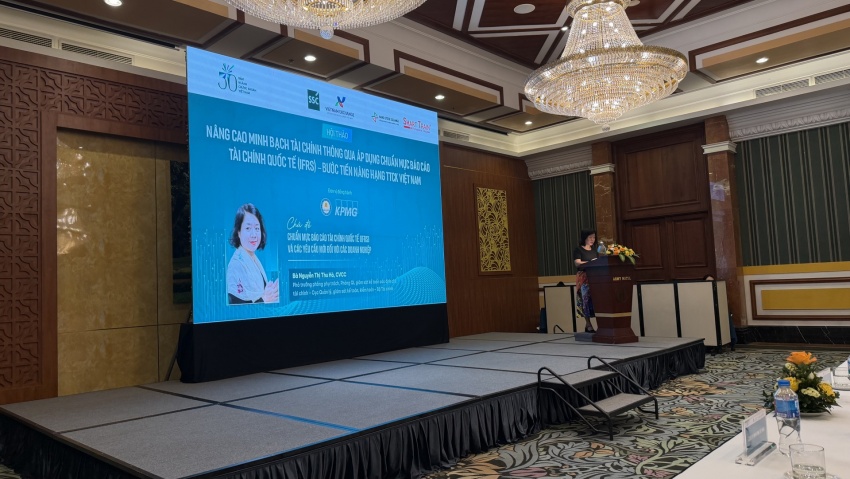 |
| Nguyen Thi Thu Ha, a representative of the Accounting Supervision of Financial Institutions Division under the Ministry of Finance. Photo: Ha Vy |
Financial statements prepared under Vietnamese Accounting Standards are often converted into IFRS to meet the requirements of foreign investors and creditors.
“Nevertheless, companies continue to face significant challenges in preparing IFRS-compliant financial statements due to the absence of detailed implementation guidance from the competent authority, namely the MoF,” said Ha.
“Many enterprises have had to engage audit firms to support the conversion process. This underscores that IFRS adoption demand in Vietnam is an objective reality, primarily concentrated among large listed firms and foreign-invested enterprises.”
Ha also shared insights from recent working sessions with the MoF, noting that major FDI corporations in Vietnam such as Samsung, LG, Panasonic, Canon, and IBM, along with several domestic enterprises including Vinamilk, Medlatec have expressed readiness and a strong desire to adopt IFRS.
“Some companies have formally submitted requests to the Ministry of Finance seeking approval to use IFRS in preparing their financial statements. Audit firms have also confirmed their preparedness in terms of resources and their readiness to provide IFRS audit services,” she said.
“Many banks such as Vietcombank, Techcombank, and VPBank have already prepared IFRS-based financial statements to pull in strategic investors, and in recent discussions, commercial banks have shown support for IFRS adoption. However, to ensure comparability on a consistent basis, the State Bank of Vietnam needs to revise certain regulatory frameworks that differ from IFRS, such as provisioning policies, and establish a clear roadmap for implementation.”
At the same time, Ha pointed out that some banks have yet to begin adoption due to limited understanding, with exposure largely confined to workshops organised by the MoF.
“These banks, particularly those with foreign shareholders, also wish to adopt IFRS. However, their shareholders and management believe implementation should only proceed when mandated by the government, given the significant costs associated with IT systems and workforce training,” she said.
Phan My Linh, partner, audit services, head of Industrial Manufacturing, KPMG in Vietnam, highlighted the importance of prioritising on-the-job training based on real business transactions rather than focusing solely on theory. This approach enables management to better understand key assumptions and make informed decisions during IFRS implementation.
Linh also proposed a cautious rollout strategy, recommending that companies first implement IFRS conversion at subsidiary level to assess impacts over a one-year period before scaling up to the group level.
“Accordingly, the roadmap is structured into three phases with four key steps. The preparation phase focuses on defining scope and establishing a project management team. This is followed by requirement analysis to identify both quantitative and qualitative gaps. The design and build phase involves adjustments to IT systems and document workflows. The final stage is implementation, including the preparation of opening balances and comprehensive training,” Linh said.
At the event, the Vietnam Exchange also announced plans to collaborate with stakeholders to organise a similar workshop in Ho Chi Minh City, targeting listed companies on the Ho Chi Minh Stock Exchange, home to large-cap and market-leading firms.
 | Profit divide widens among securities firms in Q1 The securities industry posted a stark split in the first quarter of 2026, with bank-backed brokerages delivering strong profit growth while smaller firms struggled with losses amid rising competition and risky proprietary bets. |
 | SSIAM partners with Japanese financial institutions to expand capital market solutions SSI Asset Management Company Limited, CCI CrossBorder, and Daiwa Corporate Investment have signed a strategic cooperation agreement to expand co-investment opportunities and facilitate capital connections between Japanese financial institutions and Vietnamese enterprises. |
 | Vietnam strengthens foundations for balanced long-term growth Vietnam’s financial system is gradually evolving towards greater balance and resilience as policymakers and experts push for deeper capital markets and more diversified funding sources to support sustainable long-term growth. |
What the stars mean:
★ Poor ★ ★ Promising ★★★ Good ★★★★ Very good ★★★★★ Exceptional
 Tag:
Tag:
Related Contents





Latest News


More News
- From loans to women’s economic empowerment (October 06, 2026 | 17:58)
- VIB named Outstanding Retail Bank 2026, targets transaction banking (October 06, 2026 | 10:52)
- FTSE upgrade paves way for stronger stock market development (October 05, 2026 | 18:44)
- coLoan to empower women through inclusive green finance (October 05, 2026 | 18:42)
- Techcombank CEO: AI no longer a tool but a new operating foundation (October 05, 2026 | 18:11)
- Banks sustain profit growth as funding costs squeeze margins (October 02, 2026 | 22:22)
- Nam A Bank delivers strong breakthrough in 2026 (October 02, 2026 | 19:00)
- Policy credit builds sustainable livelihoods from the grassroots (September 29, 2026 | 07:48)
- VIB deploys Front Arena treasury and foreign exchange trading system on AWS (September 28, 2026 | 16:46)
- Nam A Bank receives $60 million loan from FMO (September 28, 2026 | 12:37)


Latest News





 Mobile Version