

Tighter capital redraws property market

At the conference “Real estate market 2026: Weathering Headwinds, Embracing a New Cycle” organised by VIR on May 12 in Ho Chi Minh City, experts highlighted tightening credit conditions, evolving funding structures, and interest rate dynamics as key forces reshaping Vietnam’s property market. They also pointed to a gradual shift towards a more balanced and sustainable growth trajectory.
According to Can Van Luc, chief economist at BIDV and member of the National Financial and Monetary Policy Advisory Council, the real estate market this year is witnessing both diversification and robust expansion in capital flows.
“Credit remains a key pillar. By the end of 2025, outstanding loans to the real estate sector were estimated at $188 billion, up 36 per cent on-year, compared to overall system credit growth of more than 19 per cent,” Luc said.
“This year, with system-wide credit growth targeted at around 15 per cent, real estate lending will also be kept under control. However, by February, outstanding loans for real estate business activities alone had reached approximately $89.4 billion, up 11.7 per cent from the end of 2025, while the sector’s non-performing loan ratio stood at 2.22 per cent.”
Luc stressed that tighter credit oversight should not be interpreted as a blanket tightening, but rather a recalibration following a period of strong expansion. In his view, real estate credit could still grow by around 15 per cent this year, albeit in a more selective manner.
“Controlling credit does not mean ‘tightening’ indiscriminately. It is about rebalancing and prioritisation,” he said. “Regulators are guiding banks to channel credit towards homebuyers with genuine housing demand, while limiting flows into speculative segments to mitigate systemic risks.”
 |
| Huynh Anh Huy, industry analyst at Kafi Securities. Photo: Le Toan |
Huynh Anh Huy, industry analyst at Kafi Securities, pointed out that the policy of capping real estate credit growth in line with overall banking sector expansion is placing tangible pressure on developers, particularly as project sizes continue to scale up.
“Projects of only a few hundred billion dong are now rare. Most developments require investments of several trillion, even tens of trillions of dong,” he said. “If credit growth limits are constrained early in the year, the market will naturally be concerned about developers’ ability to access capital and sustain the strong implementation momentum seen during the 2025 recovery.”
Huy emphasised that bank credit was no longer the sole funding channel. He argued that Vietnam’s real estate sector still has significant room to diversify its capital base, particularly through capital markets.
“The corporate bond market still holds considerable potential compared to regional peers such as Malaysia and Thailand,” he said. “At the same time, the equity market, capital increases, and fundraising from investors remain underutilised channels.”
He added that the wave of IPOs and stake sales in the second half of 2025 underscored this potential, especially as Vietnam’s stock market moves closer to emerging market status.
“As the market upgrade story gains traction, foreign capital inflows are likely to increase. This presents an important opportunity for real estate firms to raise additional equity capital,” Huy said.
From the banking perspective, interest rate dynamics are emerging as another critical variable shaping both capital access and market sentiment. Nguyen Le Nam, director of Retail Banking Division at Asia Commercial Joint Stock Bank (ACB), expressed cautious optimism as deposit rates show signs of easing following recent policy signals from the central bank.
“For banks, a decline in deposit rates is a positive development as it helps reduce funding costs,” Nam said. “In reality, banks do not seek to lend at high rates, but are often constrained by input costs. When funding costs come down, there is greater room to lower lending rates.”
 |
| Nguyen Le Nam, director of Retail Banking Division at ACB. Photo: Le Toan |
He noted that a stable interest rate environment would play a crucial role in supporting genuine housing demand, reinforcing the sustainability of the real estate market.
“Stable rates will enable banks to extend credit to those with real housing needs, supporting healthier and more sustainable market development,” he said. “We expect the State Bank of Vietnam to continue providing clear policy direction to stabilise the rate environment, giving borrowers greater confidence to access financing for homeownership.”
Nam also highlighted that increasing segmentation across housing types, from social and mid-range housing to high-end and luxury segments, as well as resort real estate, is creating more targeted opportunities for both lenders and buyers.
“ACB is committed to taking a more proactive approach in financing, while developing longer-term and more stable solutions to support homebuyers,” he said. “Curbing speculation and prioritising genuine demand not only protects banks from risk but also contributes to a healthier real estate market.”
At the same time, he acknowledged that supporting homebuyers through longer loan tenors presents new challenges for banks.
“Extending loan tenors from 20 to 30 years is a meaningful solution to support customers, but it also introduces greater financial management challenges,” he said. “A 30-year loan inherently carries higher risk due to the unpredictability of market conditions over such an extended period.”
Despite these pressures, Nam stressed that such measures reflected a longer-term commitment by banks to accompany customers through economic cycles, even at the expense of short-term profitability.
 | Tighter bank financing to drive divergence in housing supply mix Stricter bank lending conditions in 2026 are expected to widen disparities in housing supply mix, financing structures, and credit profile of developers. |
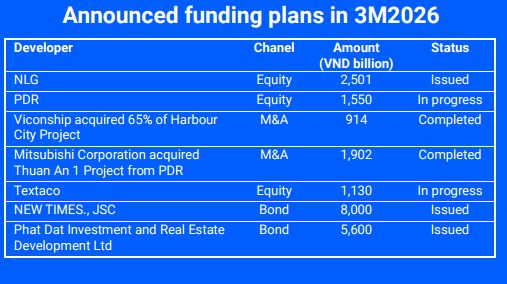 | Property developers diversify funding sources amid tighter credit Constrained real estate credit growth and higher refinancing needs are expected to drive residential real estate developers to widen funding sources in 2026. |
 | Untangling bottlenecks in Vietnam’s property market The panel “Untangling Bottlenecks, Unlocking Resources” at VIR’s real estate seminar discussed some of the market’s most pressing issues, including the mismatch between supply and demand, homebuyer confidence and investor sentiment. |
What the stars mean:
★ Poor ★ ★ Promising ★★★ Good ★★★★ Very good ★★★★★ Exceptional
 Tag:
Tag:
Related Contents



Latest News





More News
- From loans to women’s economic empowerment (October 06, 2026 | 17:58)
- VIB named Outstanding Retail Bank 2026, targets transaction banking (October 06, 2026 | 10:52)
- FTSE upgrade paves way for stronger stock market development (October 05, 2026 | 18:44)
- coLoan to empower women through inclusive green finance (October 05, 2026 | 18:42)
- Techcombank CEO: AI no longer a tool but a new operating foundation (October 05, 2026 | 18:11)
- Banks sustain profit growth as funding costs squeeze margins (October 02, 2026 | 22:22)
- Nam A Bank delivers strong breakthrough in 2026 (October 02, 2026 | 19:00)
- Policy credit builds sustainable livelihoods from the grassroots (September 29, 2026 | 07:48)
- VIB deploys Front Arena treasury and foreign exchange trading system on AWS (September 28, 2026 | 16:46)
- Nam A Bank receives $60 million loan from FMO (September 28, 2026 | 12:37)


Latest News







 Mobile Version