

Tokenised asset market could begin operations in Q3

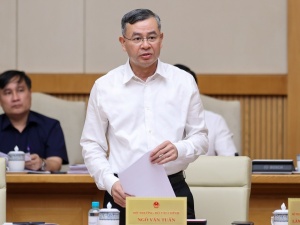
Speaking at the Digital Trust in Finance 2026 forum on May 12 in Hanoi, Nguyen Duc Chi, Deputy Minister of Finance, said the market would operate under state supervision to ensure safety and transparency.
“We believe that, at the earliest, the first official activities of Vietnam’s tokenised asset market could begin in the third quarter, with service providers operating under the management of state agencies to ensure market safety and transparency,” Chi said.
According to Deputy Minister Chi, the Ministry of Finance (MoF) has coordinated with the Ministry of Public Security and the State Bank of Vietnam to approve five entities to prepare for the provision of tokenised asset market services.
 |
| Deputy Minister of Finance Nguyen Duc Chi delivered a speech at the event. Photo: Digital Trust in Finance |
The move follows the issuance of Resolution No.05/2025/NQ-CP on piloting a tokenised asset market in Vietnam, which is regarded as the country’s first legal framework governing the sector. The framework is designed to support the market’s development under controlled conditions while ensuring transparency, efficiency, and the protection of the lawful rights and interests of participating organisations and individuals.
Chi said the development of digital finance and digital trust has become increasingly important as digital transformation accelerates both in Vietnam and globally.
“Alongside significant opportunities, the process also presents major challenges, particularly in building trust in the digital economy and digital finance,” he said. “The key task is to minimise risks associated with digitalisation while establishing policies and management mechanisms that both encourage innovation and safeguard the national financial system.”
Vietnam has stepped up efforts to boost digital transformation following the Politburo’s Resolution No.57-NQ/TW on sci-tech, innovation, and national digital transformation, issued in December 2024. The resolution targets the digital economy accounting for at least 30 per cent of GDP by 2030, while cashless payments are expected to reach 80 per cent of all transactions.
In line with these targets, the MoF has been reviewing and revising legal regulations to remove obstructions and support innovation and technology development.
Chi said the ministry had proposed amendments to the Law on State Budget to simplify administration and unlock resources for digital transformation and innovation. From 2025, at least 3 per cent of the state budget will be allocated to digital transformation, sci-tech and innovation.
At the same time, revisions to the Law on Tax Administration are aimed at modernising tax management and improving convenience for businesses and taxpayers. Electronic invoices have also been deployed nationwide to improve transparency, prevent fraud, and protect businesses and citizens.
“The MoF is also accelerating tax reforms and implementing preferential credit policies to encourage investment in sci-tech,” Chi said, adding that the sci-tech sector continues to receive the highest level of tax incentives under the Corporate Income Tax Law.
The ministry is also implementing a series of large-scale digital transformation projects, including IT systems for digital customs, tax administration, the state budget and accounting system and a KRX trading system for the stock market.
 | MoF honing draft amending tax laws On April 20, the Standing Committee of the National Assembly met to discuss amending the Law on Personal Income Tax, the Law on VAT, the Law on Corporate Income Tax, and the Law on Special Consumption Tax. |
 | Vietnam nears investment grade as reforms and growth strengthen outlook Vietnam’s sovereign credit ratings are now approaching investment grade, standing just one notch below the threshold under S&P Global Ratings and Fitch Ratings, and two notches below under Moody’s, bringing the country closer to its target of achieving investment-grade status. |
 | Ministry of Finance tightens fiscal discipline amid global pressures Facing mounting inflation, trade and investment pressures, the Ministry of Finance is stepping up institutional reforms, tightening fiscal discipline and accelerating policy action to safeguard growth momentum and macroeconomic stability. |
What the stars mean:
★ Poor ★ ★ Promising ★★★ Good ★★★★ Very good ★★★★★ Exceptional
 Tag:
Tag:
Related Contents


Latest News





More News
- From loans to women’s economic empowerment (October 06, 2026 | 17:58)
- VIB named Outstanding Retail Bank 2026, targets transaction banking (October 06, 2026 | 10:52)
- FTSE upgrade paves way for stronger stock market development (October 05, 2026 | 18:44)
- coLoan to empower women through inclusive green finance (October 05, 2026 | 18:42)
- Techcombank CEO: AI no longer a tool but a new operating foundation (October 05, 2026 | 18:11)
- Banks sustain profit growth as funding costs squeeze margins (October 02, 2026 | 22:22)
- Nam A Bank delivers strong breakthrough in 2026 (October 02, 2026 | 19:00)
- Policy credit builds sustainable livelihoods from the grassroots (September 29, 2026 | 07:48)
- VIB deploys Front Arena treasury and foreign exchange trading system on AWS (September 28, 2026 | 16:46)
- Nam A Bank receives $60 million loan from FMO (September 28, 2026 | 12:37)


Latest News






 Mobile Version