
FTSE upgrade signals new era for Vietnam's equity market

Held on March 19, the webinar gathered market participants to discuss the structural transition required to secure and sustain secondary emerging market status. The impending upgrade of Vietnam's equity market is expected to reshape capital flows and investor composition.
The consensus among insiders is that achieving secondary emerging market status is merely the starting point for a broader evolutionary process within the country's financial ecosystem.
As the anticipated FTSE Russell classification inclusion targets a September timeline, local market participants are observing a significant undercurrent of preparation from global entities.
 |
Thomas Nguyen, chief global markets officer at SSI Securities Corporation, highlighted that this milestone will fundamentally alter operations and demographics of the Vietnamese stock exchange.
“My primary expectation is that this institutionalisation will lead to reduced volatility over time,” Thomas said. “Transitioning away from a retail-dominated market fundamentally changes how profit is made and how stocks behave.”
The traditional structure of the Vietnamese stock market has long been characterised by a heavy reliance on individual day traders. Thomas noted that the historical rule of thumb saw a market split of 90 per cent retail and 10 per cent institutional participation.
However, his observations indicate this ratio has already begun to shift to approximately 85 per cent retail and 15 per cent institutional. Looking ahead to the end of 2027, Thomas forecasts an estimate of 20 per cent institutional participation and 80 per cent retail.
This demographic shift is being preceded by tangible preparations from the global financial ecosystem, which comprises international brokers, custodians, and ultimate funders.
SSI Securities has reported a 52 per cent on-year surge in overseas institutional account openings for the year-to-date. While these accounts are not yet executing trades in high volumes, their establishment strongly signals that global participants are laying necessary technical groundwork to embrace the market.
"We often hear that the actual fund flow entering Vietnam will be approximately $1.5 billion," Thomas said. "The players indexed to FTSE will become significant shareholders, holding 5 per cent or more of every major Vietnamese company. When substantial overseas investors hold stakes in companies like FPT, Vinamilk, or Vingroup, the presence of these massive, passive holders changes the dynamic."
"My primary expectation is that this institutionalisation will lead to reduced volatility over time, along with an increase in fundamental investors who take a long-term view rather than focusing on day-to-day fluctuations," he added.
The necessity of this institutional transition is strongly echoed by those deploying capital on the ground in Ho Chi Minh City and Hanoi.
Thu Nguyen, deputy CEO of Vinacapital Fund Management, provided a practitioner's perspective on how current retail dominance creates market inefficiencies.
"Retail investors account for 85-90 per cent of trading volume, often exhibiting the irrationality or extreme behaviour seen in other markets," she explained. "This retail-driven environment has historically cemented the country as a prime market for alpha generation, where active managers can uncover undervalued assets and overlooked 'hidden gems' based on strong fundamentals."
The influx of overseas institutional capital is expected to correct these mispricings gradually and reduce market blind spots.
While passive flows will largely chase market size, active international flows are forecast to be even more substantial. Thu noted that enhanced transparency and normalisation of corporate governance are critical byproducts of this institutionalisation process, which will make the market more efficient over time.
To truly accommodate this institutional capital and ensure sustained momentum, the nation must actively expand its investable universe.
Vu Viet Linh, thematic strategist for Institutional Research at Maybank Securities Vietnam, outlined the broader macroeconomic requirements of the market upgrade.
“From our perspective, the imminent upgrade is like Vietnam receiving a ticket to a much larger market,” said Linh.
He estimated that total portfolio inflows could range between $5 billion and $6 billion from both passive and active financiers in the short term.
To fully capitalise on this capital influx and match regional peers, Linh identified two critical solutions for market expansion.
The first is actively encouraging foreign invested companies to list locally. While the foreign direct investment (FDI) sector is vital and accounts for over 20 per cent of GDP, it represents a mere 2 per cent of total stock market capitalisation.
Linh pointed out that current equity book value of FDI firms operating here stands at approximately $200 billion. Tapping into this sector, replicating successful models seen in India and Malaysia, would drastically improve market depth and assist global institutional investors with their diversification strategies.
The second avenue is accelerating IPOs of prominent state-owned enterprises.
Driven by Circular 57, which prioritises non-bank sectors like telecommunications, transportation, and minerals for ownership restructuring, Linh estimated an additional $60 billion in market capitalisation could be unlocked.
Ultimately, he noted that these structural improvements could pave the way for the country’s national sovereign credit rating to be upgraded to investment grade, an event that historical case studies of Indonesia and the Philippines suggest could boost stock indices by up to 50 per cent over a two-year period.
Securing and maintaining this heightened institutional interest requires continuous regulatory evolution from local authorities.
Meanwhile, Wanming Du, director of Index Policy for Asia-Pacific at FTSE Russell, explained that criteria for emerging market status have evolved significantly over the past two decades to reflect modern global market best practices.
“Vietnam cannot simply remain stationary. They must improve in tandem with their peers to sustain their status,” Wanming warned. “It is important that we see continued momentum in building a proper central counterparty system that is functional and practical for the Vietnamese market. Additionally, we are looking at foreign ownership restrictions to ensure a larger, more investable portion of the market becomes accessible to international investors.”
Looking ahead, Wanming stressed the importance of fostering a mature investment landscape to replace traditional saving habits, especially to cater to the nation's energetic younger demographic. Introduction of diverse, cost-effective passive products, such as exchange-traded funds, fixed income offerings, and index funds, will be crucial. These structured products are deemed essential to help the next generation build and sustain long-term wealth within a newly institutionalised and internationally integrated market environment.
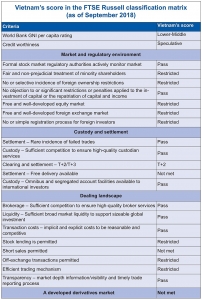 | Vietnam closer to key FTSE upgrade Vietnam is now edging even closer to the coveted emerging market status, after FTSE Russell announced that the country is now on the watch list to join its secondary emerging market ranking. |
 | Vietnam after FTSE upgrade: a shift in both quantity and quality of foreign capital FTSE Russell's decision to upgrade Vietnam from frontier to secondary emerging market status has spurred optimism in the stock market. Le Hoai An, founder of Integrated Financial Solutions JSC, spoke with VIR's Van Dung about the impact of the milestone. |
 | Stock market posts resilient 2025 performance Vietnam’s stock market closed 2025 on a strong footing, demonstrating resilience amid global volatility and reinforcing investor confidence in its long-term growth trajectory. |
What the stars mean:
★ Poor ★ ★ Promising ★★★ Good ★★★★ Very good ★★★★★ Exceptional
 Tag:
Tag:


Latest News





More News
- Nam A Bank named in top 10 largest listed banks in Southeast Asia (October 13, 2026 | 09:46)
- Citi appoints Michael Zezas as global head of research (October 12, 2026 | 17:23)
- From carbon value to greener capital (October 12, 2026 | 09:15)
- From cost advantage to ecosystem strength (October 12, 2026 | 09:00)
- Corporate treasury on the cusp of AI transformation (October 12, 2026 | 08:00)
- Vietnam strengthens global credit standing with R&I upgrade to BBB (October 09, 2026 | 16:56)
- From risk to reputation: Jason Ho on what makes a bank worthy of trust (October 08, 2026 | 14:00)
- Building Vietnam’s next chapter of FDI growth (October 08, 2026 | 12:15)
- Policy loans open new paths for people rebuilding their lives (October 07, 2026 | 17:24)
- FTSE upgrade opens door to $2 billion in passive fund inflows (October 07, 2026 | 12:12)








 Mobile Version