
Fresh graduates fall short on soft skills, employers say

 |
| Photo: Nguyen Huong |
At a discussion on shaping talent in the 4.0 era in Hanoi on October 8, Ngo Thi Ngoc Lan, managing director of Navigos Search, said that employers hiring experienced professionals tend to prioritise technical expertise and relevant work experience. For fresh graduates, however, the priorities are different.
“Attitude is what employers expect most from young people. They want to know whether you are willing to stay and grow with the company. Businesses are struggling with young employees who join and leave after just a few days, before they have learnt or contributed much,” she said.
Resilience is another quality that employers increasingly value. Lan noted that some young employees tend to withdraw when confronted with difficult assignments or unexpected problems, rather than working through challenges and seeking solutions.
Time management, meanwhile, reflects an employee’s ability to plan, prioritise, and honour commitments. “You may not have enough time to do everything, but you should have enough time to do the most important things,” she said.
These observations are supported by the 2026 Vietnam Employability Report, released by British University Vietnam in collaboration with research firm Decision Lab in early October. The study surveyed 375 domestic and international companies about their recruitment decisions for fresh graduates.
The report assessed seven capability areas and found that employers considered all seven important, with between 74 and 86 per cent rating each as important. Yet graduates fell short of expectations in six of the seven areas.
Time management recorded the widest gap, at 26 percentage points, followed by problem-solving at 23 percentage points. Communication and adaptability showed gaps of 12 and 11 percentage points, respectively. Digital literacy was the only area in which graduates exceeded employers’ expectations, by three percentage points.
The findings suggest that the challenge extends beyond academic knowledge. Employers need graduates who can apply what they have learnt to real-world situations, coordinate with colleagues, take responsibility for their work, and make decisions when information is incomplete or circumstances change.
For Le Quoc Vinh, chairman and CEO of Le Group, who has spent more than two decades recruiting and managing employees, said differences in attitudes and behaviour between generations have become increasingly apparent.
"Limited exposure to workplace environments can make it harder for young people to understand organisational culture and integrate into established teams. Familiarity with professional expectations needs to be developed through practical experience rather than acquired solely through classroom learning," he said.
At Le Group, Vinh encourages interns to seek as many opportunities for workplace experience as possible. Academic qualifications and professional knowledge remain important, but an employee’s ability to adapt to the organisation and understand its values also matters.
“Recruitment depends significantly on whether candidates can fit into and understand the working practices and cultural values of the company,” Vinh said.
However, Nguyen Thi Thu Anh, member of the National Council for Education and Human Resource Development, cautioned against generalising these shortcomings to an entire generation.
"Many young people demonstrate considerable creativity, initiative, and a strong sense of responsibility," Thu Anh said.
She pointed to schools and universities that increasingly use project-based learning and problem-solving assignments to encourage students to take ownership of their work. Such approaches can strengthen independent learning and equip students to handle complex situations.
“I do not think all young people lack problem-solving skills or responsibility, or are ready to leave their jobs at the first difficulty,” she said. "Nevertheless, young workers can be sensitive to setbacks and may be more inclined to leave when workplace experiences fail to meet their expectations. This makes it important to help students develop the resilience needed to navigate the demands of working life."
Bridging the employability gap requires closer cooperation between universities and employers, particularly while students are still studying. Yet, the British University Vietnam report indicates that collaboration remains concentrated on recruitment and internships, rather than the design and delivery of education.
Although 59 per cent of surveyed employers take on student interns, only 15 per cent contribute to curriculum design, while 23 per cent do not collaborate with any university.
Vinh acknowledged that businesses must take greater responsibility for this gap. Employers often criticise universities for failing to produce graduates who meet their needs, yet may do little to help institutions understand those needs or prepare students accordingly.
“Businesses cannot simply wait for universities to produce the people they want and then recruit the best candidates. They also need to contribute to the education and training process,” he said.
He suggested that universities take a more proactive approach by approaching companies with specific proposals for collaboration. Clear requests for industry feedback, practical projects, and input into training programmes could make it easier for businesses to participate.
Thu Anh agreed that the policy framework already places considerable emphasis on connecting education with practical needs. The challenge lies primarily in implementation.
"Universities should actively engage businesses to understand the competencies expected of graduates and use that feedback to refine curricula, teaching methods, and assessment. Employers, in turn, must be willing to invest time and expertise in supporting students," she said.
 | Vietnam highlighted in best alternative study abroad destinations Global student mobility is undergoing a notable shift, with Vietnam emerging as an increasingly attractive destination for international students. |
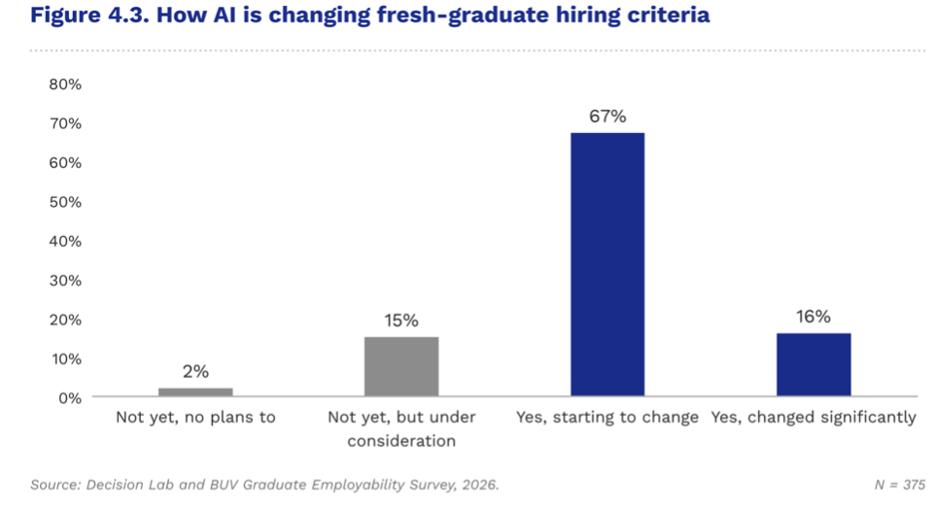 | AI beginning to reshape recruitment criteria Digital literacy is the only capability area in which fresh graduates meet employers’ expectations, according to a new report. Yet, it is also the standard rising fastest, as businesses increasingly expect new hires to use AI effectively in the workplace. |
What the stars mean:
★ Poor ★ ★ Promising ★★★ Good ★★★★ Very good ★★★★★ Exceptional
 Tag:
Related Contents





Latest News
More News
- Ford innovations continue towards sustainable growth (October 19, 2026 | 09:40)
- Preparing professionals for a new business environment (October 19, 2026 | 09:13)
- KN Holdings honoured for ESG efforts in Vietnam (October 18, 2026 | 11:00)
- APEA 2026 Vietnam honours 65 outstanding leaders and enterprises (October 17, 2026 | 10:00)
- MEXC highlights AI-driven trading and broader market access at TOKEN2049 (October 17, 2026 | 09:00)
- EuroCham confidence index holds at 78.3 despite operational hurdles (October 16, 2026 | 17:27)
- Shrimp and rice firms face rising standards in export markets (October 16, 2026 | 09:00)
- SCG and Prime Group add value to the ecosystem (October 15, 2026 | 15:55)
- Project readiness key to unlocking green finance (October 15, 2026 | 12:35)
- Sovereign AI and human oversight key to secure digital government (October 15, 2026 | 12:32)







 Mobile Version