
Experts urge simpler tax rules for small household businesses

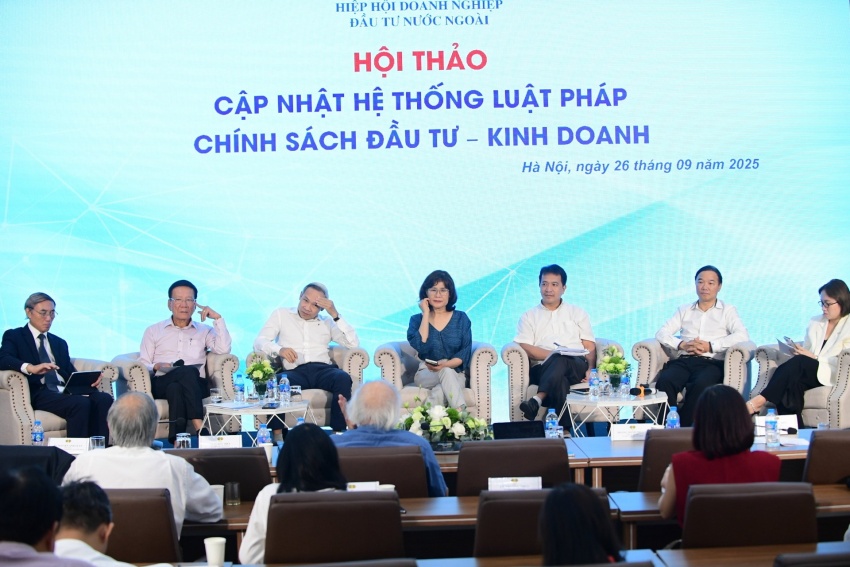
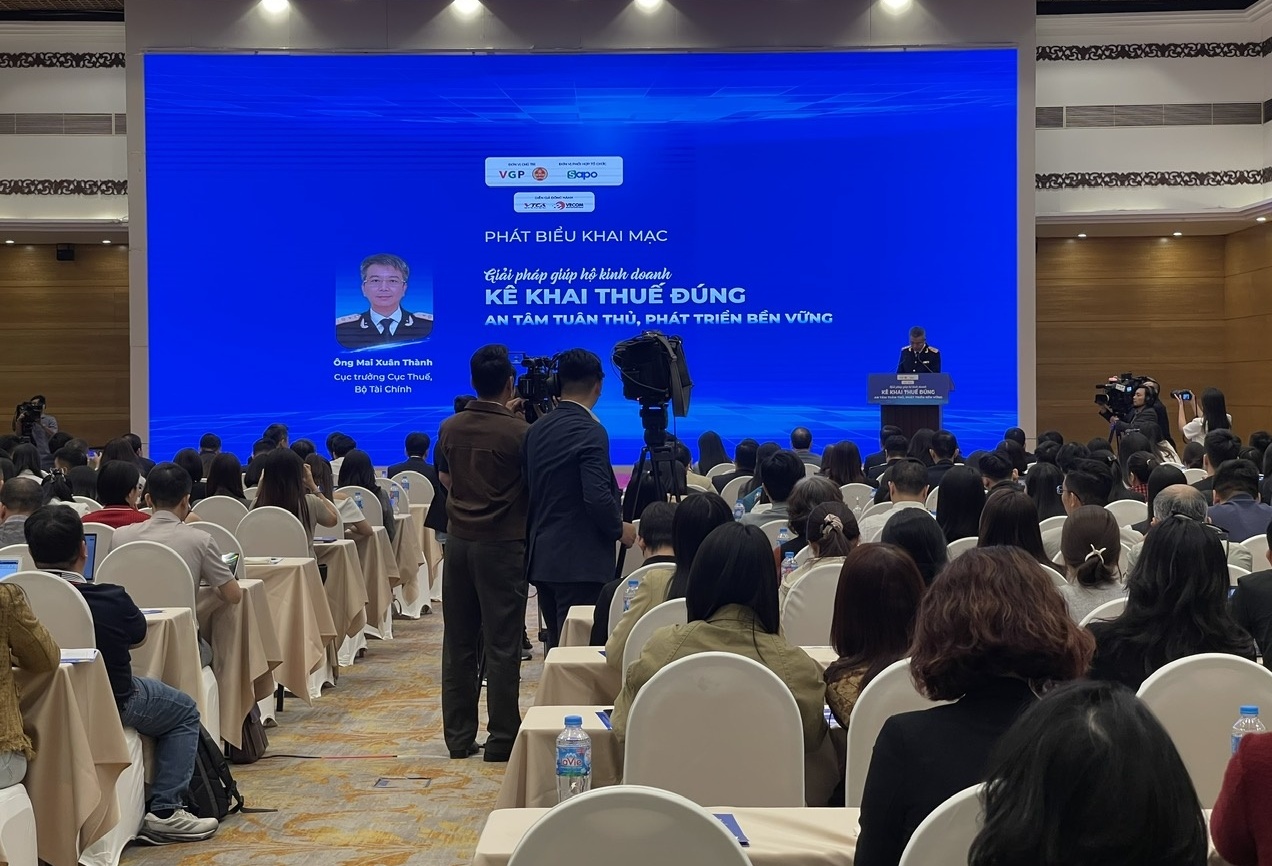
The Vietnam Association of Foreign-Invested Enterprises (VAFIE) held a seminar on September 26 to provide members with timely updates and systematic analysis of key legal and policy changes. Among the highlights was Decree No.70/2025/ND-CP on invoices and documents, a significant step in modernising tax management but one that raises challenges for smaller household businesses.
 |
| Nguyen Anh Tuan, chairman of VAFIE |
In his opening remarks, Nguyen Anh Tuan, chairman of VAFIE, highlighted how Vietnam’s legal and investment policy systems have been continuously improved to meet the needs of economic growth and international integration, especially since 2024, with many key legal documents revised and supplemented.
"Institutional reform is being vigorously advanced to clear the ‘bottleneck of bottlenecks’ and transform the framework from a hindrance into a national competitive advantage, as directed by Party General Secretary To Lam," he said.
Tuan stressed that businesses must quickly grasp new legal regulations on investment and business to ensure compliance and seize the opportunities created by institutional reform for their development.
However, practical implementation of investment business laws shows that several obstacles and difficulties have also arisen. These need timely resolution to encourage investment and production-business development, contributing to fast and sustainable national growth, with this year's GDP growth target above 8 per cent, and aiming for double-digit growth in the coming years.
One of the greatest concerns at the seminar was the impact of Decree No.70/2025/ND-CP, which amends Decree No.123/2020/ND-CP on invoices and documents.
While participants recognised the decree’s aim of bringing household businesses into a stricter, more transparent tax framework to enhance oversight, prevent fraud, and ensure fairness, several experts and enterprises voiced concerns over challenges in its implementation.
"This domestic tax policy have such a wide-ranging impact on foreign-invested enterprises. Many companies, especially in consumption goods, saw revenues decline immediately after Decree 70 took effect, as their distribution systems heavily depend on small household businesses," said Nguyen Viet Ha, vice chair of the American Chamber of Commerce in Hanoi.
 |
According to a survey of the Vietnam Chamber of Commerce and Industry in July, nearly 90 per cent of household businesses are unaware of their obligations regarding e-invoices from POS systems. Only 11.4 per cent fully understand the regulations; 68 per cent have basic knowledge or are unclear on how to comply; 20.7 per cent completely lack understanding or knowledge of how to implement the changes.
Moreover, tax authority support is limited. More than half of all household businesses have never received guidance, and only 14.2 per cent received specific instructions.
"As a result, the new regulation unintentionally creates administrative burdens for small household businesses," said Ha before proposing to allow for at least a one-year transition period with no penalties during the initial phase to help households adapt.
She suggested raising the revenue threshold for applying POS-based e-invoices connected to the tax authority from VND1 billion ($40,000) to VND2-3 billion ($80,000-120,000) per year, in line with market realities.
Ha also proposed to allow small retailers like groceries, food stalls to use simple invoices without immediate connection to the tax system; as well as implement tax exemption/reduction for the first 6–12 months, and support with affordable POS systems/software, especially for vulnerable groups.
While commenting on the draft Law on Tax Administration, some experts highlighted an issue that household businesses are now required to fulfill two obligations simultaneously, including issuing e-invoices, and maintaining input accounting records
Observers argued this places a heavy burden on small household businesses, which typically lack dedicated accounting departments. They reported rising costs for accounting services, complicated procedures, and a higher risk of non-compliance or incorrect filings, leading to potential fines.
According to international best practices, in Japan, small household businesses only need to issue simplified invoices and are not required to maintain detailed accounting systems. Singapore applies a simplified accounting regime, requiring only the retention of basic documents for inspection when needed.
Huong Vu, VAFIE’s vice chairwoman and CEO of EY Vietnam, proposed allowing e-invoices to replace accounting books and introducing a simplified accounting regime for small household businesses with annual revenue under $120,000. Under this mechanism, such businesses would only need to store input and output invoices and record revenue using simple tax authority forms, without preparing detailed financial statements.
"Amending the Law on Tax Administration should reflect the spirit of reform – cutting down forms, eliminating duplication between e-invoices and accounting books, and making compliance easier for small businesses, while still giving tax authorities sufficient information for oversight," she said.
 | Tax sector pushes digital transformation in administration overhaul The tax sector is restructuring administrative processes to build a modern, transparent system, leveraging digital technology and data to improve compliance, efficiency, and risk management. |
 | Key tax reforms set to boost efficiency and digital governance Le Thi Duyen Hai, deputy secretary general of the Vietnam Tax Consultants’ Association, highlights key reforms in the amended Law on Tax Administration aimed at minimising procedures and promoting digital tax governance. |
 | Tax procedures for household businesses to be simplified The Ministry of Finance is finalising the revised Law on Tax Administration, aiming to simplify procedures and increase voluntary compliance. |
What the stars mean:
★ Poor ★ ★ Promising ★★★ Good ★★★★ Very good ★★★★★ Exceptional
 Tag:
Tag:Related Contents







Latest News





More News
- French experts share AI and digital governance insights in Hanoi (October 11, 2026 | 08:00)
- Digital government push focuses on data connectivity and AI (October 10, 2026 | 08:00)
- Ho Chi Minh City holds dialogue with businesses to address operational hurdles (October 09, 2026 | 17:27)
- AI beginning to reshape recruitment criteria (October 09, 2026 | 16:49)
- Electronics firms boost raw material reserves sevenfold amid supply concerns (October 09, 2026 | 08:00)
- NSRP navigates global energy supply volatility (October 08, 2026 | 16:59)
- Minitab launches campaign to combat illegal software use in Vietnam (October 08, 2026 | 15:54)
- Raising construction materials supply chain standards amid green transition (October 08, 2026 | 14:00)
- Samsung Vietnam to deepen cooperation with local manufacturers (October 08, 2026 | 12:00)
- Sojitz in Vietnam: 40 years from individual projects to a business cluster 'KATAMARI' (October 08, 2026 | 09:00)








 Mobile Version