
Cyber Tops Allianz Asia Pacific Risk Rankings

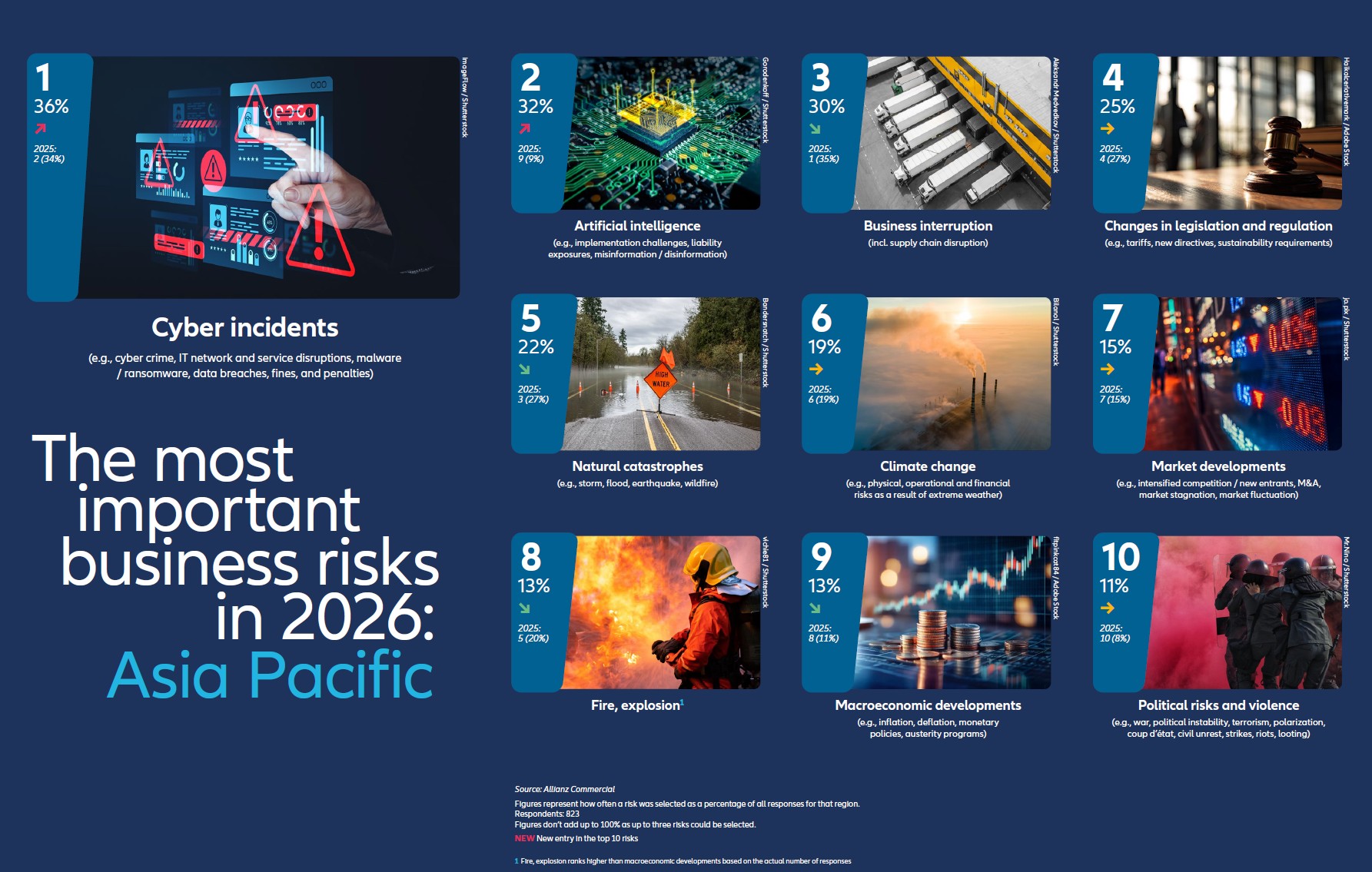
SINGAPORE - Media OutReach Newswire - 14 January 2026 - Cyber incidents created many headlines in 2025 and are still the biggest worry for companies in Asia Pacific and globally in 2026, according to the Allianz Risk Barometer. The past year has also been a significant one for accelerated adoption of artificial intelligence (AI), which is reflected in its ranking as the biggest riser in the annual survey at #2 as a complex source of operational, legal, and reputational risk for businesses. For the first time in five years, Business interruption is not in the top two risks for Asia Pacific, dropping to #3. Yet, this peril remains a significant concern given it can be a consequence of other risks in the top 10.
Allianz Commercial CEO Thomas Lillelund comments: "Following the volatility and uncertainty of 2025, businesses continue to face interconnected and highly complex risks in 2026's fast-changing environment. Given the continuing rise of AI across society and industry, it is unsurprising that it is the big mover in the Allianz Risk Barometer. As well as bringing huge opportunities, its transformative potential and rapid evolution and adoption are also reshaping the risk landscape, making it a standout concern for firms of all sizes worldwide, alongside other more established threats."
Christian Sandric, Allianz Commercial President, Commercial, Asia Pacific, says, "The evolving risk landscape, particularly in the areas of cyber threats and the adoption of AI, pose new challenges to businesses in the region. With Asian economies playing a pivotal role in global and regional trade, the potential for business interruption also remains a significant concern. This volatile environment stresses the importance of resilience in a business' supply chain, response measures, and risk management strategies to withstand and recover from disruptions."
Cyber risks the biggest concern for companies
Cyber incidents is the top risk in Asia Pacific, and a top three risk in Australia, Hong Kong, India, Japan, Singapore, South Korea, and Thailand. The Asia Pacific region experienced the most cyberattacks in 2024, increasing 13% year-on-year and accounting for 34% of attacks globally. While businesses in Asia, in particular large companies, have shown an increase in cyber resilience and appetite for cyber risk transfer solutions, their overall cyber coverage is generally lower compared to American or European peers and a significant portion of large organizations still remain self-insured.
Globally, cyber incidents is the top risk for the fifth year in a row, with its highest-ever score (42% of responses), and by a higher margin than ever before (+10%). It ranks as the main corporate concern in every region (Americas, Asia Pacific, Europe, and Africa and Middle East). The continued presence of cyber at the top of the Allianz Risk Barometer reflects a deepening reliance on digital technology at a time when the cyber threat landscape, and geopolitical and regulatory environments, are fast evolving.
AI creates emerging risks as well as new business opportunities
Ranking #2 in Asia Pacific, AI is a top three risk and biggest riser in Australia, China, Hong Kong, India, Malaysia, and Singapore, economies which are in the top 50% in terms of AI readiness. More than 90% of companies in the region are planning to scale up Generative AI over two years, with a focus on managing costs and lifting revenues.
Globally, AI has surged into the top tier of business concerns, rising to #2 (32%) in 2026 from #10 in 2025 – the biggest jump in this year's ranking. It is a big mover in all regions – ranked #2 also in the Americas, Africa and the Middle East, and #3 in Europe – and is a growing risk for companies of all sizes too, moving into the top three for large, mid-sized and smaller firms. As AI adoption accelerates and becomes more deeply embedded in core business operations, respondents expect AI-related risks to intensify, especially when it comes to liability concerns. The rapid spread of generative and agentic AI systems, paired with their growing real-world use, has raised awareness of just how exposed organizations have become.
Business interruption strongly connected to geopolitical risks and natural catastrophes
Business interruption (BI) is the third most significant risk in Asia Pacific and a top three risk in China, India, Japan, Malaysia, Philippines, Singapore, and South Korea. The closely linked risk of changes in legislation and regulation – which includes trade tariffs – ranks #4 (25%), unchanged year-on-year driven by concerns over growing protectionism. Commerce is increasingly taking place between geopolitically aligned economies, resulting in new paths in global trade and the emergence of next generation trade hubs, including Vietnam, Malaysia, and Thailand in the region.
2025 marked a shift towards protectionist trade policies and tariff wars that brought uncertainty to the world economy. Geopolitical risks are putting supply chains under increasing pressure, but as risks rise, just 3% of Allianz Risk Barometer respondents view their supply chains as "very resilient". In the past year alone, trade restrictions have tripled to affect an estimated US$2.7trn of merchandise – nearly 20% of global imports according to Allianz Trade – fueling companies exploring trends such as friendshoring and regionalization. These developments lead to a high-risk perception – 29% of respondents rank BI as a top peril, placing it at #3 globally, although it drops a position year-on-year.
Natural catastrophes ranks #5 (22%) in Asia Pacific, and is a top three risk in Japan, Malaysia, Philippines, and Thailand. The region experienced several natural catastrophes in 2025, including the Myanmar Earthquake, Typhoons Matmo, Ragasa, and Bualoi, Cyclone Alfred, wildfires in South Korea, as well as floods in Malaysia and Thailand. A delayed onset of the tropical cyclone season resulted in flooding and landslides, exerting a high human and economic toll in Asia where the insurance gap remains high at over 80%. According to research, there has been a significant increase in the intensity of tropical cyclones in recent decades, and these trends are linked to rising ocean temperatures and climate change, which retains its #6 ranking (19%) in the survey.
Resources:
- Global media release and top 10 business risks for 2026
- Allianz Risk Barometer methodology and full global and country risk rankings
- Media releases for Australia, China, Hong Kong, India, Japan, Malaysia, Singapore, South Korea and Thailand.
The issuer is solely responsible for the content of this announcement.
What the stars mean:
★ Poor ★ ★ Promising ★★★ Good ★★★★ Very good ★★★★★ Exceptional
 Tag:
Tag:Related Contents


Latest News


More News
- Honda LCR reviews GOD55 Sports partnership milestones (April 02, 2026 | 11:26)
- SWISS REJU wins Hong Kong body treatment award, launches AI service (April 02, 2026 | 11:16)
- LIVE4WELL to showcase AI health management at Hong Kong expo (April 02, 2026 | 11:12)
- Linklogis processes RMB 500 billion supply chain assets, launches platform (April 02, 2026 | 11:09)
- VET wins US Orange Dot Award for pet food innovation (April 02, 2026 | 09:00)
- Tim Ho Wan earns 17th consecutive Michelin recognition (April 01, 2026 | 17:45)
- Hong Kong Science Park hosts Global Innovation Exchange (April 01, 2026 | 17:30)
- Food-like supplements gain traction in Malaysia market (April 01, 2026 | 15:45)
- Phuket targets UK families as secure residential destination (April 01, 2026 | 15:42)
- ISCA holds inaugural Shanghai ceremony, partners with SCCCI (April 01, 2026 | 15:40)







 Mobile Version