
Corporate bonds key to easing Vietnam’s long-term capital pressure

FiinGroup and its subsidiary FiinRatings, in collaboration with S&P Global Ratings, hosted the Vietnam Corporate Bond Market Forum 2026 in Hanoi on April 2, drawing regulators, financial institutions, businesses, and investors. The event comes as Vietnam’s capital market enters a restructuring phase, with expectations of becoming a more effective channel for medium- and long-term funding.
Opening the forum, Nguyen Quang Thuan, chairman of FiinGroup, highlighted the need for a shift from scale-driven expansion to deeper, quality-led development of the corporate bond market.
In his view, rising capital demand, particularly for infrastructure, energy, and green transition projects, requires the bond market to move beyond a supporting role and become a core pillar of capital mobilisation. Thuan also pointed to a persistent imbalance in Vietnam’s capital structure.
“Bank credit continues to dominate funding, yet remains largely short-term, while demand for long-term capital is increasing rapidly. This mismatch underscores the urgency of developing the capital market in a more coordinated way, with corporate bonds playing a central role,” he said.
He highlighted structural limitations within the market. Around 91 per cent of issuance is conducted through private placements, with a significant share concentrated in the banking sector, limiting capital flows into key areas such as manufacturing, infrastructure, and energy.
To address these issues, Thuan proposed a more comprehensive approach, including diversifying supply, expanding the investor base, strengthening financial intermediaries, and improving transparency and standardisation across the bond lifecycle.
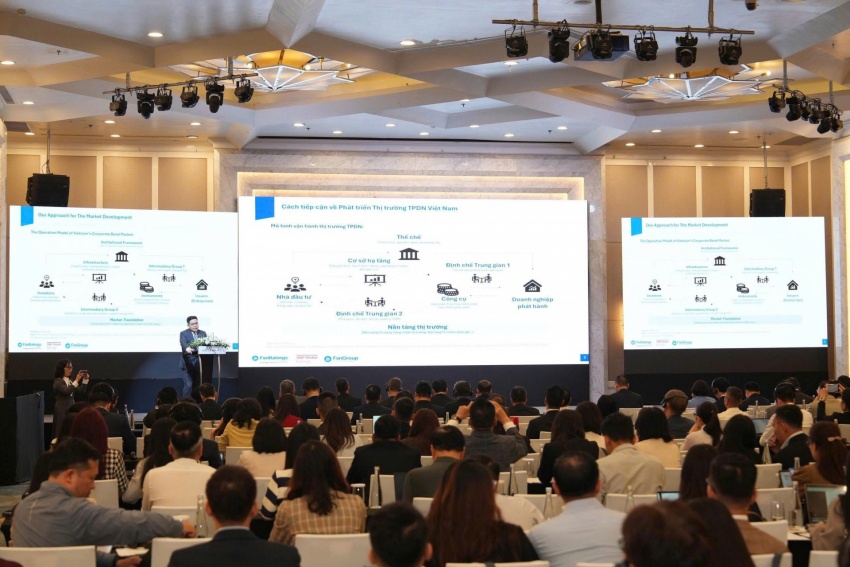 |
| Nguyen Quang Thuan, chairman of FiinGroup, spoke at the forum, underscoring the shift towards deeper, quality-driven development of the corporate bond market. Photo: FiinRatings |
From the regulatory side, Nguyen Hoang Duong, Vice Chairman of the State Securities Commission of Vietnam, noted that the forum comes as the Ministry of Finance and the commission step up efforts to develop the corporate bond market into a more effective long-term funding channel.
He pointed to a clear recovery in 2025, with private placements reaching approximately $23 billion, up 31.6 per cent on-year, while public issuances totalled nearly $2.1 billion, up 36 per cent.
“Delayed bond payments have declined, and investor confidence is gradually improving,” said Duong.
Duong acknowledged that structural challenges remain, including incomplete disclosure, misuse of proceeds, and distribution to inappropriate investor groups. “These issues highlight the need to strengthen market discipline and enhance accountability among issuers and intermediaries,” he said.
Maturity pressure remains a key test, with bonds worth around $7.6 billion expected to fall due in 2026, part of a broader wave in the 2024–2026 period. “This is also an opportunity to restructure the market, filter out weaker issuers, and strengthen its foundation for more sustainable development,” Duong added.
He noted that regulators will continue refining the legal framework, boosting credit ratings, developing long-term institutional investors, and strengthening supervision to improve transparency and market discipline.
During the morning session, discussions turned to market outlook and structural issues, with both domestic and international experts highlighting the scale of capital demand as Vietnam enters a higher growth phase.
According to S&P Global Ratings, Vietnam remains among the fastest-growing economies in the region, with GDP projected to expand by an average of 6.7 per cent annually between 2026 and 2028. However, expanding infrastructure investment is expected to increase fiscal pressure and require greater capital mobilisation.
Nguyen Anh Quan, manager of Financial Institutions Ratings at FiinRatings, estimated that achieving high growth would require total social investment of nearly 40 per cent of GDP, equivalent to an additional $20-30 billion in medium- and long-term capital each year.
“With the credit-to-GDP ratio already exceeding 140 per cent, the banking system is unlikely to continue serving as the primary funding source,” he said
Quan also pointed to a key bottleneck in pricing mechanisms. Most corporate bonds are still benchmarked against short-term deposit rates rather than a standard yield curve that reflects credit risk, limiting transparency and reducing appeal to institutional investors.
“Private placements, which account for more than 90 per cent of issuance, further constrain secondary market liquidity and limit participation from long-term investors such as insurers and investment funds,” he added.
Experts at the forum agreed that for the corporate bond market to play a larger role, it will be necessary to develop pricing infrastructure, standardise data, diversify the investor base, and enhance transparency across the market. The afternoon session continued with discussions on market infrastructure and enabling conditions, alongside solutions to support a more transparent and sustainable corporate bond market.
 | Corporate bonds a critical lifeline for Vietnam’s infrastructure ambitions With limited public funding, corporate bonds are emerging as a vital tool to attract long-term private capital and boost sustainable growth, especially as Vietnam needs $245 billion for infrastructure development by 2030. |
 | Bond issuance mulled as rate duress mounts Stronger credibility and successful capital mobilisation make now a prime moment to issue USD-denominated bonds for stabilising exchange rate purposes. |
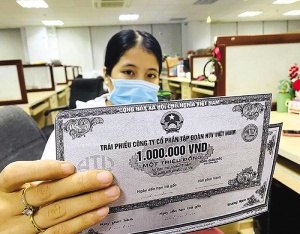 | Corporate bond issuances surge as firms accelerate capital restructuring Vietnam's corporate bond market saw a surge in new issuances and early redemptions in mid-October, signalling active capital restructuring by businesses amid stable interest rates and improved liquidity. |
What the stars mean:
★ Poor ★ ★ Promising ★★★ Good ★★★★ Very good ★★★★★ Exceptional
 Tag:
Tag:Related Contents






Latest News




More News
- From loans to women’s economic empowerment (October 06, 2026 | 17:58)
- VIB named Outstanding Retail Bank 2026, targets transaction banking (October 06, 2026 | 10:52)
- FTSE upgrade paves way for stronger stock market development (October 05, 2026 | 18:44)
- coLoan to empower women through inclusive green finance (October 05, 2026 | 18:42)
- Techcombank CEO: AI no longer a tool but a new operating foundation (October 05, 2026 | 18:11)
- Banks sustain profit growth as funding costs squeeze margins (October 02, 2026 | 22:22)
- Nam A Bank delivers strong breakthrough in 2026 (October 02, 2026 | 19:00)
- Policy credit builds sustainable livelihoods from the grassroots (September 29, 2026 | 07:48)
- VIB deploys Front Arena treasury and foreign exchange trading system on AWS (September 28, 2026 | 16:46)
- Nam A Bank receives $60 million loan from FMO (September 28, 2026 | 12:37)


Latest News







 Mobile Version