
Comet-landing mission on track, one last hurdle ahead

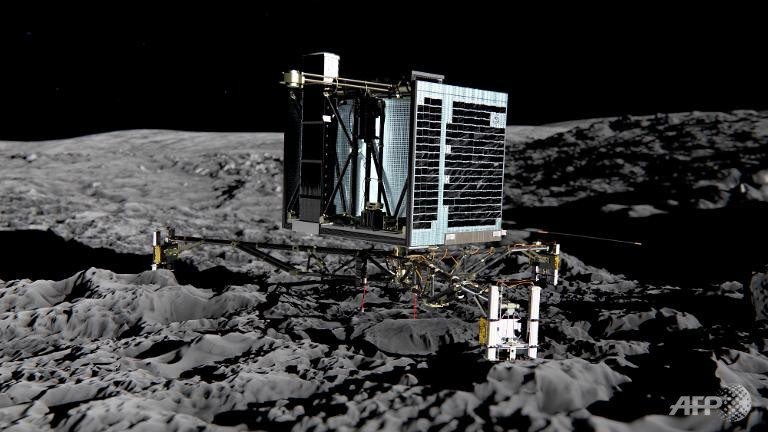
An artist's impression of Rosetta's lander Philae on the surface of comet 67P/Churyumov-Gerasimenko. (AFP)
PARIS: Europe's mission to land the first-ever probe on a comet was on track Wednesday (Nov 12) with one final "go" pending for the robot lab to eject from its mothership and start a nail-biting seven-hour descent.
Ground controllers in Darmstadt, Germany, gave the Rosetta spacecraft and her precious cargo, lander Philae, the all-clear in the first three of four crucial systems checks before landing manoeuvres will be initiated. The high-stakes mission should receive its conclusive "go/-no-go" signal about an hour before Philae is scheduled to depart at 4.35pm Singapore time on the final, solo leg of an epic, 6.5-billion km space journey.
"The Philae Control Team at the Lander Control Centre have completed a final check and verification of the lander's health. The GO was given at 10.35am Singapore time," said an entry on the European Space Agency's Rosetta blog. "Following a short manoeuvre set for 3.30pm (Singapore time), the final GO for separation will be made around 3.35pm (Singapore time)," it added.
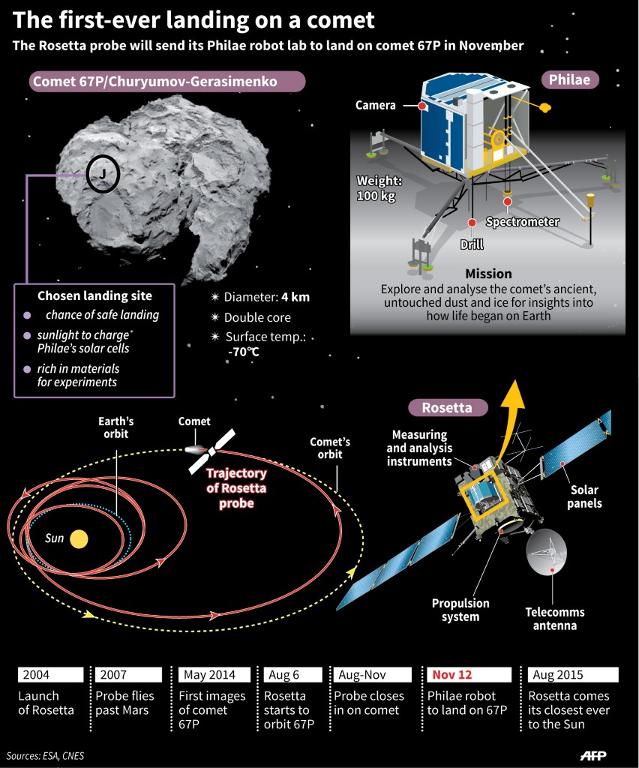
The mission's landing phase passed its first systems check late Tuesday to confirm Rosetta was on the correct trajectory. The second check at 8am Singapore time confirmed the telecommand instructions for Philae's separation from Rosetta, and its subsequent landing, had been correctly uploaded.
The third "go/no-go" signal, an hour later than initially scheduled, confirmed Philae was in good health and ready for its 20km descent to the 900 x 600m landing site.
Philae is a 100kg lander carrying 10 scientific instruments for the first-ever on-site analysis of a comet, which astrophysicists hope will reveal secrets about the origins of the Solar System and maybe even life on Earth.
One of the most complex and ambitious unmanned programmes in space history, the €1.3 billion (US$1.6-billion) mission was approved in 1993. Hoisted into space more than ten years later, Rosetta took another decade to reach its target, comet 67P/Churyumov-Gerasimenko, in August this year.
'EVERYONE IN TENTERHOOKS'
From its orbit, Rosetta has made some astonishing observations including that the comet's profile somewhat resembles that of a rubber bath duck, with a treacherous, irregular surface - a difficult target to land on. The big test will be for Philae to settle down safely as Rosetta and 67P zip towards the Sun at a breakneck 18 kilometres per second, at a distance of 510 million km from Earth.
"Everyone's nervous, everyone's on tenterhooks, but we know the risk is worth taking. The rewards are enormous," ESA senior science advisor Mark McCaughrean said Tuesday of the historic attempt. "You won't get anything without taking risks. Exploration is all about going to the limits."
Philae has no thrusters, which means Rosetta can only eject it when the velocity and trajectory are exactly right. Any error in its course will widen during descent - the probe could miss its landing site and smash into rocks or cliffs nearby.
Touchdown is expected about seven hours after Philae separates from Rosetta, with a confirmation signal expected on Earth at about 12am (Singapore time). Philae is meant to settle down at a gentle 3.5 kmh, firing two harpoons into a surface that engineers fervently hope will provide enough grip. Ice screws at the end of its three gangly legs will then be driven into the low-gravity comet to stop the probe bouncing back into space.
Comets are believed to be balls of primordial ice and carbon dust left over from the building of the Solar System. Some scientists theorise they may have "seeded" Earth with life-giving carbon molecules and water.
What the stars mean:
★ Poor ★ ★ Promising ★★★ Good ★★★★ Very good ★★★★★ Exceptional
Latest News





More News
- Asia-Pacific ministers meet FAO to boost food security (April 24, 2026 | 10:07)
- Vietnam must build resilience, says UNDP (April 15, 2026 | 08:15)
- Asian public finance leaders gather in Seoul to advance AI-driven governance (April 01, 2026 | 18:10)
- ADB unveils support package for members hit by Middle East crisis (March 25, 2026 | 11:10)
- ASEAN countries exposed by Middle East oil dependence (March 23, 2026 | 17:18)
- Vietnam ranks among top 50 happiest countries in 2026 (March 20, 2026 | 09:00)
- International media spotlight Vietnam’s National Assembly election (March 16, 2026 | 09:41)
- Citi report finds global trade transformed by tariffs and AI (February 25, 2026 | 10:49)
- ASEAN unveils digital outlook, AI readiness research (February 11, 2026 | 11:52)
- Vietnam and Laos step up urban and infrastructure cooperation (February 04, 2026 | 16:04)








 Mobile Version