
Building Vietnam’s next chapter of FDI growth

At the seminar, “Reaching out to innovative global supply chain” hosted by VIR on October 8 in Hanoi, Kamijo Hiroki, deputy CEO of VPBank explained that Vietnam's next chapter of growth would be built not on cost advantage alone, but on the strength of its ecosystem, where capital, capability, talent, sustainability, and partnerships reinforce one another.
“Vietnam has become one of Asia’s most compelling investment destinations, supported by economic resilience, its strategic location, international integration, and the continued expansion of multinational companies across key industries,” said Hiroki. “However, the investment conversation is changing, as Vietnam is no longer assessed only as a competitive production base. It is increasingly evaluated as a long-term platform for resilient supply chains, capital, talent, innovation, and sustainable growth.”
He said this shift means Vietnam’s next chapter of FDI growth needs to move beyond its traditional cost advantage and focus increasingly on the strength of its wider business ecosystem.
“Investors expectations now are pointing to five mutually reinforcing capabilities: supply chain and infrastructure, technology and digital capacity, talent and innovation, sustainability and green growth, and integration through global partnerships,” he added.
The shift, he said, is from a cost-led model to a connected ecosystem model. Success will depend not only on attracting investment, but also on helping investors operate efficiently, expand confidently, and build deeper linkages with Vietnamese enterprises.
Hiroki stated that the VPBank- Sumitomo Mitsui Banking Corporation (SMBC) partnership was positioned to translate this ecosystem ambition into practical business outcomes by combining complementary local and global capabilities.
In supply chains, VPBank brings a strong digital platform, deep relationships with Vietnamese enterprises and a broad SME ecosystem, while SMBC contributes global multinational clients, international business relationships and demand from companies expanding into Vietnam.
“Together, we connect local suppliers with global value chains and create new supply-chain opportunities. VPBank brings the local relationships and execution capabilities needed to work with Vietnamese enterprises, while SMBC brings its global network and relationships with multinational companies. By combining these strengths, we can create new opportunities for Vietnamese suppliers to participate more deeply in global value chains,” Hiroki said.
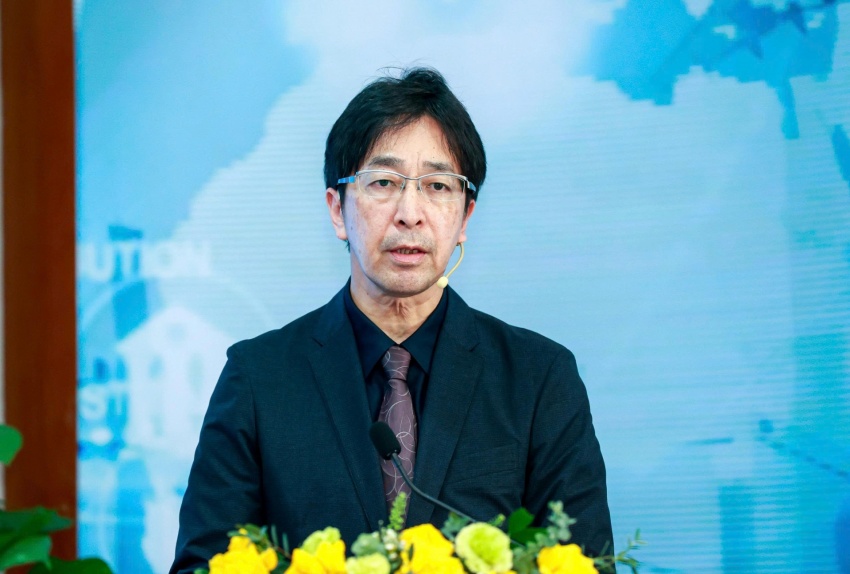 |
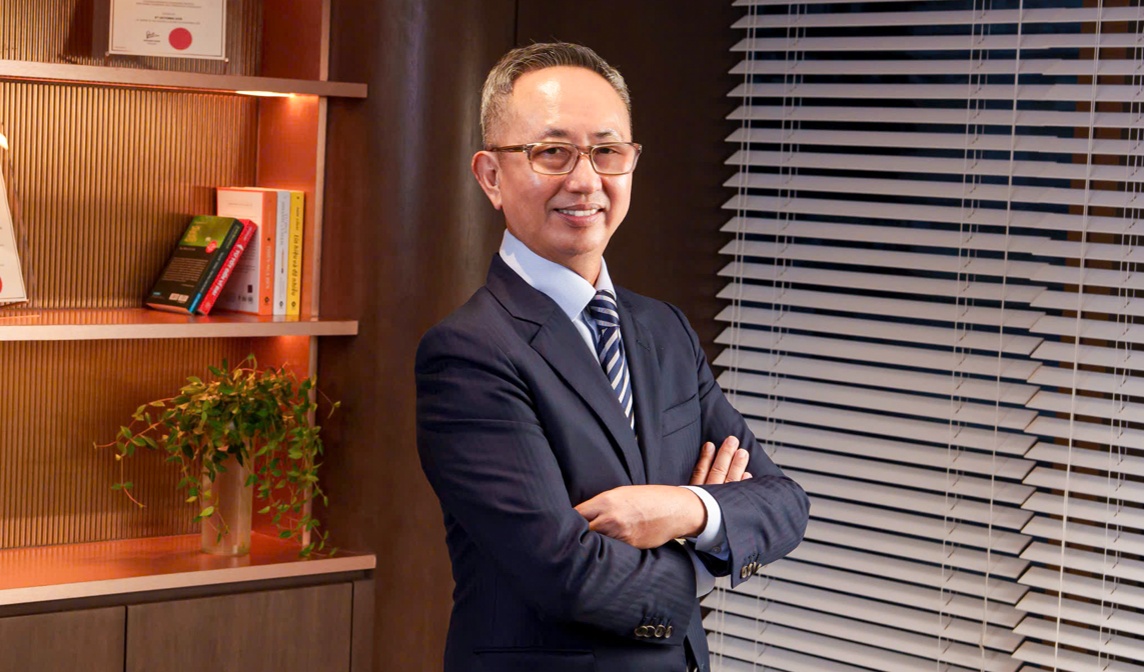
| Kamijo Hiroki, deputy CEO and head of FDI-TB at VPBank. Photo: Duc Thanh |
Funding is another area where the two institutions seek to combine their respective strengths. VPBank contributes local origination and execution capabilities, while SMBC provides access to global funding networks, development finance institutions and international capital markets.
“VPBank contributes local origination and execution capability, while SMBC provides access to global funding networks, DFIs, and international capital markets. Together, we mobilise both domestic and cross-border capital to support FDI, infrastructure, and business growth. This is an important part of how the partnership can translate international connectivity into practical financing opportunities in Vietnam,” he said.
Regarding talent development, Hiroki said that VPBank contributed talented local professionals and deep market understanding, while SMBC contributed global expertise, international best practices, and worldwide experience.
“Together, we develop future-ready leaders who can support increasingly sophisticated client needs,” he said.
Five priorities
Looking ahead, Hiroki identified five priorities for strengthening the ecosystem that supports Vietnam’s next phase of FDI growth. The first is supply chain localisation.
“Multinational companies want to increase local sourcing, while potential suppliers may need support in capacity, technology, quality systems, ESG, financial strength, and governance. Supplier development and anchor-led supply chain finance can help qualified Vietnamese companies participate more confidently in global value chains,” said Hiroki. “The second priority is cross-border treasury. Multinational companies need effective management of foreign exchange, liquidity, documentation, cash visibility, and cross-border transactions. Digital treasury, automated reconciliation, API connectivity, and stronger cash-management solutions can improve control and efficiency.”
The third priority is talent development, according to Hiroki. He explained that as investment moves into semiconductors, AI, automation, and advanced manufacturing, university–business collaboration, vocational development, and knowledge transfer must connect education more closely with industry needs.
“The fourth is the green transition and environmental, social, and governance (ESG). International carbon commitments and sustainability requirements create demand for renewable energy, energy efficiency, and green manufacturing technology. Green loans, sustainability-linked structures, transition finance, and international funding can support credible pathways,” Hiroki said.
“Finally, M&A. Investors increasingly consider acquisitions, strategic partnerships, project development, and capital-market opportunities. These require an integrated combination of funding, structuring, due diligence, regulatory coordination, and advisory support. Across all five priorities, the objective is to turn current friction points into bankable collaboration opportunities and measurable value,” he said.
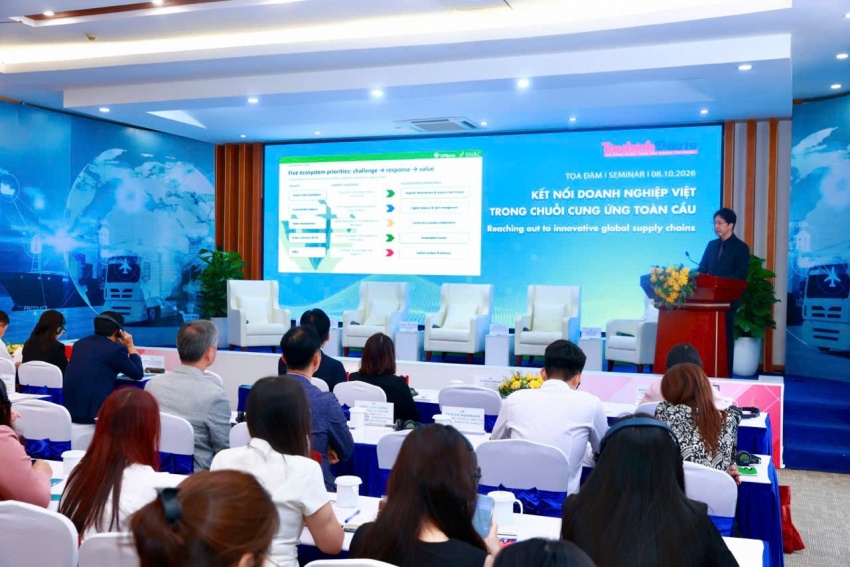 |
| VPBank's presentation at “Reaching out to innovative global supply chain” seminar. Photo: Duc Thanh |
A pathway for collaboration
Hiroki stressed that no single institution could deliver these priorities alone. Sustainable growth requires cooperation among government, Vietnamese enterprises, foreign investors, industry associations, universities and financial institutions.
“The value of the ecosystem does not come simply from placing these stakeholders around the same table. It comes from organising how they work together,” he said.
He outlined four practical steps for such collaboration: align, connect, mobilise and scale.
“First, government, business, academia, associations, and financial institutions should agree on shared priorities, from supplier localisation and future-ready talent to green investment and cross-border efficiency,” Hiroki said. “Second, connect. Industry associations and financial institutions can help match foreign-investor demand with capable Vietnamese suppliers, relevant universities, technology partners, and appropriate advisory support.”
He pointed out that once opportunities were identified, the ecosystem must bring together capital, technology, knowledge, risk solutions, and implementation capability.
“Finally, successful models should be measured, repeated, and expanded across sectors and value chains. In this way, individual collaborations become broader economic capability and sustainable impact,” he said.
Hiroki noted that VPBank and SMBC were seeking to support this pathway through four core capabilities: trade and supply chain solutions, treasury and digital solutions, green finance and ESG solutions, and M&A and advisory capabilities.
“Across these areas, our ambition is to be a trusted, client-centric, and innovative partner focused on sustainable growth. We seek to be more than a financing provider. We want to help clients connect, invest, operate, and expand with confidence,” he said.
Ultimately, he said, Vietnam’s next chapter of growth will depend not on cost advantage alone, but on the strength of its ecosystem. “By combining VPBank's local execution with SMBC's global capability, we are helping connect opportunities to solutions, investment to impact, and partnerships to growth,” Hiroki added.
 | Vietnam shifting focus to building high-quality FDI ecosystem Vietnam is shifting its approach from simply attracting foreign direct investment to developing a foreign-invested economic sector and building a high-quality ecosystem for foreign investment, according to Pham Van Hoanh, VIR's editor-in-chief. |
What the stars mean:
★ Poor ★ ★ Promising ★★★ Good ★★★★ Very good ★★★★★ Exceptional
 Tag:
Tag:
Related Contents


More News
- Policy loans open new paths for people rebuilding their lives (October 07, 2026 | 17:24)
- FTSE upgrade opens door to $2 billion in passive fund inflows (October 07, 2026 | 12:12)
- VIB raises $1 billion from international markets in record funding plan (October 07, 2026 | 10:28)
- From loans to women’s economic empowerment (October 06, 2026 | 17:58)
- VIB named Outstanding Retail Bank 2026, targets transaction banking (October 06, 2026 | 10:52)
- FTSE upgrade paves way for stronger stock market development (October 05, 2026 | 18:44)
- coLoan to empower women through inclusive green finance (October 05, 2026 | 18:42)
- Techcombank CEO: AI no longer a tool but a new operating foundation (October 05, 2026 | 18:11)
- Banks sustain profit growth as funding costs squeeze margins (October 02, 2026 | 22:22)
- Nam A Bank delivers strong breakthrough in 2026 (October 02, 2026 | 19:00)


Latest News






 Mobile Version