
Vietnamese to spend $29 billion on F&B in 2026

 |
The “Vietnam Food & Beverage Market Report 2025” is based on research involving over 3,000 restaurants/cafés and 3,000 diners nationwide.
In 2026, Vietnam's F&B market is forecast to maintain a stable growth rate of 4.6 per cent, shifting from rapid growth to substantive development. Rather than opening new outlets following trends, F&B companies will pursue well-structured operating models with effective cost control and clear business thinking.
In 2025, Vietnam’s F&B market experienced a slower and more stable development. By the end of 2025, the total number of F&B outlets in Vietnam was estimated at 329,500, representing a 2 per cent increase on-year.
Total F&B industry revenue in 2025 reached approximately $27.94 billion, up 5.5 per cent compared to 2024. Despite rapid development in the past, the growth rate is more limited recently, but consumer spending is not declining.
The survey shows that 65.58 per cent of companies reported stable or growing revenue compared to 2024. However, 69.38 per cent faced mounting pressure from rising raw material costs.
Meanwhile, 57.11 per cent expressed concerns over electronic invoicing, standardised tax declarations, and compliance with labour obligations. These are increasingly viewed as necessary “maturity” costs, helping to filter out unsustainable models and steer the market towards a more professional and equitable business environment.
Consumers are becoming more selective and pragmatic in their spending. They are willing to spend on worthwhile experiences rather than tightening their belts. In the beverage sector, 57.58 per cent of consumers now prefer drinks priced above $1.35, indicating the growing demand for experiences and space.
A series of food safety scandals in 2025 has led to lower consumer trust. Notably, the Halong Canfoco incident drew attention to Vietnam's F&B market last year. 54.45 per cent of consumers said the incident affected their purchasing decisions. This was followed by the Streptococcus suis infection (41.77 per cent) and bread-related food poisoning.
In the wake of these crises, Vietnamese consumers have developed a new mindset. They no longer trust flashy advertising, relying instead on what they can directly observe at the point of sale.
To rebuild trust, factors such as clean and well-maintained premises, transparent display of food safety certifications, and overall hygiene standards have become decisive benchmarks. This shift is turning operational transparency into a core competitive advantage, enabling F&B companies to recover and thrive after a crisis of confidence.
 | Vietnam’s F&B market entering more mature phase Our review of industry data indicates that by 2024, Vietnam had around 323,000 active food and beverage (F&B) establishments generating nearly $28.1 billion in revenues, up 16.6 per cent from 2023. |
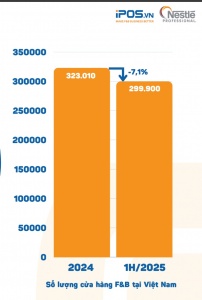 | Over 50,000 F&B outlets close in first half of 2025 Vietnam's food and beverage (F&B) sector saw over 50,000 outlets close in the first half of 2025, signalling ongoing volatility in the market. |
 | F&B brands face long-term struggle A raft of food and beverage brands are shutting their doors amid a challenging economic environment. |
What the stars mean:
★ Poor ★ ★ Promising ★★★ Good ★★★★ Very good ★★★★★ Exceptional
 Tag:
Tag:Related Contents





Latest News





More News
- Sojitz in Vietnam: 40 years from individual projects to a business cluster 'KATAMARI' (October 08, 2026 | 09:00)
- Coteccons targets 'Quality Growth' with 25 per cent dividend plan (October 07, 2026 | 13:00)
- Vietnam Education Forum opens UK Education Mission's Hanoi visit (October 07, 2026 | 12:27)
- Tax authorities deactivate TINs of nearly 180,000 businesses (October 07, 2026 | 12:08)
- World Bank raises Vietnam's 2026 GDP growth forecast to 7.4 per cent (October 07, 2026 | 11:41)
- Vietstock 2026 to spotlight livestock innovation and green transition (October 07, 2026 | 09:00)
- Vietnam’s GDP grows over 9 per cent in first nine months (October 05, 2026 | 18:45)
- Vietnam earns $56.3 billion from agro-forestry-fishery exports (October 05, 2026 | 18:32)
- DSV balances resilience and decarbonisation in supply chains (October 05, 2026 | 18:20)
- Electronics exports reach $175.4 billion in the first nine months (October 05, 2026 | 18:12)



Latest News





 Mobile Version