
Solar power could save Vietnam $600 million in fossil fuel imports

 |
One consequence of the current conflict in the Middle East is soaring energy prices in Asia. Asian liquefied natural gas (LNG) prices hit $6 per million British thermal units as of March 11, up 49 per cent from before the war broke out.
Prices of Asian Newcastle coal, Asia’s benchmark, rose to $150 per tonne on March 9, the highest since November 2024. Prices have been affected by major supply cuts as a result of the war. Asian countries account for most of the oil and gas flows from the Strait of Hormuz, which is now effectively closed.
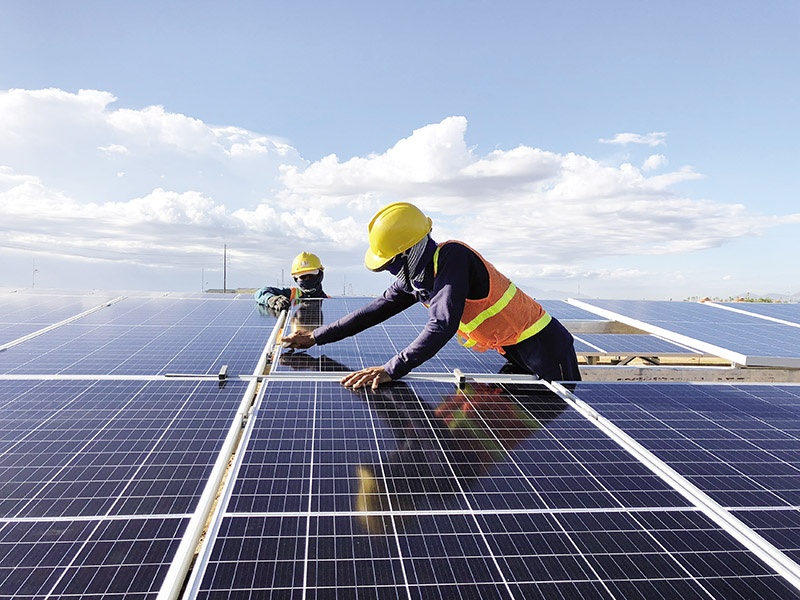
With gas and coal prices now rising sharply, Zero Carbon Analytics estimated how much Vietnam could avoid spending on imports through its use of domestically generated solar power. To do this, analysts calculated how much it would cost Vietnam to replace its 25.9 Terawatt-hour of solar generation with coal and gas imported at prices during the first week of March, the initial week of the attacks on Iran.
Vietnam’s solar generation could help the country avoid $594 million in coal and gas imports, assuming current benchmark prices remain at similar levels for a year. These savings comprise $49.3 million from gas import costs and $545.4 million from coal imports.
Analysts assumed that coal and gas could replace solar proportionally to their respective shares of total generation, as they make up more than 99 per cent of fossil fuels in the mix. The ratio of coal imports to domestic supplies would remain the same at about 50 per cent imports.
For gas, Vietnam’s LNG-based power generation share is assumed using reported operational capacity of 1.6 GW of LNG-to-power plants relative to the country’s approximately 8.9 GW total gas-fired power capacity, implying that approximately 15 per cent of gas power capacity currently relies on imported LNG. This ratio is therefore applied as the assumed share of power generation derived from imported LNG.
Prioritising clean energy in its power mix could help Vietnam avoid the impacts of soaring global energy prices from the current war. These avoided costs could help fund the annual healthcare needs of about 2.2 million citizens.
Vietnam has the highest solar and wind generation compared to the ASEAN-5 (Indonesia, Malaysia, Thailand, Singapore and the Philippines), according to data from energy think tank Ember.
In 2024, Vietnam’s solar and wind generation totalled 38.7 Terawatt-hours, representing about 13 per cent of its power generation. Comparatively, the share of solar and wind in each of the ASEAN-5 countries remained under 5 per cent.
Vietnam saw solar capacity rise dramatically from 2017 to 2020. This growth was largely due to supportive policies. In 2017, the government implemented a feed-in tariff that paid solar generators for the energy they sell to the grid. This provided incentives for rooftop solar systems that generate extra power beyond the building’s needs.
 | Solar power tasks must be confronted As Vietnam ramps up its energy transition goals, rooftop solar has evolved from concept to commitment, with new legal foundations enabling investment-ready decisions across the industrial sector. |
 | Criteria is clear to ensure value in Vietnam’s rooftop solar power With rooftop solar emerging as a critical tool for Vietnamese manufacturers to meet global green supply chain demands, Pham Dang An, deputy general director of Vu Phong Energy Group, told VIR’s Nguyen Thu that the race is now on to resolve financing, policy, and storage barriers. |
 | SmartSolar brings total funding to $3.15 million with European financing On March 17, Vietnam-based rooftop solar startup SmartSolar closes a debt financing round, bringing total funding to $3.15 million in combined equity and debt as it scales financing for small and medium-sized businesses struggling with rising electricity costs. |
What the stars mean:
★ Poor ★ ★ Promising ★★★ Good ★★★★ Very good ★★★★★ Exceptional
 Tag:
Tag:Related Contents





Latest News


More News
- GreenYellow and Vina Paper partner on rooftop solar project (October 05, 2026 | 09:00)
- Consultation workshop refines Vietnam's clean hydrogen strategy (October 04, 2026 | 08:00)
- JBIC considers new financing options for Vietnam’s energy projects (October 03, 2026 | 08:00)
- Vestas to supply 16 turbines for two new Vietnam wind farms (October 01, 2026 | 07:00)
- Inter-sectoral cooperation on Montreal protocol (September 30, 2026 | 17:20)
- EV battery recycling rate proposed at 8 per cent from 2029 (September 29, 2026 | 16:00)
- Bankability remains hurdle for Vietnam's JETP projects (September 29, 2026 | 12:08)
- Binh Minh Plastics extends clean water project to border communities (September 29, 2026 | 10:57)
- Coca-Cola Vietnam expands packaging collection programme (September 25, 2026 | 08:15)
- Pacifico Energy secures sea survey licence for offshore wind project in Lam Dong (September 24, 2026 | 18:02)



Latest News





 Mobile Version