

Securities firms step up tech race to capture market share

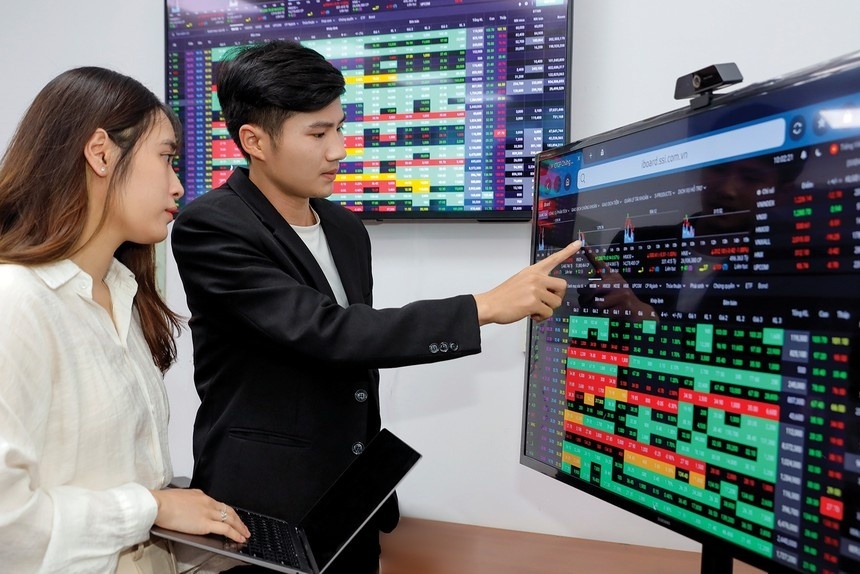
Securities companies are accelerating investment to build distinct competitive advantages through technology, with AI systems capable of handling millions of interactions, integrated trading platforms, and high-speed data infrastructure.
 |
Roughly 1.2 million queries were processed over the past year by ENSA – an AI assistant at DNSE Securities Corporation – equivalent to an average of nearly 3,300 queries per day.
The figure was shared by Nguyen Hoang Giang, chairman of the Board of Directors at DNSE, at the company’s 2026 AGM on March 26.
Beyond its role as an information support tool, DNSE’s AI technology allows investors to place large orders, with the AI automatically optimising execution prices.
The company’s leadership said that DNSE has internally developed AI agents based on large language models, combined with its proprietary standardised data to ensure accuracy in advisory functions.
Alongside projections of a boom in AI virtual assistants, the trend towards integrated investment platforms is also gaining traction across securities firms.
Recently, state lender BIDV integrated account opening and securities trading features directly into its banking application.
The solution was jointly deployed by BIDV and its subsidiary, BIDV Securities, enabling a seamless financial experience – from spending to investing – within a single application.
Meanwhile, the eWealth asset management platform, launched in 2025 by Thien Viet Securities and Thien Viet Asset Management, also integrates AI, data science, and investment advisory capabilities.
Designed as an ‘all-in-one’ model, the platform allows investors to track assets, analyse markets, subscribe to discretionary investment solutions, and receive advice from both in-house experts and virtual assistants, supported by stock scoring systems and real-time data analytics.
At DNSE, in addition to AI applications, the company is expanding its Open API ecosystem under a B2B2C model through partnerships with banks, financial platforms, and e-wallets to distribute products and services directly to end users.
This enables customers to access securities services seamlessly across popular digital platforms.
The shift is becoming increasingly evident in how securities firms invest and compete for market share.
Where competitive advantages once stemmed primarily from transaction fees, capital scale, or brokerage networks, technology is now emerging as a defining differentiator.
The Saigon-Hanoi Securities (SHS) is also orienting its next phase of development towards technology adoption, aiming to deliver a comprehensive ecosystem of financial products and services to both individual and institutional clients.
According to materials sent to shareholders ahead of its AGM scheduled for April 17, SHS leadership said the company plans to restructure its growth model for 2026-2030, gradually shifting from cyclical growth drivers towards a more stable profit foundation with improved forecasting and risk management capabilities.
This direction will be implemented across key strategic pillars, including enhancing a customer-centric mindset, strengthening organisational and human capital capabilities, accelerating technology investment, improving governance systems, and advancing sustainable development.
The transition towards technology investment is no longer a standalone strategic choice for individual firms but is becoming a systemic requirement as the stock market enters a new phase of development.
Since the KRX system came into operation in May 2025, Vietnam’s stock market has recorded notable improvements in liquidity and trading scale.
The new infrastructure enables more efficient order processing and paves the way for products such as intraday trading and new derivatives instruments in the future.
As liquidity rises alongside product expansion, pressure on securities firms’ systems is also intensifying.
Technology is no longer merely a supporting tool, but a prerequisite for maintaining stable operations and capturing growth opportunities.
Vietnam’s stock market is moving closer to secondary emerging market status, which also brings higher standards for infrastructure and operations.
As international capital flows increase, requirements for system speed, stability, and transparency will converge with global benchmarks, compelling securities firms to invest early or risk falling behind.
 | Securities firms race to raise capital ahead of market upgrade Securities firms are ramping up capital increases at an unprecedented pace, preparing for a potential market upgrade that could unlock massive foreign investment and reshape the financial landscape. |
 | Brokerage competition tightens as market shares narrow Competition among securities firms intensified last year, with market share gaps narrowing across the brokerage sector. |
 | 2025 profits mixed amid strong energy and farming results Corporate earnings in 2025 showed a sharp divergence, with energy and agriculture companies posting strong profit growth, while several firms in other sectors fell short of annual targets. |
What the stars mean:
★ Poor ★ ★ Promising ★★★ Good ★★★★ Very good ★★★★★ Exceptional
 Tag:
Tag:





Latest News




More News
- From loans to women’s economic empowerment (October 06, 2026 | 17:58)
- VIB named Outstanding Retail Bank 2026, targets transaction banking (October 06, 2026 | 10:52)
- FTSE upgrade paves way for stronger stock market development (October 05, 2026 | 18:44)
- coLoan to empower women through inclusive green finance (October 05, 2026 | 18:42)
- Techcombank CEO: AI no longer a tool but a new operating foundation (October 05, 2026 | 18:11)
- Banks sustain profit growth as funding costs squeeze margins (October 02, 2026 | 22:22)
- Nam A Bank delivers strong breakthrough in 2026 (October 02, 2026 | 19:00)
- Policy credit builds sustainable livelihoods from the grassroots (September 29, 2026 | 07:48)
- VIB deploys Front Arena treasury and foreign exchange trading system on AWS (September 28, 2026 | 16:46)
- Nam A Bank receives $60 million loan from FMO (September 28, 2026 | 12:37)


Latest News







 Mobile Version