
Calm exchange rate, persistent pressures

According to MB Securities, the USD/VND interbank exchange rate stood at VND26,313 per USD at the end of May, up just 0.16 per cent from the beginning of the year. The central exchange rate remained largely unchanged, while the free-market rate even declined by around 1.9 per cent over the same period.
Throughout May, the interbank rate traded within a narrow range of VND26,309-26,368 per USD, a remarkably tight band compared with previous periods of market stress.
Tran Thi Khanh Hien, head Of Research Department at MBS, noted that Vietnam’s external position has become less favourable, with the country recording a trade deficit of nearly $14 billion during the first five months of the year.
“This is a significant figure for an economy that has become accustomed to trade surpluses in recent years. At the same time, global oil prices have continued to fluctuate within the $90-100 per barrel range amid prolonged tensions in the Middle East, meaning inflationary pressures have not fully disappeared. In the US, both core personal consumption expenditures and consumer price index have reaccelerated in recent months, reinforcing market expectations that the higher-for-longer interest-rate environment will persist,” she added.
According to Hien, the combination of a widening trade deficit, elevated oil prices, and persistently high global interest rates would normally exert substantial pressure on the exchange rate. Yet that has not happened, and the explanation lies within Vietnam’s domestic money market.
“Market data show that the average 12-month deposit rate across the banking system currently stands at approximately 8.35 per cent per annum, up 257 basis points from the beginning of the year," she said.
Notably, despite repeated calls by the State Bank of Vietnam (SBV) for lower lending rates, deposit rates have remained elevated. Interbank rates have also stayed high. For most of May, overnight interbank rates fluctuated between 5-6 per cent before rising to around 7 per cent towards month-end. In early June, overnight rates even exceeded 10 per cent at certain points.”
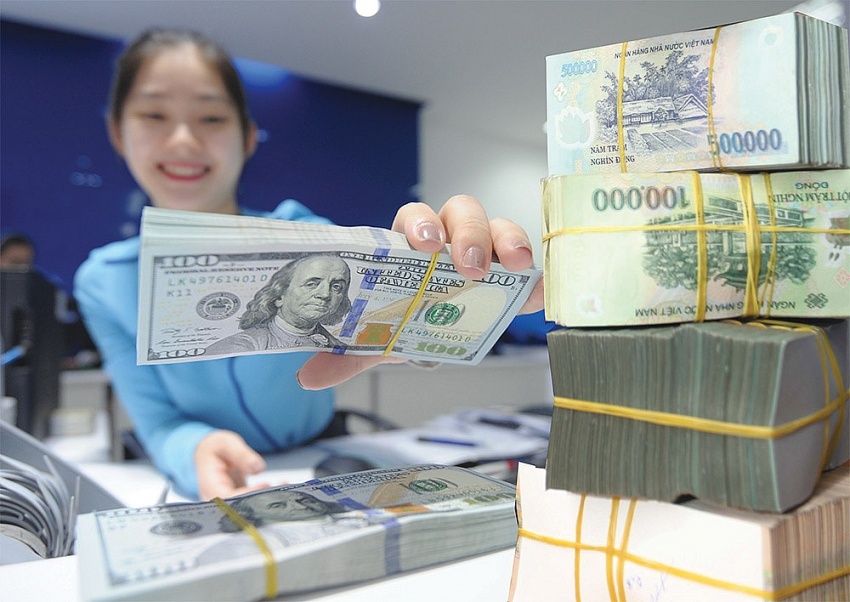 |
Saigon-Hanoi Securities (SHS) similarly observed that the spot exchange rate remained within the VND26,310-26,360 per USD range throughout May, avoiding the sharp spikes seen during the first quarter and generating little pressure on key psychological thresholds. This stability is particularly notable given the persistence of several adverse factors.
According to SHS, the SBV conducted continuous net liquidity withdrawals through open market operations during the first three weeks of May, reducing outstanding liquidity from approximately $12.3-12.7 billion to below $11.2 billion before re-injecting funds in the final week of the month.
“In the last week of May alone, the SBV injected more than $1.18 billion on a net basis to ease liquidity pressures. More notably, unusual market developments on June 1 caused overnight interbank rates to surge above 10 per cent. This occurred despite the fact that State Treasury deposits at the four state-owned commercial banks remained exceptionally large,” SHS said in a report.
As of May 22, SHS estimated that State Treasury deposits held at state-owned banks totalled approximately $28.9 billion. Meanwhile, public investment disbursement had reached only around 18 per cent of the annual plan.
“This suggests that the current liquidity story is not simply one of excess or insufficient liquidity. A substantial amount of capital remains parked within the banking system in the form of treasury deposits, while the transmission of funds into the real economy has been slower than expected,” the report said.
“As a result, policymakers are not only tasked with injecting liquidity but also with maintaining a delicate balance between exchange-rate stability, inflation control, and economic growth. From this perspective, exchange-rate stability is no longer a natural outcome but the result of continuous policy calibration across multiple objectives,” added SHS.
If exchange-rate discussions over the past two years were largely centred on when the US Federal Reserve would begin cutting interest rates, the current landscape has become considerably more complex.
According to Hien, markets have largely abandoned expectations of Fed rate cuts this year.
“FedWatch data indicate a growing probability that the Fed will maintain current rates for an extended period, while some market participants have even begun considering the possibility of further rate hikes in 2027 should inflation remain persistent,” she said.
“This represents a significant shift from the prevailing expectations just a few quarters ago, when many investors believed that a global monetary easing cycle was imminent. More importantly, however, the pressure no longer originates solely from the US.”
Analysts at Viet Dragon Securities (VDSC) noted that policy shifts are occurring simultaneously across major global financial centres.
“In Japan, monetary policy normalisation continues. After years of ultra-low interest rates, the Bank of Japan is gradually unwinding extraordinary support measures. Japanese government bond yields have risen significantly from previous levels, reflecting expectations of a new interest-rate environment. In Europe, inflation concerns are likewise forcing the European Central Bank to adopt a more cautious stance towards rate cuts,” they said.
According to VDSC, the broader global narrative is shifting from expectations of cheap money returning towards a higher-for-longer interest-rate scenario, a development with important implications for Vietnam.
“During 2023-2024, exchange-rate pressures were driven primarily by USD strength. Today, however, pressure may increasingly stem from the global interest-rate environment itself. When yields in the US, Japan, and Europe remain elevated simultaneously, international investors have more attractive alternatives. This compels emerging markets to maintain the relative attractiveness of their local currencies if they wish to limit pressure on exchange rates and capital flows,” VDSC analysts said.
On one hand, the economy requires reasonably low interest rates to support businesses, stimulate investment, and sustain growth. On the other hand, cutting rates too aggressively could narrow the yield differential between the Vietnamese VND and the USD, thereby increasing pressure on the foreign-exchange market.
Policymakers are no longer choosing between growth and inflation control, as they were in previous periods. Instead, they must simultaneously balance growth, interest rates, and exchange-rate stability.
 | Exchange rate offering test for economic footing As VND weakens to a record low against the USD, Vietnam faces a critical test in balancing growth-supportive policies with currency stability in the last six months amid tightening external conditions. |
 | Vietnam braces for financial headwinds with limited policy leeway The balance between VND mobilisation and credit in the banking system has tightened, raising concerns over macroeconomic stability in the months ahead. Despite efforts to ease borrowing costs, persistent inflationary pressures and a weakening local currency could stall further reductions in interest rates. |
 | Fed rate cut offers Vietnam room to stabilise currency and economy The US Federal Reserve’s first rate cut of 2025 is easing borrowing costs and offering Vietnam room to stabilise its currency and economy. |
What the stars mean:
★ Poor ★ ★ Promising ★★★ Good ★★★★ Very good ★★★★★ Exceptional
 Tag:
Tag:
Related Contents


Latest News




More News
- Eximbank to strengthen corporate governance structure (October 16, 2026 | 11:32)
- Citi honours 13 banks with 2025 STP Awards (October 15, 2026 | 16:01)
- Green transition requires realistic roadmap (October 14, 2026 | 17:31)
- VIR workshop explores credit policy and carbon market development (October 14, 2026 | 11:22)
- Stronger carbon market needed to unlock climate finance (October 14, 2026 | 11:00)
- Carbon market opens new avenues for green finance (October 14, 2026 | 10:00)
- VPBank and Western Union enhance digital remittance experience (October 13, 2026 | 15:44)
- Eximbank’s next chapter: Richa Goswami on purpose, relevance and trust (October 13, 2026 | 10:52)
- Vietnam and Luxembourg sign MoU to strengthen financial cooperation (October 13, 2026 | 10:20)
- Vietnam seeks stronger cooperation with Fitch Ratings to improve sovereign credit rating (October 13, 2026 | 10:07)



Latest News







 Mobile Version