
MH370 search area shifted on "new, credible lead": AMSA


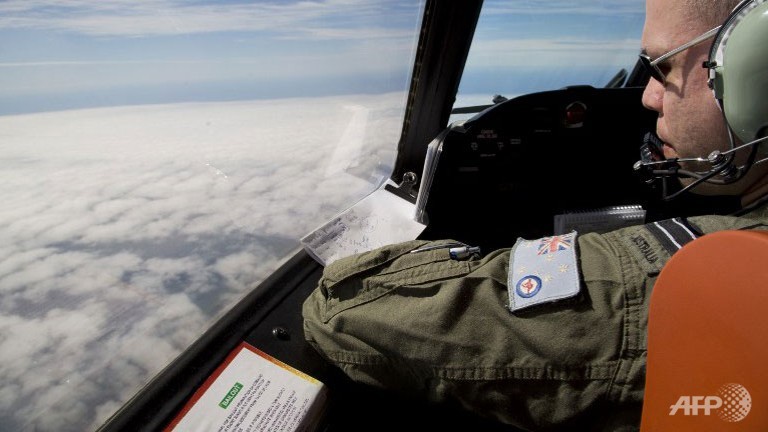
A pilot looks out of the cockpit of a Royal Australian Air Force AP-3C Orion aircraft over clouds while searching for the missing Malaysian Airlines flight MH370 over the southern Indian Ocean. The hunt resumes on Friday for wreckage from MH370 after the weather cleared. (AFP/POOL)
>> Possible debris spotted as MH370 search moves to new area
>> Malaysia tourism hit by MH370 crisis
PERTH: The search for wreckage of Flight MH370 was shifted Friday to an area 1,100 kilometres (685 miles) northeast of where planes had been looking after "a new, credible lead", Australian authorities said.
"The new information is based on continuing analysis of radar data between the South China Sea and the Strait of Malacca before radar contact was lost," the Australian Maritime Safety Authority (AMSA) said.
"It indicated that the aircraft was travelling faster than previously estimated, resulting in increased fuel usage and reducing the possible distance the aircraft travelled south into the Indian Ocean."
The updated advice was provided by the international investigation team in Malaysia with the Australian Transport Safety Bureau (ATSB) determining "that this is the most credible lead to where debris may be located".
The new search area is approximately 319,000 square kilometres and around 1,850 kilometres west of Perth.
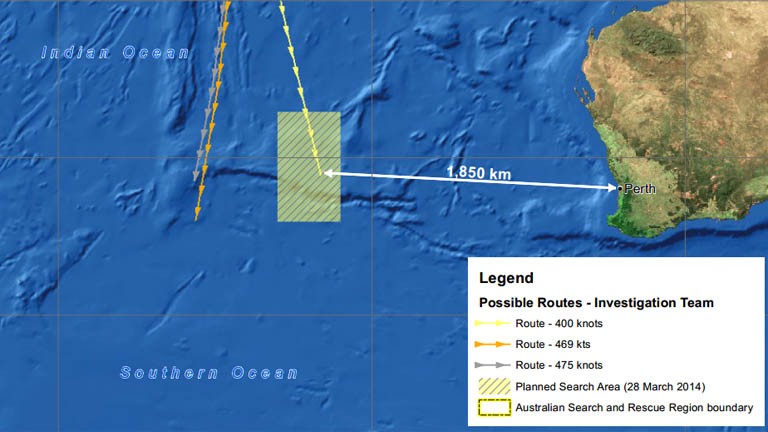
A map showing the search for Malaysia Airlines Flight MH370 on March 28. (Photo: AMSA)
At a news conference on Friday, Australia said one positive from the change in the search area is that the weather is expected to be better, as the search has shifted to a less remote area and "has moved out from the Roaring Forties".
Australian officials also said that after 21 days, "random dispersion" is expected and the search area could become larger. But data marker buoys are being used to determine the accuracy of movement of water to locate potential debris.
"ATSB advises the potential flight path may be the subject of further refinement as the international investigative team supporting the search continues their analysis," AMSA said, adding that Australia was re-positioning its satellites to the new area.
The previous MH370 search area has been abandoned, and all ships and planes are moving to the new area.
Although there have been new satellite images emerging, the Australian experts have cautioned that what's seen may not necessarily be plane wreckage.

John Young, general manager of AMSA's emergency response division, said authorities will not classify satellite imagery as debris, and no debris has been spotted yet in the new search area.
Authorities also do not know the exact speed the plane was travelling, but the assumption is that it was travelling at a constant speed heading south to the Indian Ocean, and the plane's likely flight path is still being worked out.
The new search area, however, "remains a very large one".
The new development follows Thailand reporting Thursday a satellite sighting of hundreds of floating objects.
Japan also announced a satellite analysis indicated around 10 square floating objects in a similar area.
They were the second pair of sightings in two days suggesting a possible debris field from the Boeing 777, which vanished on a flight from Kuala Lumpur to Beijing on March 8.
Ten aircraft from six countries were involved in the search Friday with a further plane on standby.
Five Chinese ships and an Australian naval vessel were steaming to the new zone of interest, AMSA added.
A US black box detector has also arrived in Perth to join the team in the search for MH370.
ATSB chief commissioner Martin Dolan stressed that under international convention, Malaysia has investigative responsibility for MH370, and at this stage, the ATSB's main task is to assist in the search for the aircraft.
What the stars mean:
★ Poor ★ ★ Promising ★★★ Good ★★★★ Very good ★★★★★ Exceptional
Latest News






More News
- Russian President congratulates Vietnamese Party leader during phone talks (January 25, 2026 | 09:58)
- Worldwide congratulations underscore confidence in Vietnam’s 14th Party Congress (January 23, 2026 | 09:02)
- Political parties, organisations, int’l friends send congratulations to 14th National Party Congress (January 22, 2026 | 09:33)
- 14th National Party Congress: Japanese media highlight Vietnam’s growth targets (January 21, 2026 | 09:46)
- 14th National Party Congress: Driving force for Vietnam to continue renewal, innovation, breakthroughs (January 21, 2026 | 09:42)
- Vietnam remains spiritual support for progressive forces: Colombian party leader (January 21, 2026 | 08:00)
- Int'l media provides large coverage of 14th National Party Congress's first working day (January 20, 2026 | 09:09)
- Vietnamese firms win top honours at ASEAN Digital Awards (January 16, 2026 | 16:45)
- ASEAN Digital Ministers' Meeting opens in Hanoi (January 15, 2026 | 15:33)
- ASEAN economies move up the global chip value chain (December 09, 2025 | 13:32)









 Mobile Version