
Ironclad spirit still shines in Vietnam


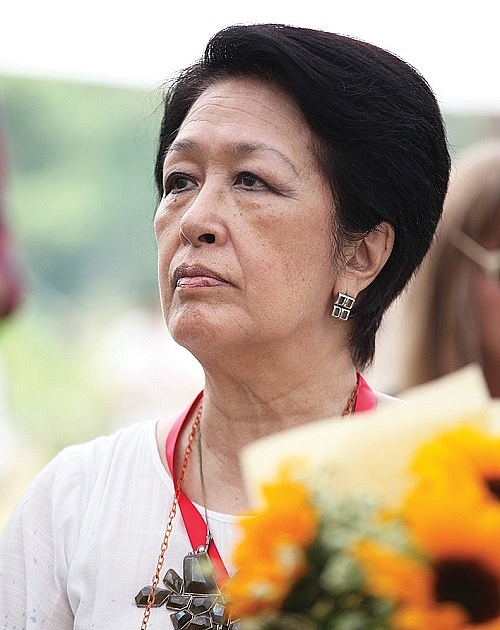 |
| Ton Nu Thi Ninh, president of the Ho Chi Minh City Peace and Development Foundation and vice president of the Vietnam Peace Committee |
Vietnam’s National Liberation Day on April 30, 1975 marked a huge milestone in the history of Vietnam. As a diplomat, how do you view the success of post-war Vietnam?
The world cannot deny Vietnam’s successful efforts in overcoming the serious fallout of the past. Still, if we compare the country’s post-war rehabilitation to that of Japan or Germany after World War II, Vietnam appears to have slower growth.
The fact that Germany and Japan could rebuild and greatly develop their countries is due to the US Marshall Plan, which aimed to strengthen the foundations of western European countries.
Conversely, Vietnam received no aid after the war’s conclusion here in 1975. Even, other wars at the southwest and northern borders of the country also ravaged the Vietnamese economy. Along with this, Vietnam suffered a 20-year trade embargo amid the collapse of the eastern European socialist block.
In light of all these obstacles, Vietnam’s success is all the more worthy of celebration. All of these are put into perspective by Jean Claude Pomonti, a journalist and Southeast Asian correspondent from French newspaper Le Monde, who once described the iron spirit of Vietnam in the aftermath of its many devastating wars.
Through the eyes of the world, Vietnamese people are considered very optimistic and tenacious in their pursuits. They are also selfless, working not for themselves but for their relatives and descendants. This is a view echoed by many non-Vietnamese people that I have met.
Vietnam has been described as a new phenomenon in global politics by the international media. Are the developing economy and stable politics of Vietnam integral to its continued growth?
I think the word ‘phenomenon’ is not entirely accurate to reflect Vietnam’s successes. We should consider our country as simply a great achievement.
In recent years, Vietnam has been chosen to host huge international events such as the Asia-Pacific Economic Cooperation (APEC) forum in 2017, the World Economic Forum last year, and the US-DPRK Summit in February. Also, Vietnam is set to assume the role of ASEAN presidency next year, as well as receive a nomination for a non-permanent member of the United Nations Security Council for the term of 2020-2021.
The strict embargo on the country lasted until 1994, nearly 20 years after the fall of the Saigon administration. When I met with a senior official of the United Nations Children’s Fund in New York in 1991, he confided in his wish to help Vietnam, but was unable to do so due to the embargo.
That year was especially challenging for our country, but this soon changed once we had adapted a multilateralism policy. It was like a ship buffeted by a storm. The more anchors the ship has, the steadier it becomes. In other words, an improvement in diplomatic relations was key to stabilising Vietnam amid the storm.
Today, I am sure that organisations and multilateral forums such as the ASEAN, the United Nations, Francophone, the World Trade Organization, and the APEC highly appreciate the efforts of Vietnam in contributing to future peace and prosperity.
Shortly after induction to the ASEAN, Vietnam successfully held the ASEAN Defence Ministers Meeting-Plus. A fruitful first term as a non-permanent member of the UN Security Council means that Vietnam is set to become the only ASEAN candidate nominated for a position in the following term.
The ASEAN bloc has been widely lauded for its role in the continued development of Southeast Asian and East Asian regions, with Vietnam emerging as one of the prominent leaders of the group.
Have you ever felt surprised by the change of diplomatic path towards diversification and multilateralisation?
My guideline of work, as it is with all diplomatic officials, is to prioritise safety. This means that we never approach a problem without taking into consideration complete and total security. The past three decades have shown us that the puzzling things have passed us by, while what remains are our successful results on the diplomatic battlefield.
You once said that it is time for Vietnam to step out and shine with the sun. Can you elaborate on the meaning of this statement?
If Vietnam can build a position of power strong enough for it to shine, after such a long time hiding inside, we certainly need to do so. But we must truly ask ourselves, do we even know how to shine?
Vietnam needs to let the world know that each of its citizens is special and unique, full of personality, style, and a perfect blend of tradition and modernity. I believe that being fully equipped with the knowledge of the nation’s vibrant history is the correct way for each Vietnamese individual to shine. However, we must also create new and vibrant images to solidify our identity going forward.
Prosperity is a burning desire of Vietnam’s generations, both past and present. In order for our country to prosper, which values should Vietnam promote?
In my opinion, there are three elements to our country’s prosperity. Firstly, it is about the people, especially the young, seeing the vitality of Vietnam and its path towards success. Secondly, we should promote creativity and a positive mindset. Finally, we need to raise the awareness of each Vietnamese citizen in not only benefitting themselves, but also finding ways of enriching the country.
After so long in the global diplomatic arena, what have been your personal highlights, and what have you learned from the experience?
I do like to tell the story of my own experience of over 30 years as a diplomat. The moments that spring to mind for me include the time I was invited by Hewlett Packard Group to participate in a forum including two former US secretaries of State, Henry Kissinger and Madeleine Albright. And also, at the Davos World Economic Forum, I gave a speech on aiding the development of Vietnam.
In the speech, I mentioned that, due to the aftermath of prolonged wars, Vietnam emerged into the final quarter of the 20th century with a “lower your head and run” policy. When you run with your head down, you can travel a great distance, but you can’t see the correct path in front of you.
After my speech, Kissinger, who played a key role in US foreign policy between 1969 and 1977, asked me about Vietnam participating in the ASEAN and other topics of Vietnamese diplomacy. He concluded our chat with the words, “don’t stand between the Vietnamese people and their sense of direction.” He made it clear to me that he had experienced the steadfast will of the Vietnamese during the negotiation of the Paris Agreement in 1973.
This, to me, shows the intelligence, determination and, ironclad spirit of the Vietnamese people. Undeniably, the main players of our story are our citizens and their resolve.
| Profile of TON NU THI NINH - President of the Ho Chi Minh City Peace and Development Foundation - Vice president of the Vietnam Peace Committee - Former Ambassador of Vietnam to the EU and Belgium (2000-2002) - Former vice chair of the Foreign Affairs Committee of the National Assembly (2002-2007) Following 10 years in Paris and Ho Chi Minh City, Ninh served as a career diplomat specialising in international peace and security, development, the environment, governance, and human rights. She also spent time at multilateral institutions such as the United Nations before being elected to Vietnam’s National Assembly. There, Ninh worked to build bridges of understanding and co-operation between Vietnam and the world, in particular highlighting the National Assembly’s integral role in Vietnam’s doi moi and democratic era. Today, she consistently pursues her lifelong commitment to Vietnam’s sustainable and inclusive development and its more efficient integration with the world. Through her frequent interaction with the public, especially youth, women, and the media, she is known as one of the public figures with a meaningful voice in Vietnam. Ninh has been awarded the French Legion d’Honneur (Commandeur), the Belgian Order of Leopold II, and the Vietnamese First Class Medal of Labour. The Royal Melbourne Institute of Technology has also conferred upon her an honorary doctorate of social science. |
What the stars mean:
★ Poor ★ ★ Promising ★★★ Good ★★★★ Very good ★★★★★ Exceptional
 Tag:
Tag:Related Contents
Latest News

More News
- Russian President congratulates Vietnamese Party leader during phone talks (January 25, 2026 | 09:58)
- Worldwide congratulations underscore confidence in Vietnam’s 14th Party Congress (January 23, 2026 | 09:02)
- Political parties, organisations, int’l friends send congratulations to 14th National Party Congress (January 22, 2026 | 09:33)
- 14th National Party Congress: Japanese media highlight Vietnam’s growth targets (January 21, 2026 | 09:46)
- 14th National Party Congress: Driving force for Vietnam to continue renewal, innovation, breakthroughs (January 21, 2026 | 09:42)
- Vietnam remains spiritual support for progressive forces: Colombian party leader (January 21, 2026 | 08:00)
- Int'l media provides large coverage of 14th National Party Congress's first working day (January 20, 2026 | 09:09)
- Vietnamese firms win top honours at ASEAN Digital Awards (January 16, 2026 | 16:45)
- ASEAN Digital Ministers' Meeting opens in Hanoi (January 15, 2026 | 15:33)
- ASEAN economies move up the global chip value chain (December 09, 2025 | 13:32)








 Mobile Version