
Government weighs higher foreign investment limit for local airlines

This is among the notable contents in Submission No.32/TTr-BXD recently submitted by the Ministry of Construction (MoC) to the government regarding the draft decree on air transport regulations.
In the latest draft decree, the drafting agency continues to propose raising the foreign ownership cap in Vietnamese airlines from 34 per cent to a maximum of 49 per cent, while also seeking opinions from government members on the proposal.
According to the MoC, under bilateral and multilateral aviation agreements to which Vietnam is a signatory, the criterion ‘substantial ownership’ for the designation or approval of designated airlines means that foreign investors may hold no more than 49 per cent of charter capital in foreign-invested aviation enterprises.
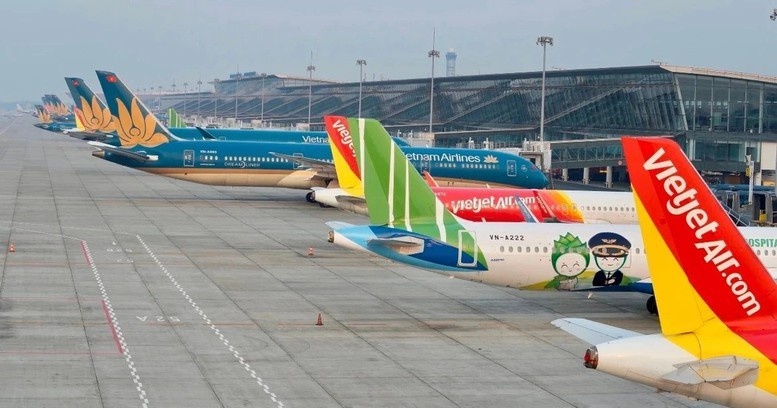 |
| With nearly 100 million population and strong growth momentum, local aviation market is increasingly attractive to foreign investors |
The drafting agency said that increasing the foreign ownership limit would enable airlines to access additional international capital sources, thereby improving financial capacity, especially as many businesses continue to face prolonged impacts from the COVID-19 pandemic.
“Adjusting the foreign ownership ratio would help airlines attract investment capital, improve financial efficiency, and gain access to modern technologies, management expertise and operational experience from foreign partners,” the MoC stated.
According to the agency’s review, many countries currently allow foreign investors to own up to 49 per cent of airline equity, including Singapore, Thailand, Indonesia, Brunei, Myanmar, Australia, Turkey, Brazil and China.
The MoC also noted that under trade agreements to which Vietnam is a party, particularly the Comprehensive and Progressive Agreement for Trans-Pacific Partnership and EVFTA, Vietnam has the right to determine and announce the foreign ownership ratio in the air transport sector in accordance with domestic laws and regulations.
At present, Decree No.89/2019/ND-CP stipulates that foreign ownership in air transport enterprises must not exceed 34 per cent of charter capital. The MoC then argues that increasing the cap to 49 per cent would be appropriate and would not violate Vietnam’s international commitments.
During the consultation process, the carriers Vietnam Airlines and Vietjet reportedly proposed maintaining the current foreign ownership ceiling of 34 per cent. The Ministry of Justice also recommended considering retention of the existing cap to ensure prudence in the aviation sector.
However, based on an overall assessment, the drafting agency argued that domestic airlines have not yet fully utilised the current 34 per cent foreign ownership ‘room’, and therefore there is insufficient basis to conclude that the current threshold is optimal.
In addition, the MoC believes that the current 34 per cent cap does not fully reflect capital mobilisation needs in the aviation industry, which is highly capital-intensive and subject to significant volatility.
According to the drafting agency, raising the cap to 49 per cent would still ensure that domestic investors retain effective controlling rights, in line with international practices, and would not alter the nature of Vietnamese enterprises operating in the aviation sector.
Notably, the MoC noted that increasing the ownership ratio to 49 per cent would not be mandatory, but would simply provide enterprises with greater flexibility and additional options when capital mobilisation needs arise in practice.
“Risks related to financial dependence, conflicts of interest, or national defence and security can fundamentally be managed through business conditions, corporate governance regulations and supervisory mechanisms of state management agencies, rather than by maintaining a low administrative ownership cap,” the drafting agency stated.
Among Vietnam’s seven airlines currently operating scheduled commercial air transport services, Vietnam Airlines is currently the only carrier with a foreign airline as a shareholder.
After investing more than VND2.4 trillion ($96 million) to acquire more than 8.7 per cent stake in Vietnam Airlines in 2016, All Nippon Airways’ ownership in the national flag carrier has now declined to around 5.62 per cent.
Meanwhile, Vietjet also has indirect foreign investor participation through investment funds and financial institutions, although foreign ownership remains capped at 34 per cent under Government Decree No.89/2019/ND-CP, issued in November 2019, which amended and supplemented provisions of Decree No.92/2016/ND-CP and Decree No.30/2013/ND-CP governing air transport business and general aviation activities.
 | Bank stocks widen the gate for foreign capital Foreign capital is pouring into Vietnamese bank stocks, fuelled by regulatory tailwinds and expanding foreign ownership limits across a sector poised for deeper global integration. |
 | Masan Consumer lifts foreign ownership limit to 100 per cent On March 18, the State Securities Commission announced that it had received Masan Consumer Corporation’s application to double its foreign ownership limit to 100 per cent. |
 | Vietnam stock market gathers pace as upgrade window opens Vietnam’s recent market correction appears tactical rather than structural, as strong growth momentum and FTSE upgrade prospects anchor a compelling medium-term outlook. |
What the stars mean:
★ Poor ★ ★ Promising ★★★ Good ★★★★ Very good ★★★★★ Exceptional
 Tag:
Tag:
Related Contents







Latest News


More News
- Vietnam’s registered FDI surpasses $50 billion in nine months (October 07, 2026 | 10:30)
- Samsung Electro-Mechanics to add $1.85 billion semiconductor investment in Thai Nguyen (October 06, 2026 | 18:23)
- Electronics funding will be won via a capable ecosystem: SGS (October 06, 2026 | 09:00)
- LNG power plant projects risk falling behind schedule (October 03, 2026 | 09:00)
- Pandora opens world’s largest fine jewellery crafting facility (October 02, 2026 | 22:21)
- An Phat 5 Industrial Park positions for new wave of investment in northern Vietnam (October 02, 2026 | 09:00)
- Hanoi to launch portal to ease hurdles for tech businesses (October 01, 2026 | 09:00)
- Foreign investors to be widened for market access (September 30, 2026 | 17:54)
- Phu Quoc Airport planning adjusted to serve APEC 2027 (September 30, 2026 | 17:35)
- Nearly 200 foreign-invested enterprises in Vietnam to pay global minimum tax (September 30, 2026 | 17:26)


Latest News




 Mobile Version