
Corporate bond market shifts towards public issuance, transparency

The Vietnamese corporate bond market demonstrated a significant evolution in internal structure during February, primarily driven by a surge in public issuance and a strengthening of credit discipline. Total new issuance for the month reached $136 million, representing a 44 per cent increase on-year, despite a seasonal slowdown attributed to the Lunar New Year holidays, according to the latest report from HSC Research – the research arm under Ho Chi Minh City Securities Corporation.
 |
Crucially, the public offering channel maintained an almost dominant position, accounting for 98 per cent of monthly volume for the second consecutive month. This migration towards public channels is inextricably linked to a suite of recent regulatory reforms aimed at standardising market practices and protecting investors.
Along with this, Decree No. 245/2025/ND-CP, which came into effect in late 2025, has been instrumental by mandating credit ratings for non-bank entities seeking to issue bonds to the public.
Furthermore, under Law No. 56/2024/QH15, issuers are now required to obtain credit ratings, and provide collateral or payment guarantees for private placements offered to professional individual investors. This requirement became effective from January.
The impact of these reforms is reflected in the rapid expansion of Vietnam's credit information infrastructure. Data aggregated from domestic rating agencies, including FiinRatings, VIS Rating, S&I Ratings, and Saigon Ratings, shows that 137 issuers had been rated by the end of 2025, a substantial increase from just 79 in the previous year.
Currently, approximately one-third of all corporate bond issuers in the market have obtained a credit rating. While the real estate sector holds the largest share of rated entities, their ratings are predominantly concentrated in the speculative-grade range of BB+ to BBB-, highlighting inherent sensitivities to funding conditions.
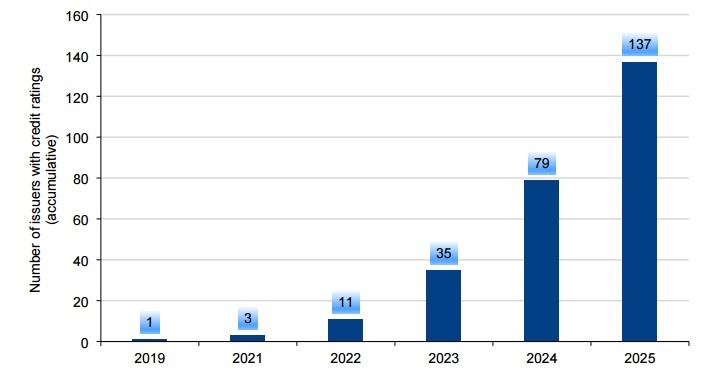 |
| Number of Vietnam corporate issuers with credit ratings surged in 2025. Source: HSC Research |
The banking sector continues to serve as the primary anchor, representing approximately 49 per cent of the total $59.48 billion in outstanding corporate bonds as of late February. Commercial banks, led by institutions such as BIDV, dominated February’s issuance with a total of $132 million raised primarily for Tier 2 capital strengthening.
In contrast, the real estate sector’s share of the outstanding market has declined to 26 per cent, down from 29 per cent a year earlier, as developers continue to prioritise deleveraging and balance sheet restructuring.
For the first two months of the year, cumulative issuance reached $348 million, with the public channel accounting for 95 per cent of this total.
This structural shift suggests a move away from opaque private placement practices towards more transparent and regulated funding channels.
Issuance tenors in February remained concentrated in the six-to-ten-year range, reflecting a strategic focus by banks on optimising long-term funding profiles. However, average issuance yields have trended higher to 9.2 per cent, tracking the upward movement in benchmark deposit rates and signalling rising funding costs.
Secondary market liquidity for private placements experienced a seasonal dip, with average daily trading values falling 23 per cent on-month to $168 million.
Despite this, trading remains concentrated in bonds issued by major real estate developers and banks.
A report by FiinGroup – a top provider of integrated financial data and information services shows that the total value of corporate bonds in circulation stood at approximately $55.6 billion by early March, a marginal decline of 0.1 per cent from the end of 2025.
Looking ahead, the market faces significant debt servicing obligations, with $4.9 billion in principal and interest payments due in the first half of the year, a 49.2 per cent increase on-year.
For the full year, maturities are projected to reach $8.23 billion, with the real estate sector accounting for 42 per cent of this volume.
Despite these pressures, market discipline appears to be improving; no new late payments were recorded in February for the second consecutive month. Problematic bonds, which currently represent 15.3 per cent of the total outstanding market, are increasingly being addressed through technical restructuring and maturity extensions rather than outright defaults.
 | Public bonds crucial for fast-tracking North-South Expressway The need to accelerate the North-South Expressway project by securing funding through public bond issuance with attractive interest rates to ensure swift completion and at acceptable cost is critical for regional economic growth. |
 | Overhaul aims to secure Vietnam’s bond market As Vietnam’s corporate bond market braces for over $5.26 billion in maturing debt in the second half of 2025, more than half of which stems from the real estate sector, policymakers are accelerating legal reforms to fortify market stability and investor confidence. |
 | Corporate bond issuances surge as firms accelerate capital restructuring Vietnam's corporate bond market saw a surge in new issuances and early redemptions in mid-October, signalling active capital restructuring by businesses amid stable interest rates and improved liquidity. |
What the stars mean:
★ Poor ★ ★ Promising ★★★ Good ★★★★ Very good ★★★★★ Exceptional
 Tag:
Tag:
Related Contents











Latest News





More News
- Policy loans open new paths for people rebuilding their lives (October 07, 2026 | 17:24)
- FTSE upgrade opens door to $2 billion in passive fund inflows (October 07, 2026 | 12:12)
- VIB raises $1 billion from international markets in record funding plan (October 07, 2026 | 10:28)
- From loans to women’s economic empowerment (October 06, 2026 | 17:58)
- VIB named Outstanding Retail Bank 2026, targets transaction banking (October 06, 2026 | 10:52)
- FTSE upgrade paves way for stronger stock market development (October 05, 2026 | 18:44)
- coLoan to empower women through inclusive green finance (October 05, 2026 | 18:42)
- Techcombank CEO: AI no longer a tool but a new operating foundation (October 05, 2026 | 18:11)
- Banks sustain profit growth as funding costs squeeze margins (October 02, 2026 | 22:22)
- Nam A Bank delivers strong breakthrough in 2026 (October 02, 2026 | 19:00)









 Mobile Version