
Contentious auto bill up for reinstatement


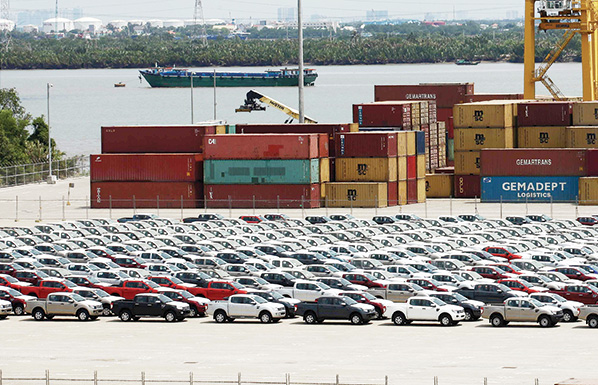 |
A draft decree compiled by the Ministry of Industry and Trade (MoIT) on car imports is seeking relevant authorities’ opinions. Accordingly, firms must show proof that they are authorised dealers for foreign automakers in order to import complete-build-up (CBU) cars with less than nine seats. The documents have also to be notarised by Vietnamese diplomatic representatives in the country of origin.
Those regulations were originally prescribed in the MoIT’s Circular 20/2011/TT-BCT, effective in 2011.
Automobile joint ventures which are authorised dealers certainly support an extension of the bill. Toyota and General Motors, for instance, quickly sent proposals to the Vietnamese government asking for the renewal of Circular 20.
Lawyers and Vietnamese importers, however, blamed the requirements for creating a ‘monopoly’ for foreign automobile firms in Vietnam.
“According to the Law on Competition, state administrative bodies are not permitted to discriminate between enterprises or force an enterprise, organisation or individual to purchase or sell goods or services with an enterprise appointed by such body [Article 6, Clause 1 and 2],” said Dau Anh Tuan, head of the Vietnam Chamber of Commerce and Industry’s (VCCI) Legal Department.
Tuan told VIR that the import condition discriminated between authorised and unauthorised dealers of automakers, indirectly forcing buyers to only purchase cars from a small number of sellers. “This violated the Law on Competition.”
Reportedly, after the ratification of Circular 20 five years ago, the total number of local importers fell dramatically from nearly 200 to fewer than 20, due to this lack of competition. Some shifted their business model to used car importation instead.
“The MoIT is also the state authority supervising market competition, so it needs to fulfil its responsibility to ensure fairness amongst enterprises,” Tuan stressed.
Another argument against the regulations is the contradiction between them and the Law on Intellectual Property.
Under the Law on Intellectual Property, even owners of an industrial property object do not have the right to prevent others from circulating, importing, or exploiting uses of a product legally put into the marketplace [Article 125].
In this case, the VCCI’s Tuan interpreted the law to mean “foreign carmakers have no right to prohibit independent importers from selling their products in the Vietnamese market”. But the MoIT’s requirements do the opposite.
Lawyer Truong Thanh Duc, chairman of Basico law firm, told VIR that the MoIT’s regulations feature a business condition for importation of cars less than nine seats, which “goes against the country’s Constitution and the Law on Enterprises 2014.”
“Under the Constitution, everyone has the right to freedom of enterprise in the sectors and trades that are not prohibited by law. This means only laws can regulate conditional businesses – decrees or circulars are not allowed to,” he noted.
At present, imports of cars with less than nine seats are not listed amongst the prohibited or restricted goods and services specified in the Law on Enterprises 2014.
In addition, legal experts pointed out that this measure stands in violation of the MoIT’s requirements against specialised regulation.
Many local importers found it impossible to achieve the required documents under Circular 20, because “foreign automakers having joint ventures or subsidiaries in Vietnam had not given such authorisation to local importers,” said Vu Hai Lam, head of the sales division of the local importer Nam Son Auto Company.
The Vietnam Automotive Manufacturer Association (VAMA), representing joint ventures and subsidiaries of foreign carmakers, defended the regulations, saying that they have protected consumers from low-quality products and services.
VAMA also argued that the requirements helped prevent false declaration of taxable price by unauthorised importers, which otherwise would cause serious impact to the state tax revenue.
Not everyone agrees with this assessment. “Dealing with tax-avoidance behaviours is the mission of specialised tax laws and tax authorities,” the VCCI’s Tuan said.
The MoIT has praised the requirements as “they reduced the huge trade deficit situation in 2011 which was led by car imports”, despite the fact that statistics suggest otherwise.
According to the General Statistics Office, the number of CBU imported to Vietnam rose from 55,000 units in 2011 to 125,000 units in 2015. Moreover, pre-tax import value also increased from $1.02 billion to $2.98 billion during the period, implying a hike in foreign currency spent.
The fierce debate confused the General Department of Customs, the state agency supervising import-export activities. It has had to ask the MoIT for guidance on car imports since July 2015.
“That’s ridiculous,” said Basico law firm’s chairman Duc. “Circular 20 became invalid on July 1, but customs authorities still have to seek guidance from the MoIT on the issue.”
| Dang Huy Dong Deputy Minister of Planning and Investment
It is the consumers’ decision to choose the products and accompanied services, and the government’s business is not governing what they can buy. Besides, cars are already examined by the Vietnam Register under the Ministry of Transport before circulation in terms of quality and safety Registration agencies have the responsibility of offering registration certificates to cars which qualify. Circular 20 does not have the function of managing cars’ quality. Also, foreign car producers have the right of selecting agencies for their products. The state should not interfere with this issue because it is the market’s decision. Economist Le Dang Doanh Former director of the Central Institute for Economic Management (CIEM)
It is unnecessary to reinstate Circular 20, as it has run its course. The elimination of the circular is necessary for business environment reform, facilitating fair competition and small and medium-sized enterprises’ development. Nguyen Tuan Director of car trader Thien An Phuc
The circular has failed in protecting consumers’ rights, and failed to improve macroeconomic stability, in accordance with the goals set for it. In fact, it has favoured a monopoly of authorised importers, putting consumers at a disadvantage because of limited choice. Yoshihisa Maruta Chairman of the Vietnam Automobile Manufacturers’ Association (VAMA)
Without the requirements stated in Circular 20, we worry about who will take care of vehicle quality and customer service, and who will take care of recall and recycling issues if unauthorised importers close their businesses. There are also other issues at stake, which will affect the government. We are afraid that without the requirements of Circular 20, unauthorised importers will under-invoice to avoid taxes or make illegal, ‘off the books’ payments – the same as happened before the original passing of Circular 20. That will cause serious impact to the government tax revenue. For the above mentioned reasons, VAMA would like to propose that the prime minister urgently issue a decree effective from July 1, 2016, in order to extend the requirements of Circular 20 and protect the consumer’s rights, traffic safety, and environment. Michael Behrens CEO of Mercedes-Benz Vietnam
We propose to the government to maintain the original “spirit” of Circular 20. Therefore, we support the draft revision of Decree 187 which includes those requirements for protection of consumer’s rights, traffic safety and environment protection. Our proposal is also in line with the expectation of other business associations like the Vietnamese Automotive Manufacturing Association (VAMA), the European Chamber of Commerce (Eurocham) and the German Chamber of Commerce (GBA). We believe that, in a free market, protection of customers and road safety has to be top priority of any responsible auto manufacturer. Given the fact that regulations of Circular 20 made significant contribution to the stability of Vietnam auto market as well as the protection of consumers during the past five years, we recommend that the government maintains these regulations of Circular 20 in the legal documents on the subject matter which will be issued by the government in the coming time. Tran Ba Duong Chairman of auto car maker Truong Hai
At that time, Vietnam was inundated with car dealerships. Nearly 100,000 cars were imported between 2008 and 2010, resulting in a big trade deficit, and an unstable foreign exchange market. Many car enterprises did not invest in warranty and repair services, and did not ensure supply of spare parts for warranty. If Circular 20 is invalidated, and is not replaced by other technical barriers or regulations, the car production and trade environment might regress to levels not seen since 2011. The government should ask the Ministry of Industry and Trade to co-operate with other relevant agencies, and take measures to ensure the smooth development of the automobile market. Xavier Coiffard - General director of France's Auto Motors Vietnam
This is also the assurance of having professional and serious importers. Furthermore, Circular 20 requires importers to have an after-sales service with minimum service and quality. This requirement ensures the customers of imported vehicle to have an after-sales service of high level. |
 Limiting the participation of new car dealers in the auto market will eliminate the competition in the market.
  Circular 20 gives unfair regulations, facilitating big enterprises and hurting small ones, creating an unfair competitive environment, negatively affecting businesses and consumer rights.
  Spending on auto import has risen, passing the $1.5-2.5 billion threshold each year since 2014 – compared to some $1 billion in 2010 and 2011. The circular started taking effect in 2011. Have the circular’s goals of protecting domestic car production and minimising foreign currency flow abroad from Vietnam been reached? Who has benefited from the car import increase? Car prices have increased because Circular 20 has facilitated some car traders in holding a monopoly.
 Automobiles are complicated, high-technology products – and especially in Vietnam, cars are related to traffic safety for many people. Selling cars requires a professional, long-term relationship with consumers. In order to provide that, a car dealer needs authorisation from its original manufacturer for technical support, human resource training, and genuine parts supply. There is also periodical maintenance, warranty, and recall to ensure the vehicle runs at a high standard during its long service life. Vehicle quality, professional service, and maintenance have a big influence on traffic safety and environmental protection.
 For automobile products, safety and environment protection are at top priority. Vehicles affect customer’s safety and health. Any single malfunction of the vehicle can lead to unsafe operation. The official importers therefore represent the manufacturer to maintain the vehicles according to established processes, execute possible recalls and retrofit flawed products (if any) to assure the highest safety and ensure a kind of “peace in mind” for the customers.
 Before Circular 20 came into effect in 2011, all car traders were allowed to import new cars with less than nine seats. Thus, many traders imported cars from foreign dealerships without transparent origins and standards.
 It is very important that Circular 20 is extended in the same terms as the previous one. Indeed, being an importer to import vehicles in Vietnam is the only way for the Vietnamese authorities to control cars importation.
 What the stars mean:
★ Poor ★ ★ Promising ★★★ Good ★★★★ Very good ★★★★★ Exceptional
Latest News



More News
- Foreign leaders extend congratulations to Party General Secretary To Lam (January 25, 2026 | 10:01)
- 14th National Party Congress wraps up with success (January 25, 2026 | 09:49)
- Congratulations from VFF Central Committee's int’l partners to 14th National Party Congress (January 25, 2026 | 09:46)
- 14th Party Central Committee unanimously elects To Lam as General Secretary (January 23, 2026 | 16:22)
- Worldwide congratulations underscore confidence in Vietnam’s 14th Party Congress (January 23, 2026 | 09:02)
- Political parties, organisations, int’l friends send congratulations to 14th National Party Congress (January 22, 2026 | 09:33)
- Press release on second working day of 14th National Party Congress (January 22, 2026 | 09:19)
- 14th National Party Congress: Japanese media highlight Vietnam’s growth targets (January 21, 2026 | 09:46)
- 14th National Party Congress: Driving force for Vietnam to continue renewal, innovation, breakthroughs (January 21, 2026 | 09:42)
- Vietnam remains spiritual support for progressive forces: Colombian party leader (January 21, 2026 | 08:00)








 Mobile Version