
Vietnam enters the world stage


Vietnam is now centre stage. The Asia Pacific Economic Cooperation forum (APEC), which gathered economic leaders from 21 member economies, has brought the country into the global spotlight as a dynamic economy rather than the impoverished and war-ravaged land it used to be.
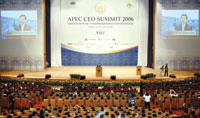 Vietnam’s triumphant arrival on the world stage was warmly received by delegates at the successful APEC forum |
APEC is a good chance for Vietnam to contribute to global trade liberalisation and investment promotion, a role it has actively played within the Association of Southeast Asia Nations (ASEAN).
Membership in the World Trade Organization will give Vietnam more opportunities to discuss international trade issues, like the resumption of the Doha round. As Prime Minister Nguyen Tan Dung said: “Vietnam will be a responsible and active member within the WTO community.”
Vietnam will have a larger role to play globally as well. It is the only candidate nominated by Asian countries for a non-permanent seat in the UN Security Council for the 2008-9 term.
So the country that was once only in the international limelight for the decade-long American War is luring attention again. Chinese President and Communist Party General Secretary Hu Jintao, US president George W. Bush and Japanese Prime Minister Shinzo Abe paid official visits to Vietnam during the APEC Economic Leaders’ Meeting, only adding to the energy.
As political ties deepen, economic ties grow. During the talks between president Hu Jintao and Vietnamese leaders, the two sides wished to bring bilateral trade value to $15 billion in 2010, a significant rise from expected $10 billion this year.
That is also the amount Prime Minister Dung expects the bilateral trade relations between Vietnam and the US to gain within the next four years. Despite the setback when the US House of Representatives recently voted against permanent normal trade relations (PNTR), Dung hopes the US will be the leading its investors to Vietnam.
Japanese investors are leading the way as well. Prime minister Shinzo Abe’s visit will further boost their confidence in this Southeast Asian nation, which hopes to receive another wave of investment from the second largest economy in the world.
Vietnam lures investors to its largely untapped market with its population of 85 million, strategic geographical position in one of the world’s most economically dynamic regions, stable political situation and high economic growth.
The shift from centrally planned economy to market economy over the last two decades is also paying off with average annual growth of 7 per cent. Prime minister Dung told international investors last week that the country aims to achieve growth of 8 per cent over the next few years, to bring Vietnam out of its status as an undeveloped country, with targets of $1,200 per capita income by 2010.
To fuel economic growth, Vietnam needs further investment and to lure investors it has introduced regulatory and institutional reforms. WTO membership is a sort of approval that Vietnam is bringing itself in line with common international practices and is opening up more sectors to foreign investment.
With built-up internal strength Vietnam looks ready to take a larger role on the world stage.
No. 788/November 20-26, 2006
What the stars mean:
★ Poor ★ ★ Promising ★★★ Good ★★★★ Very good ★★★★★ Exceptional
 Tag:
Tag:
Related Contents

Latest News



More News
- Foreign fruits flood Vietnamese market (December 09, 2025 | 13:22)
- Vietnam’s fruit and vegetable exports reach $7.8 billion in first 11 months (December 05, 2025 | 13:50)
- Vietnam shapes next-generation carbon market (November 26, 2025 | 15:33)
- PM urges Ho Chi Minh City to innovate and remain Vietnam’s economic locomotive (November 26, 2025 | 15:29)
- Experts chart Vietnam's digital finance path: high hopes, high stakes (November 14, 2025 | 10:56)
- Vietnam’s seafood imports surge 30 per cent in first 10 months (November 10, 2025 | 19:35)
- Vietnam’s durian exports hit $1 billion milestone (October 30, 2025 | 17:41)
- Beyond borders: Sunhouse and new era of Vietnamese brands on Amazon (October 28, 2025 | 10:46)
- Record-breaking trade fair set to open in Hanoi (October 15, 2025 | 15:59)
- Timber sector seeks solutions to VAT refunds (October 14, 2025 | 18:58)








 Mobile Version