
South Korea advances in investment rankings

According to figures released last week by the National Statistics Office under the Ministry of Finance, South Korea is now Vietnam’s third-largest trade partner after China and the US.
The Vietnam-South Korea trade turnover in the first three months of this year reached $26.8 billion, up from $20.7 billion in the corresponding period last year. This included $8.1 billion worth of Vietnamese exports, up 19.6 per cent, and $18.7 billion for South Korean exports, up 34.5 per cent.
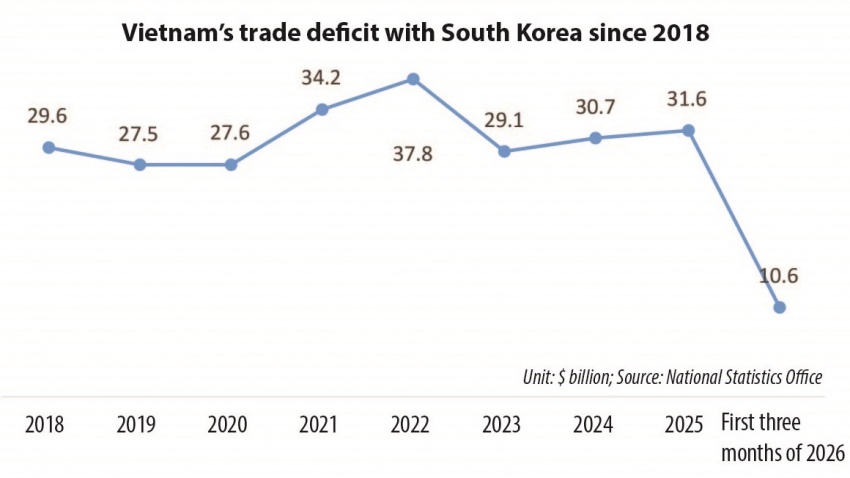
The total trade deficit for Vietnam in the period sat at $10.6 billion, up from $7.1 billion in the same period last year.
Vietnam has for many years suffered from a trade deficit with South Korea (see chart). However, according to the Vietnamese Ministry of Industry and Trade (MoIT), the country remains an attractive destination for South Korean investors, who often import assorted materials for production from their home market into Vietnam, where such materials cannot be produced directly due to a weaker supporting industry.
Last year, both nations’ total trade turnover reached $89.4 billion. Vietnam’s exports to South Korea hit $28.9 billion, accounting for 6 per cent of the former’s total export turnover ($475 billion). Meanwhile, Vietnam’s imports from South Korea stood at $60.5 billion, occupying 13.3 per cent of Vietnam’s total import value ($455 billion).
The key item groups that were imported most from South Korea includes computers and electronics, machinery and equipment, assorted petrol and oil, plastic materials, metals and steel, automobile spare parts, and mobile phone and related spare parts. All these figures recorded an on-year increase.
These imported items do not compete with those in Vietnam, where many of similar items are not produced, and they are all used for domestic production in Vietnam, according to the MoIT.
The two countries are stepping up efforts to reach a target of $150 billion in bilateral trade turnover in a more balanced manner by 2030. According to the MoIT, an expansion in South Korean investment into Vietnam has contributed to a rise in imports from South Korea.
Meanwhile, President of South Korea, Lee Jae-myung, will pay a state visit to Vietnam during April 21-24. It is reported that this visit will be accompanied by leaders of South Korea’s top conglomerates as they seek business opportunities to hedge against uncertainties stemming from the Middle East crisis and rising protectionist policies.
The South Korean business delegation will likely include representatives from hundreds of companies who will participate in a business forum with Vietnamese companies.
Many major investors are performing well in Vietnam. For example, SK Innovation has recently secured a large-scale project in Vietnam worth $2.3 billion, including the construction of a gas-fired power plant and a liquefied natural gas terminal, as it ramps up its energy infrastructure business.
Samsung Electronics manufactures nearly half of its global smartphone shipments in Vietnam, while Samsung Display’s Vietnam unit also operates in the country. LG Electronics, LG Innotek, and LG Display run global production bases in Vietnam through 12 affiliates.
Hong Sun, a representative from the Korea Chamber of Business in Vietnam, told VIR that Vietnam remains a top player for South Korean investors.
“All major companies from South Korea are already operating in Vietnam. Vietnam is home to over 10,000 South Korean companies employing more than one million domestic workers,” Sun said. “Their investments are largely focused on the manufacturing industry.”
Figures from the Ministry of Finance’s Foreign Investment Agency show that cumulatively as of late March, South Korea was the biggest foreign investor in Vietnam, with about 10,450 valid projects registered at almost $99 billion. In the January-March period, total newly registered and newly added capital and stake acquisition and capital contributions from South Korean investors in Vietnam hit $4.38 billion, up 128.8 per cent on-year.
Vietnam and South Korea have also been enhancing cooperation in industries such as gas-fired power generation, fuel conversion in coal-fired power plants, and the co-firing of hydrogen and green ammonia in thermal power plants. They also agreed to expand the electricity grid and develop smart grid systems.
Both sides have also committed to exploring opportunities for government-business cooperation in the use of critical minerals and to intensifying efforts to attract investment aimed at building critical mineral supply chains.
| Ko Tae Yeon, chairman, Korea Chamber of Business in Vietnam
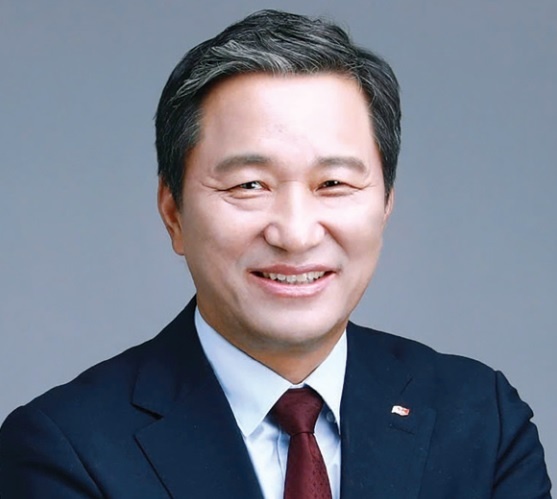
On the occasion of the upcoming 35th anniversary of diplomatic relations between Vietnam and South Korea, I would like, on behalf of the South Korean business community, to extend a warm welcome for the state visit to Vietnam by President of South Korea Lee Jae-Myung. Over more than three decades, the two countries have maintained close economic cooperation, with manufacturing at its core. As of 2025, South Korean investment in Vietnam has exceeded 10,000 projects, accounting for approximately 25 per cent of the country’s total foreign direct investment, with cumulative registered capital reaching almost $99 billion. South Korea continues to rank first among 154 countries and territories investing in Vietnam. At the same time, bilateral cooperation has steadily expanded into tourism, education, culture, and people-to-people exchanges, serving as a clear testament to the strength of partnership and shared prosperity between the two nations. These achievements have brought tangible improvements to the lives of people in both countries. This visit by the South Korean president marks an important milestone to reflect on the long-standing values of cooperation, while also discussing strategic orientations for the future. In the context of an increasingly uncertain global landscape and rapidly shifting economic dynamics, the cooperation model between Vietnam and South Korea needs to evolve beyond its traditional manufacturing-led framework. It should move towards new growth drivers such as digital transformation, green energy, and the development of smart infrastructure. Vietnam’s strategic goals – sustaining high economic growth, reinforcing its middle-income foundation, and aspiring to become a developed nation by 2045 – require a strong focus on advancing high-tech industries. Within this transformation, areas such as upgrading power infrastructure, enhancing logistics systems, and developing smart cities present significant opportunities for deeper collaboration. These are sectors where South Korea’s technological expertise and development experience can make meaningful contributions to Vietnam’s innovation capacity and overall growth trajectory. I expect that this visit by President Lee will not only reinforce existing achievements in bilateral cooperation but also open up more substantive collaboration in advanced sectors. It will contribute to fostering an innovation-driven ecosystem, strengthening people-to-people ties, and broadening cooperation, thereby elevating the relationship to a new level – one defined by genuine partnership for friendship and shared prosperity. As Vietnam and South Korea join hands in building a model of innovation-led development, the two countries are not only shaping a successful bilateral partnership but also setting a benchmark for regional cooperation in East Asia, earning recognition from the international community. I am confident that this visit will serve as a new milestone in bilateral relations, laying a solid foundation for further deepening the comprehensive strategic partnership between the two countries. |
| When it comes to investment cooperation, as of late March, South Korea remained Vietnam’s largest foreign investor among 154 countries and territories, with total registered capital reaching nearly $99 billion across about 10,450 projects. This accounts for more than 23 per cent of the total number of projects and 18 per cent of Vietnam’s total registered foreign direct investment. South Korean capital is concentrated in key sectors of the Vietnamese economy, including processing and manufacturing industries, high technology, electronics, automobiles and auto parts, construction, and real estate. Vietnam is continuing to encourage South Korean enterprises to launch new initiatives and expand existing investments, with priority given to areas where South Korea holds strengths and Vietnam has demand, such as infrastructure development, high-tech electronics manufacturing, semiconductors, AI, renewable energy, smart urban development, and the establishment of specialised industrial production complexes integrated along value chains. Regarding development cooperation, Vietnam continues to be a top priority partner for South Korea, receiving approximately 20 per cent of the Northeastern Asian nation’s total official development assistance (ODA) provision. Over the past five years, South Korea’s total assistance to Vietnam has exceeded $500 million, of which 90 per cent is concessional ODA loans and 10 per cent non-refundable grants. ODA loans are extended by the South Korean government through the Economic Development Cooperation Fund under the Export-Import Bank of Korea. In June 2023, the two sides signed a $2 billion agreement under the Economic Development Promotion Facility to support the implementation of transport and urban infrastructure development projects in Vietnam. As for labour cooperation, the two countries signed an MoU on the dispatch and reception of Vietnamese workers under South Korea’s Employment Permit System (EPS) in June 2023, which was extended for a new phase from August 2025. According to the Korea Immigration Service, by the end of 2025, nearly 45,000 Vietnamese workers had been admitted under the EPS programme. In addition, there were 28,500 seasonal workers and 14,700 skilled workers. With regard to science and technology cooperation, both countries have maintained the ministerial-level joint committee mechanism on Vietnam-South Korea science and technology cooperation. They are actively working together to advance Phase 2 of the Vietnam-Korea Institute of Science and Technology project. Major South Korean high-tech conglomerates have also invested in the National Innovation Centre, with SK supporting capital and research programmes for Vietnamese enterprises, and Samsung establishing the Samsung Innovation Campus research facility. In tourism, last year, South Korea was Vietnam’s second-largest source of international visitors, with 4.3 million arrivals, accounting for 21 per cent of total inbound tourists. As of the end of 2025, approximately 352,000 Vietnamese nationals were residing in South Korea, an increase of 30,000 compared to the same period in 2024. Source: Vietnamese Ministry of Foreign Affairs |
 |
What the stars mean:
★ Poor ★ ★ Promising ★★★ Good ★★★★ Very good ★★★★★ Exceptional
 Tag:
Tag:Related Contents

Latest News
More News
- Vietnam’s registered FDI surpasses $50 billion in nine months (October 07, 2026 | 10:30)
- Samsung Electro-Mechanics to add $1.85 billion semiconductor investment in Thai Nguyen (October 06, 2026 | 18:23)
- Electronics funding will be won via a capable ecosystem: SGS (October 06, 2026 | 09:00)
- LNG power plant projects risk falling behind schedule (October 03, 2026 | 09:00)
- Pandora opens world’s largest fine jewellery crafting facility (October 02, 2026 | 22:21)
- An Phat 5 Industrial Park positions for new wave of investment in northern Vietnam (October 02, 2026 | 09:00)
- Hanoi to launch portal to ease hurdles for tech businesses (October 01, 2026 | 09:00)
- Foreign investors to be widened for market access (September 30, 2026 | 17:54)
- Phu Quoc Airport planning adjusted to serve APEC 2027 (September 30, 2026 | 17:35)
- Nearly 200 foreign-invested enterprises in Vietnam to pay global minimum tax (September 30, 2026 | 17:26)


Latest News



 Mobile Version