

70 per cent of stocks trading at crisis-conditions values

 |
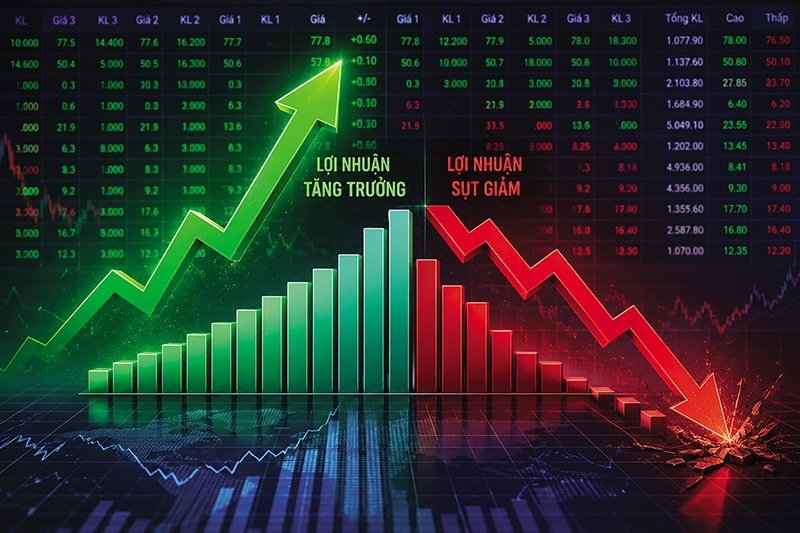
According to VinaCapital, the VN-Index is trading at an attractive 13x forward price-to-earnings (P/E) ratio valuation versus 15 per cent expected earnings growth, but that headline figure obscures a deeper discount: over 70 per cent of the market is trading below 10x P/E, a valuation that is consistent with past Vietnam stock market shocks.
The market is trading as if Vietnam were experiencing an economic crisis – which is a sharp disconnect from Vietnam’s resilient economy and booming high-tech exports in 2026. This bifurcation stems from the stellar stock price performance of the Vingroup family of companies, which now account for nearly 30 per cent of the VNI’s market cap.
VN-Index earnings grew 51 per cent on-year in the first quarter, dwarfing the 15 per cent consensus expectation. That surge was partly driven by Vinhomes (VHM), but even when stripping out VHM, earnings grew by around 30 per cent – or double consensus expectations.
This reflects the sound fundamentals of these stocks amid the tail risk to the global economy that the US-Iran war presents. The growth is driven by broad-based strength in real estate, materials, retail, energy, and consumer staples.
VinaCapital highlights that Vietnam’s stock market is currently facing multiple headwinds, including the prolonged disruption in the Strait of Hormuz. Meanwhile, Vietnam’s trade deficit has more than doubled from 3 per cent of GDP pre-war to over 6 per cent/GDP as of mid-May.
The war contributed more than 2 percentage points towards the widening of Vietnam’s trade deficit because oil prices and the value of China’s currency have both soared (Vietnam sources over one-third of the production materials it uses to produce exports from China), but rising imports of production materials and capital goods required to produce high-tech products account for most of Vietnam’s current trade deficit.
Foreign-invested high-tech companies are increasingly importing capital goods used in the production of precision components. This important but nuanced point helps explain why the currency and stock markets are brushing off the recent jump in the trade deficit.
In addition, inflation in Vietnam is now well above 5 per cent, which is pushing interest rates higher. Another headwind is persistent foreign outflows, with investors selling roughly $2 billion of Vietnamese equities year-to-date (following $5 billion of outflows last year).
Nevertheless, VinaCapital believes the Vietnamese government has the capacity to counter these issues and achieve 7 per cent GDP growth this year.
Vietnam is advancing a wide-ranging series of reforms that are aimed at improving the efficiency of state-owned enterprise, that are tied to FTSE EM inclusion, that target restarting stalled real estate projects, etc.
Still, the full impact of these reforms has yet to be priced into the stock market. The benefits will accrue gradually through better liquidity, more listings, state-owned enterprise restructuring, and the reactivation of delayed projects.
 | Vietnam moves closer to MSCI upgrade Vietnam’s stock market is gaining momentum for a potential MSCI Watchlist inclusion as regulatory reforms, foreign ownership improvements and resilient earnings strengthen its emerging-market upgrade case. |
 | Stock market enters selective phase driven by earnings quality With earnings quality emerging as the key driver of valuations, Vietnam’s stock market is entering a more selective phase in which capital is expected to concentrate in industry leaders benefiting from structural growth trends and policy tailwinds. |
 | Net fund outflows ease in April as Vingroup rally polarises performance Net outflows from Vietnam investment funds slowed significantly in April despite a persistent net selling trend, buoyed by a sharp turnaround in equity fund performance engineered by Vingroup-related stocks. |
What the stars mean:
★ Poor ★ ★ Promising ★★★ Good ★★★★ Very good ★★★★★ Exceptional
 Tag:
Tag:
Related Contents






Latest News




More News
- Vietnam moves closer to MSCI upgrade (May 07, 2026 | 18:16)
- FTSE upgrade signals new era for Vietnam's equity market (March 20, 2026 | 10:00)
- Vietnam's securities sector leads new IPO wave (October 29, 2025 | 11:04)
- Market sentiment hinges on Q1 earnings results (April 22, 2025 | 17:18)
- Power tickers anticipate rosier future (April 10, 2024 | 15:09)
- Weighting stock market prospects (April 09, 2024 | 15:23)
- VinaCapital CIO forecasts further stock market growth (April 08, 2024 | 16:31)
- Stock market shows potential for growth (April 05, 2024 | 16:22)
- VIR hosting talk show on the stock market stability and sustainability (April 04, 2024 | 10:22)
- Stock market supported by diverse factors (March 14, 2024 | 16:46)


Latest News







 Mobile Version