
Soc Trang targets connectivity growth

 |
| Efforts are being made in Soc Trang to improve infrastructure across various ventures |
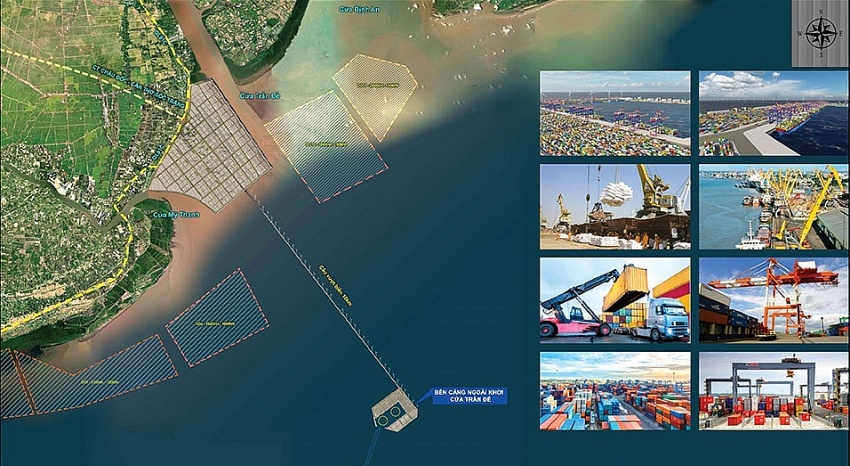
Last month, the Ministry of Construction approved the detailed development plan for the land and water areas of Soc Trang port with a vision to 2050.
At the core of the plan is the Tran De offshore port, which is expected to feature 2-4 general, container, and bulk cargo berths, with a total length ranging 800-1,600 metres by 2030.
The port will be capable of accommodating general and container vessels up to 100,000DWT and bulk carriers of up to 160,000DWT, handling 25-32 million tonnes of cargo annually.
Onshore transfer terminals in Tran De will be developed concurrently in scale and timeline to support offshore port operations as envisioned in the master plan.
 |
Looking ahead to 2050, Tran De offshore port is expected to accommodate approximately 14 berths in a bid to address projected increases in cargo volumes.
The approval of the aforesaid detailed development scheme lays a foundation for attracting investment into the province’s seaport infrastructure - especially Tran De port complex, which is designated to become a specialised seaport. This move concretises the goals crafted in Soc Trang’s provincial planning for the rest of the decade.
The province’s planning scheme emphasises the strategic importance of Soc Trang’s coastal location and inter-regional transport infrastructure. The vision is to establish Soc Trang as a key gateway to the East Sea for the Mekong delta, and a regional hub for agriculture, industry, services, and logistics - with Tran De offshore port as the focal point.
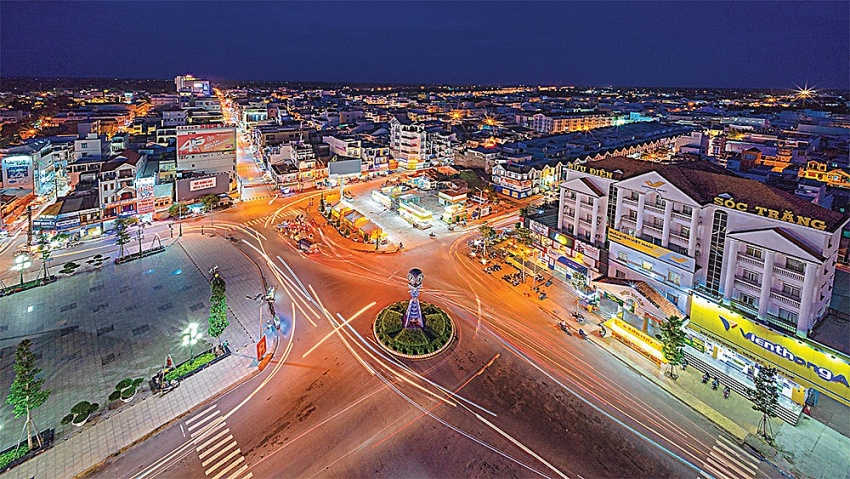 |
By 2030, Soc Trang aims to become one of the more developed localities in the delta region, with a modern, sustainable agricultural base; a thriving industrial and service sector; fully integrated infrastructure; and smart, green urban development with high climate resilience.
One major development identified by Soc Trang is the efficient mobilisation and use of resources, prioritising strategic and high-impact infrastructure, especially in transportation, such as expressways, east-west and north-south corridors, seaports, coastal economic zones, industrial parks, and smart urban zones.
The province is aligning development efforts with its three economic pillars: processing industries; agriculture and aquaculture; and services and tourism. At the same time, it is unlocking high-potential sectors such as renewable energy, seaports, logistics, digital economy, and smart cities.
In order to effectively expedite the provincial planning, in February, Soc Trang People’s Committee enacted an action plan focused on mobilising and efficiently allocating resources.
The plan emphasises leveraging public investment to entice greater private and social capital sources, alongside accelerating the development of modern and interconnected infrastructure.
Public investment will be strategically allocated to impactful projects with strong regional connectivity, particularly in transportation.
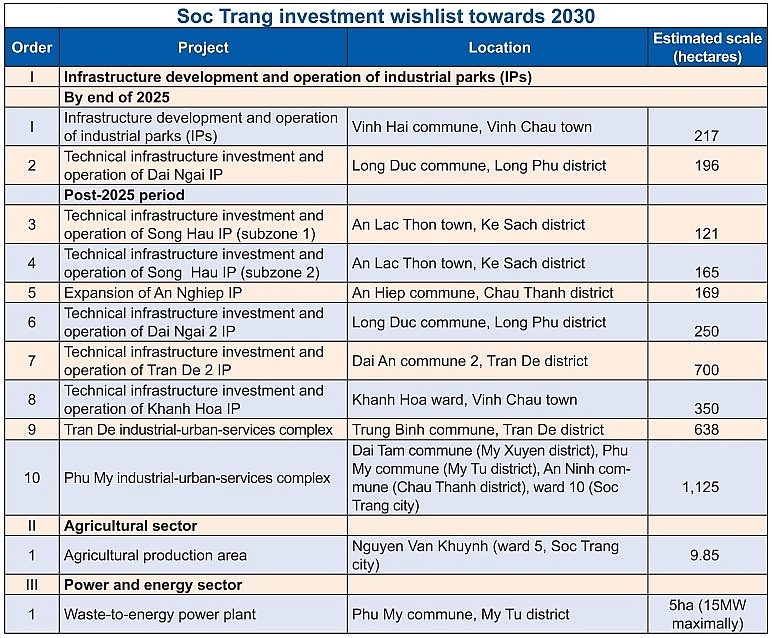
Accordingly, key projects include Tran De offshore port; North-South Economic Corridor, comprising National Highway 1, Quan Lo-Phung Hiep road, National Highway 91B, and coastal routes connecting Soc Trang with Bac Lieu and Tra Vinh via national highway 60; among others.
Parallel efforts will target improvements in healthcare, education, culture, sports, social welfare, science and technology, and digital infrastructure- particularly in designated growth areas as a way to attract investment and optimise the province’s development structure.
For projects financed through non-public sources, Soc Trang will prioritise those aligned with public infrastructure to maximise investment efficiency.
Key sectors include processing industries; high-tech agriculture, forestry, and fisheries; renewable energy; logistics; commercial infrastructure; and ecotourism and agri-tourism.
To ramp up investment appeal, Soc Trang leverages public-private partnerships model to implement critical infrastructure and maximise local advantages. The province is making efforts to craft investment criteria and a list of infrastructure projects suitable for such partnerships in each development phase to attract private sector participation.
This approach is seen as a main solution to modernise infrastructure and support the province’s broader goals of restructuring its economy and adopting a new growth model.
The provincial management is also stepping up efforts to effectively expedite investment incentives and support policies, while preparing land and ensuring favourable conditions for site clearance, resettlement, and workforce development to facilitate investor entry.
With a clear strategic vision and a focus on high-impact infrastructure, Soc Trang is positioning itself as a dynamic growth engine and an essential logistics and investment gateway for the Mekong delta region.
 | Soc Trang to become trade gateway for Vietnam's south Tran De Port has been classified as a Type III seaport, belonging to the Group 5 of seaports, meaning potential for advancement into a special seaport as it forms the gateway port for the Mekong Delta region, according to the decade-long master plan for the development of Vietnam's seaport system approved by the Prime Minister Pham Minh Chinh. |
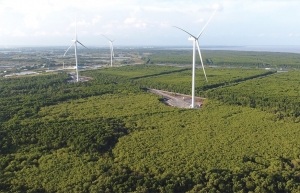 | Soc Trang province bagging rosy results Soc Trang province in Vietnam’s Mekong Delta region has secured buoyant performance across the board in the first half of this year, with a constantly improving investment environment. |
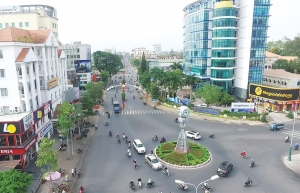 | Soc Trang sets 2030 targets to complete urban system Soc Trang province in the Mekong Delta region is aiming to develop its urban system before 2030, with 25 areas to be incorporated into a simple 5-tier system. |
What the stars mean:
★ Poor ★ ★ Promising ★★★ Good ★★★★ Very good ★★★★★ Exceptional
 Tag:
Tag:Related Contents

Latest News

More News
- Quang Tri province to tighten delayed power projects (October 13, 2026 | 10:34)
- $600 million Ho Chi Minh City - Long Thanh expressway expansion under pressure (October 09, 2026 | 16:00)
- Hung Yen’s regional GDP beats expectations (October 09, 2026 | 15:25)
- VIR seminar focuses on taking domestic suppliers into global supply chains (October 08, 2026 | 14:50)
- Building Vietnam’s next chapter of FDI growth (October 08, 2026 | 12:15)
- Vietnam to foster links between foreign and domestic sector (October 08, 2026 | 11:00)
- Vietnam shifting focus to building high-quality FDI ecosystem (October 08, 2026 | 10:45)
- VIR seminar to explore innovative global supply chains in Hanoi (October 07, 2026 | 12:04)
- Vietnam’s registered FDI surpasses $50 billion in nine months (October 07, 2026 | 10:30)
- Samsung Electro-Mechanics to add $1.85 billion semiconductor investment in Thai Nguyen (October 06, 2026 | 18:23)






 Mobile Version