
Revised CIT law brings major changes for foreign-invested enterprises

The 2025 tax finalisation season is taking place as many new tax policies come into force, notably the revised Corporate Income Tax (CIT) Law and the global minimum tax mechanism.
These changes require businesses, especially those backed by foreign investment, to review and prepare early to ensure compliance and minimise risks during tax finalisation.
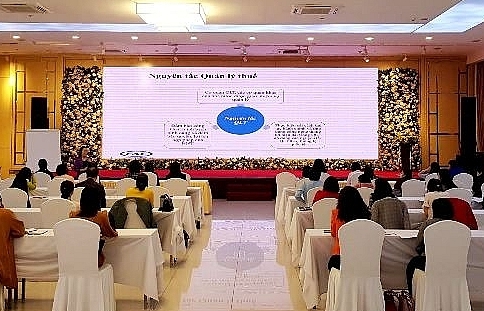
According to Nguyen Thi Thuy Duong, CEO of Hinh Lam Tax Advisory Services and vice chairwoman of the CFO Vietnam Club at Vietnam-Singapore Industrial Park, the 2025 Corporate Income Tax Law took effect from October 1 but applies retroactively to the entire 2025 tax period.
 |
| Photo: An Thu |
Businesses therefore need to review ongoing contracts – particularly those signed before October 1 but extending into 2026 – to assess whether any provisions conflict with the new regulations on revenue and expense recognition under the 2025 CIT Law.
“CFOs and chief accountants should maintain accounting records that allow data to be separated before and after the October 1 milestone. Although tax finalisation covers the entire year of 2025, such separation will make it easier for firms to explain and justify the reasonableness of costs during tax inspections in this transitional period,” said Duong.
Another issue drawing attention from foreign investors concerns changes to deductible and non-deductible expenses under the new regulations. According to experts, certain 'sensitive' expenses may be adjusted by tax authorities if firms lack sufficient supporting evidence.
Intra-group service fees are considered a common risk. Many businesses incur management, consulting, or technical support fees paid to overseas parent companies or affiliates. If the Vietnamese entity cannot demonstrate direct economic benefits from these expenses, tax authorities may exclude them from deductible costs.
Employee-related expenses such as welfare benefits, voluntary insurance, or bonuses may also be disallowed if not clearly stipulated in labour contracts or collective agreements. Additionally, new 2025 regulations require greater transparency in documentation for non-cash payment transactions.
Given these risks, experts recommend that foreign-backed firms review their entire tax governance systems. Accounting data systems need standardisation to clearly separate taxable income from tax-exempt or reduced-income categories by project or product line.
The revised CIT Law also expands its regulatory scope to include foreign enterprises conducting business through digital platforms and e-commerce in Vietnam. Foreign companies generating income in the country, including through digital platforms, are now required to declare and pay taxes accordingly. The concept of 'permanent establishment' has been broadened to include digital platforms providing goods and services to the Vietnamese market, strengthening the legal basis for tax management of cross-border activities.
Regarding taxable income determination, the new law introduces additional income types subject to declaration, including benefits received as goods or services provided as gifts without payment, as well as support or sponsorship provided in the form of services. These are categorised as 'other income' and subject to corporate income tax.
Another notable change is the tightening of conditions for corporate income tax incentives applied to large-scale investment projects. For investment expansion projects, the new regulations also clarify the mechanism for applying tax incentives.
Accordingly, additional income generated from expansion projects may continue to enjoy incentives under the original project if the incentive period remains valid, without requiring separate accounting. If the original venture's incentive period has expired, the expansion may be considered for tax incentives similar to those granted to new initiatives under current regulations.
 | New tax policies aim to bolster tech sector As Vietnam’s consumer technology sector continues to expand, the country’s tax authorities are intensifying efforts to refine policies that promote a more transparent and equitable business environment. |
 | Tax policies and market clean-up boost retail stocks With the recent approval of maintaining current VAT rates and intensified efforts to tackle counterfeit goods, the retail sector is expected to benefit from a more favourable policy environment conducive to sustained growth. |
 | MoF pledges fair, transparent tax policies for Korean investors The Ministry of Finance has held a dialogue with South Korean businesses, addressing tax and customs issues and pledging stronger support for investors. |
What the stars mean:
★ Poor ★ ★ Promising ★★★ Good ★★★★ Very good ★★★★★ Exceptional
 Tag:
Tag:
Related Contents











Latest News






More News
- KN Holdings honoured for ESG efforts in Vietnam (October 18, 2026 | 11:00)
- APEA 2026 Vietnam honours 65 outstanding leaders and enterprises (October 17, 2026 | 10:00)
- MEXC highlights AI-driven trading and broader market access at TOKEN2049 (October 17, 2026 | 09:00)
- EuroCham confidence index holds at 78.3 despite operational hurdles (October 16, 2026 | 17:27)
- Shrimp and rice firms face rising standards in export markets (October 16, 2026 | 09:00)
- SCG and Prime Group add value to the ecosystem (October 15, 2026 | 15:55)
- Project readiness key to unlocking green finance (October 15, 2026 | 12:35)
- Sovereign AI and human oversight key to secure digital government (October 15, 2026 | 12:32)
- MEXC Ventures partners with Corelia Academy: Bringing digital asset education closer to Vietnamese students (October 15, 2026 | 09:00)
- Global design expertise meets a more sophisticated Vietnam market (October 15, 2026 | 09:00)









 Mobile Version