
Global semiconductor equipment sales hit $135 billion, up 15%

MILPITAS, Calif., April 8, 2026 /PRNewswire/ -- Worldwide sales of semiconductor manufacturing equipment increased 15% to $135.1 billion in 2025 from $117.1 billion in 2024, driven by continued investment in advanced logic, memory, and AI-related capacity expansion, SEMI, the industry association representing the global electronics design and manufacturing supply chain, reported today. The data is available in the Worldwide Semiconductor Equipment Market Statistics (WWSEMS) report.
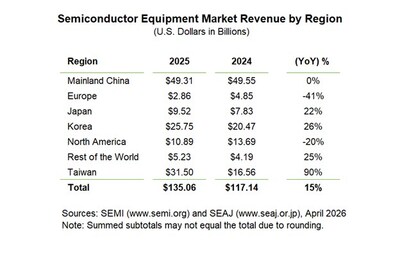
Semiconductor Equipment Market Revenue by Region
In 2025, the global front-end semiconductor equipment market posted solid growth, with wafer processing equipment sales increasing 12% and other front-end segments rising 13%. The expansion was driven primarily by continued investment in leading-edge logic and memory capacity, supported by AI-related demand and ongoing node and technology migrations.
The back-end equipment segment also recorded strong growth in 2025. Test equipment billings surged 55% year-over-year as AI devices and high-bandwidth memory (HBM) increased performance requirements and test intensity, while assembly and packaging equipment sales rose 21% as adoption of advanced packaging technologies continued to expand.
"Record semiconductor equipment billings of $135 billion in 2025 underscore the scale and urgency of the industry's buildout as AI accelerates demand for leading-edge logic, advanced memory and high-bandwidth architectures," said Ajit Manocha, SEMI President and CEO. "From wafer fab investments to the rapid rise of advanced packaging and test, the global ecosystem is expanding capacity and capability to support the next wave of innovation."
Regionally, semiconductor equipment spending remained concentrated in Asia in 2025, with mainland China, Taiwan, and Korea together accounting for 79% of the global market, compared with 74% in 2024.
In 2025, spending in mainland China remained near record levels at $49.3 billion, down just 0.5% from the prior year, as domestic chipmakers continued to invest in mature nodes and select advanced capacity. Equipment spending in Taiwan rose 90% year-over-year to a record $31.5 billion, reflecting AI- and HPC-driven capacity expansion. Korea increased 26% to $25.8 billion as investment in HBM and DRAM remained strong.
Japan recorded 22% growth to $9.5 billion, supported by continued investment in domestic advanced-node manufacturing. Europe declined 41% to $2.9 billion, marking a second consecutive year of contraction amid ongoing weakness in automotive and industrial demand. North America fell 20% to $10.9 billion as spending moderated following earlier capacity expansion. The rest of the world increased 25% to $5.2 billion, reflecting expanding activity in emerging semiconductor production markets.
Compiled from data submitted by members of SEMI and the Semiconductor Equipment Association of Japan (SEAJ), the WWSEMS report is a summary of the monthly billings figures for the global semiconductor equipment industry.
What the stars mean:
★ Poor ★ ★ Promising ★★★ Good ★★★★ Very good ★★★★★ Exceptional
 Tag:
Tag:Related Contents

Latest News



Latest News





 Mobile Version