
Career guidance aligned with global norms gain traction

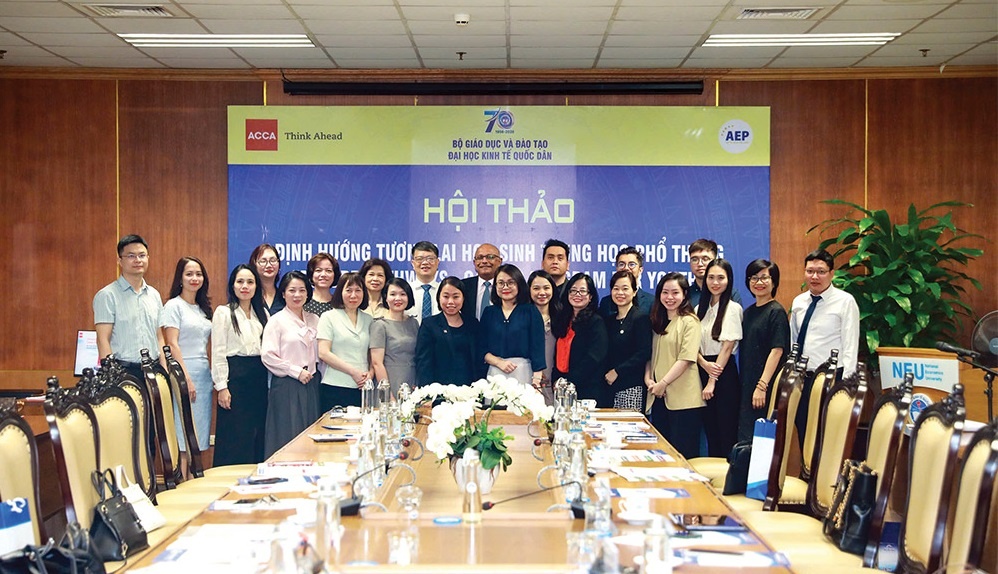 |
| The event heard that education must become more adaptable as the labour market evolves |
Policy attention is shifting towards strengthening career guidance in schools and expanding learning pathways.
In this context, the Association of Chartered Certified Accountants (ACCA) has launched a stakeholder-led initiative to support the gradual development of internationally aligned models through a series of “Future Pathways” workshops held in Hanoi and Ho Chi Minh City.
The initiative brings together regulators, schools, businesses, and professional organisations to exchange practical approaches to career guidance at the secondary level. Discussions centre on developing models that combine career information, essential skills, practical exposure, and digital tools, aimed at helping students build pathways aligned with labour market requirements.
This policy direction was reflected at a workshop held in Hanoi in mid-April, co-organised with the National Economics University, where participants focused on how to operationalise career guidance under the new regulatory framework.
Ren Varma, head of Mainland Southeast Asia for the ACCA, said expanding access to professional learning and career opportunities remains a core priority, particularly as expectations for the younger workforce continue to evolve.
“Early access to high-quality career guidance and internationally aligned learning pathways is particularly important,” he said. “Career guidance should begin earlier, in a structured and practical manner, closely linked to teachers who engage with students on a daily basis.”
Building on this approach, the ACCA aims to support schools in developing career guidance content tailored to local conditions while maintaining alignment with international standards. The programme is designed to provide secondary students with integrated learning that combines academic knowledge with practical insights, business awareness, and professional skills delivered throughout the academic year.
From the perspective of higher education institutions, the need for early intervention is becoming more evident. Vu Van Ngoc, dean of the School of Advanced Education Programmes at the National Economics University, said early career guidance has become an urgent requirement, requiring closer coordination between schools, businesses, and professional organisations.
“Through the Career Pathways programme, students gain early access to foundational knowledge in business and finance aligned with international standards, alongside opportunities to understand career fields, connect with businesses, and develop skills such as critical thinking, communication, and teamwork,” said Ngoc.
He added that integrated training models combining university education with international professional qualifications are being expanded, allowing students to work towards recognised certifications alongside their degree programmes.
Following the issuance of the Ministry of Education and Training’s (MoET) Circular No.16/2026/TT-BGDDT in March, implementation is now a key focus.
Nguyen Thu Ha, a representative from the MoET, said the circular places emphasis on delivery conditions, particularly development of teachers.
“The development of teaching and management staff is a key factor, alongside encouraging the participation of experts and businesses to provide practical perspectives,” Ha said. “Schools are also guided to utilise existing facilities and mobilise additional resources to support career guidance activities.”
Alongside this, the MoET is expected to develop a national career guidance portal providing data on industries, labour market trends, and learning pathways, while local authorities and schools will take responsibility for implementation.
Developed adaptability
Discussions at the Hanoi workshop highlighted the need to expand access to career guidance content and support students in assessing their abilities and interests when selecting study pathways.
This focus on practical implementation continued at a follow-up workshop in Ho Chi Minh City on April 22, held with partners including VHV Corp and the city’s Youth Cultural House, with participation from universities and secondary schools.
At the event, Phan Thi Bao Quyen, vice dean of the School of Accounting under the College of Business at the University of Economics Ho Chi Minh City, said education needs to shift towards developing adaptability as labour market requirements evolve.
“With around 23 per cent of jobs expected to change and nearly 50 per cent of skills requiring updates, education needs to move beyond knowledge transmission,” she said. “Students are becoming more proactive in identifying the skills needed for future careers.”
She added that early career guidance helps students define clearer learning goals and better prepare for higher education through increased exposure to real-world environments, internships, and project-based learning.
Industry representatives highlighted the role of early exposure in shaping careers. Tram Tu Mai Anh, director of Assurance Services at PwC Vietnam, said access to career information and workplace experience enables students to make more informed choices.
“This is a long-term investment in personnel. Practical experience helps students develop the mindset and skills needed for career orientation,” she said. “Employers increasingly assess candidates based on their understanding of the profession, career goals, and adaptability, rather than academic results alone.”
She added that such initiatives create opportunities for businesses to engage earlier with students and contribute to workforce development.
At the school level, early adoption models are also emerging. Sedbergh Vietnam, part of the Canadian International School System, plans to integrate Foundation in Accountancy subjects under ACCA standards into its career guidance programme from the 2026-2027 academic year.
Nguyen Tran Bich Thao, a representative of the school, said integrated models combining academic and career-oriented content allow students to engage more effectively.
“Instead of separating academic learning from career guidance, integrated programmes bring these elements together,” she said.
Across both workshops, participants agreed that career guidance should be implemented early and continuously, with stronger coordination between secondary education, vocational training, higher education, professional organisations, and businesses.
On that basis, the initiative calls for expanded collaboration to develop scalable models, with the expectation that career guidance will evolve into a more structured and continuous process linked across education levels.
| Khuat Thi Lien Huong, lead for Education Relationships ACCA Mainland Southeast Asia The ACCA is preparing to introduce an open online learning platform aligned with the MoET’s learning outcomes framework, aimed at enabling more flexible adoption by schools, particularly in the context of limited classroom time. The delivery model does not require full or uniform implementation. Schools are given autonomy to select topics, modules, or project-based components based on their capacity and conditions. The approach prioritises flexibility, with elective content and project-based learning options offered as alternatives to formal curriculum integration, helping to reduce pressure on existing programmes while maintaining student access. The initiative is structured around three elements: access to content aligned with international professional qualifications, exposure to practical experience through business engagement, and the development of pathways to higher education. It is designed to support exploration rather than early specialisation. Students are provided opportunities to engage with different fields and build understanding before making decisions on their future study or career direction. Dr. Nguyen Thu Ha, representative, Department of General Education Ministry of Education and Training Circular 16 on career guidance and student streaming in general education establishes a formal framework covering content, delivery methods, and coordination between schools, businesses, and higher education institutions. A key change is the expansion of coverage across the full education cycle, from primary to upper secondary levels, replacing the previous focus on upper secondary education. The circular calls for a more systematic and continuous approach, linked to practical experience and embedded within the general curriculum, while maintaining student choice and coordination among schools, families, and relevant stakeholders. The student streaming mechanism is clarified, focusing on guidance aligned with students’ abilities and labour market demand. Blended models combining academic learning with career exposure are encouraged, alongside vocational orientation activities to enhance flexibility across education levels. Implementation priorities include teacher development and greater involvement of experts and businesses. Policy direction in finance and business education is also being extended to include entrepreneurship-related content. Over the 2026-2030 period, related knowledge and skills are expected to be introduced progressively, supporting financial literacy and creating opportunities for collaboration between schools, professional organisations, and businesses. |
What the stars mean:
★ Poor ★ ★ Promising ★★★ Good ★★★★ Very good ★★★★★ Exceptional
 Tag:
Tag:Related Contents




Latest News




More News
- Sojitz in Vietnam: 40 years from individual projects to a business cluster 'KATAMARI' (October 08, 2026 | 09:00)
- Coteccons targets 'Quality Growth' with 25 per cent dividend plan (October 07, 2026 | 13:00)
- Vietnam Education Forum opens UK Education Mission's Hanoi visit (October 07, 2026 | 12:27)
- Tax authorities deactivate TINs of nearly 180,000 businesses (October 07, 2026 | 12:08)
- World Bank raises Vietnam's 2026 GDP growth forecast to 7.4 per cent (October 07, 2026 | 11:41)
- Vietstock 2026 to spotlight livestock innovation and green transition (October 07, 2026 | 09:00)
- Vietnam’s GDP grows over 9 per cent in first nine months (October 05, 2026 | 18:45)
- Vietnam earns $56.3 billion from agro-forestry-fishery exports (October 05, 2026 | 18:32)
- DSV balances resilience and decarbonisation in supply chains (October 05, 2026 | 18:20)
- Electronics exports reach $175.4 billion in the first nine months (October 05, 2026 | 18:12)



Latest News





 Mobile Version