

Vietnam moves to allow pre-licensing capital flows for foreign investors

The State Bank of Vietnam (SBV) is currently preparing a draft Circular on foreign exchange management for foreign investment activities in Vietnam, intended to replace Circular No.06/2019/TT-NHNN dated June 2019.
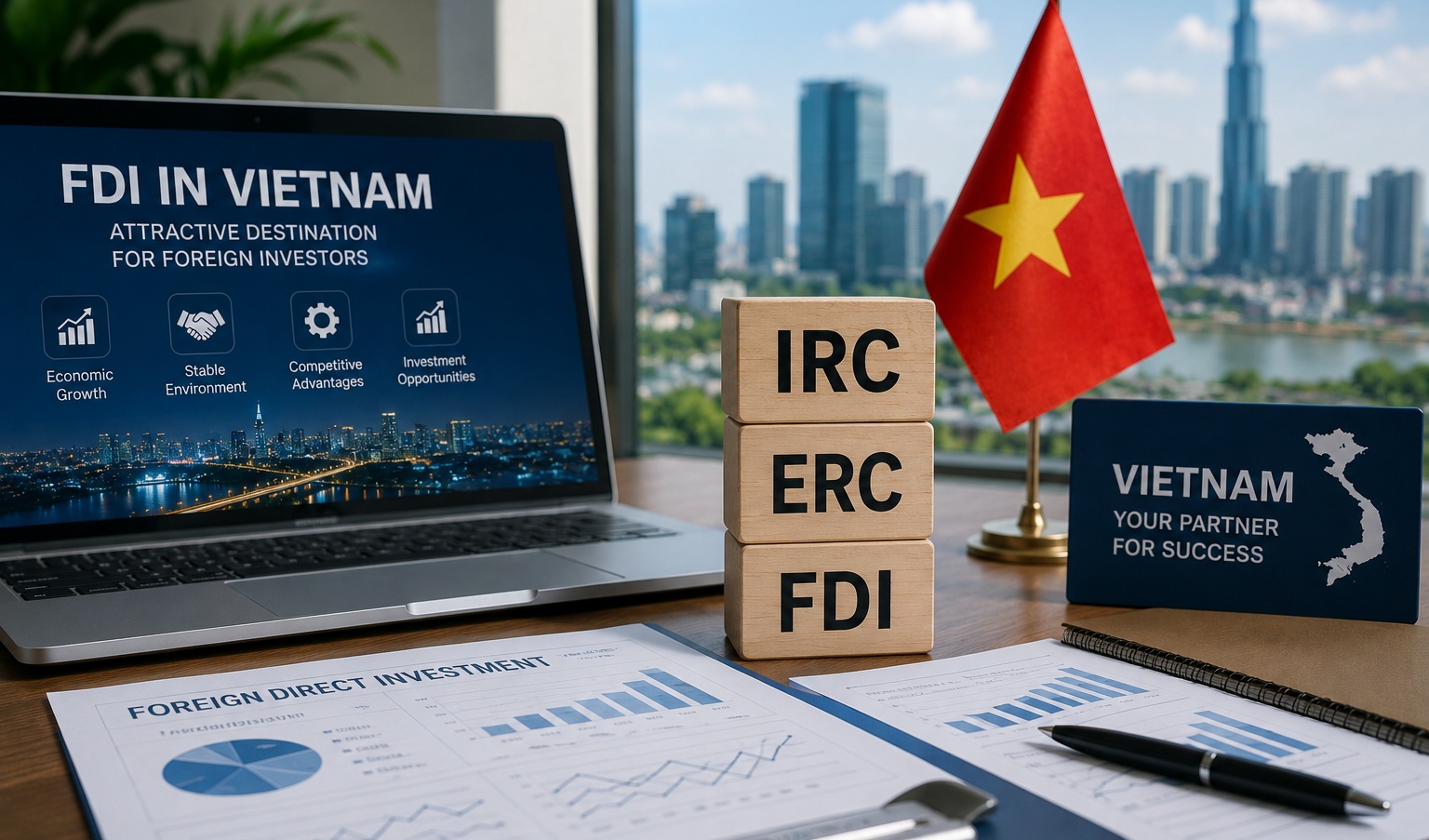
One of the most significant divergences from Circular 06 is the proposal to permit foreign investors to open investment capital accounts and execute selected payment transactions before the issuance of an Investment Registration Certificate (IRC). The amendment is designed to align with the Law on Investment 2025.
Under the existing framework of Circular 06, foreign investors were only allowed to open investment capital accounts after obtaining an IRC, a sequence compliant with requirements under the previous Investment Law.
 |
However, the Law on Investment 2025 fundamentally revises this order by allowing investors to establish an economic organisation first, and subsequently complete procedures for obtaining an IRC.
With the Law on Investment 2025 taking effect on March 1, 2026, the revision of Circular 06 is expected to ensure consistency within the current legal system and address current obstructions faced by many foreign-invested projects.
In practice, investors often need to transfer funds into Vietnam to cover preparatory expenses, lease premises, or initiate project formation, yet they encounter constraints related to account-opening mechanisms.
The draft would allow investment capital accounts to be opened as early as in the project preparation stage, before the issuance of an IRC.
Accordingly, foreign-invested business organisations and investors would be permitted to open such accounts to receive initial capital contributions, pay for project formation expenses, and refund capital in cases where projects are not approved.
For investors, this represents a meaningful procedural reform, helping shorten project implementation timelines, reduce opportunity costs, and bolster operational flexibility. Removing the requirement to complete all legal procedures before transferring capital would entail smoother cash flow management.
For the regulator, allowing early account opening would bring capital flows under supervision from the outset.
Rather than moving through non-specialised channels, all transactions would be conducted via investment capital accounts – an effective and transparent monitoring tool.
Notably, the SBV’s draft also introduces, for the first time, the concept of direct investment flows originating from international financial centres (IFCs) into the regulatory framework.
Under the draft, ‘direct investment from an international financial centre into the rest of Vietnam’ refers to capital transfers by member businesses within an IFC beyond the geographic boundaries of the centre for investment purposes.
Such investment flows would be managed as a distinct form of cross-border capital movement.
Transfers of capital, profits, and lawful revenues between IFCs and the domestic market would be subject to strict regulations governing investment capital accounts, ensuring segregation and systemic safety while maintaining operational flexibility for global financial institutions.
In addition, the draft circular clearly identifies a 50 per cent ownership threshold as the basis for distinguishing between direct and indirect foreign-invested economic organisations.
Enterprises with foreign ownership exceeding half of charter capital are deemed foreign-invested economic organisations in the ‘control’ sense and must comply with foreign exchange management regulations applicable to direct investment.
If, following share transfers or additional capital issuance, foreign ownership falls to 50 per cent or below, the enterprise would be required to close its existing direct investment capital account.
At that point, non-resident foreign investors must switch to opening indirect investment capital accounts to continue conducting inflow and outflow transactions.
This implies that even within the same enterprise, a change in ownership ratio can trigger a complete shift in the regulatory regime governing capital flows.
The transition is not merely a change in account type, but reflects a fundamental shift in the nature of the capital – from ‘control-oriented’ investment to conventional financial investment.
 | Vietnam pushes for market upgrade to attract long-term capital flows An upgrade to Vietnam's stock market status from frontier to emerging would improve the country's image and attract long-term capital flows, raise market standards, and promote institutional reforms. |
 | Upbeat picture drawn for growth in M&As As global dealmaking activity shows steady signs of recovery, Vietnam is witnessing a surge of investor confidence and record-breaking deal values – a signal that capital flows are shifting towards emerging and resilient economies. |
 | Unlocking capital flows for strategic and suitable projects The new Law on Investment, which was approved by the National Assembly in December, focuses on increasing decentralisation, standardising authority and procedures, and promoting the shift from pre-inspection to post-inspection, among others, helping to unlock quality capital influx. |
What the stars mean:
★ Poor ★ ★ Promising ★★★ Good ★★★★ Very good ★★★★★ Exceptional
 Tag:
Tag:
Related Contents










Latest News




More News
- From loans to women’s economic empowerment (October 06, 2026 | 17:58)
- VIB named Outstanding Retail Bank 2026, targets transaction banking (October 06, 2026 | 10:52)
- FTSE upgrade paves way for stronger stock market development (October 05, 2026 | 18:44)
- coLoan to empower women through inclusive green finance (October 05, 2026 | 18:42)
- Techcombank CEO: AI no longer a tool but a new operating foundation (October 05, 2026 | 18:11)
- Banks sustain profit growth as funding costs squeeze margins (October 02, 2026 | 22:22)
- Nam A Bank delivers strong breakthrough in 2026 (October 02, 2026 | 19:00)
- Policy credit builds sustainable livelihoods from the grassroots (September 29, 2026 | 07:48)
- VIB deploys Front Arena treasury and foreign exchange trading system on AWS (September 28, 2026 | 16:46)
- Nam A Bank receives $60 million loan from FMO (September 28, 2026 | 12:37)


Latest News






 Mobile Version