
Swimming against the tide


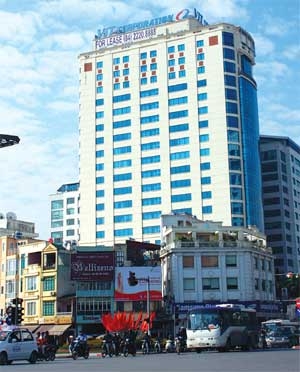 For example, VIT Corporation recently opened for sale its 10th and 13th floors of its VIT Tower located opposite Daewoo hotel in Kim Ma street of Hanoi, at VND41.7 million ($1,985) per square metre for 900sqm floor and VND45.9 million ($2,185) per square metre for 450sqm floor, for the whole lifespan of the project.
According the developer, the sale of the whole floor was a chance for investors to diversify their investment portfolio and a high yield investment with projected income of $200,000 per annum.
Under VIT’s financial analysis, investors can pay VND33.8 billion ($1.6 million) for the whole life of the 900sqm floor. Then this investment capital could be paid back within maximum of nine years with internal rate of return at 13.38 per cent.
‘This percentage is noticeable in a such difficult investment time when the economy is in a downturn,” said Nguyen Long, a property investor in Hanoi.
VIT is not alone in selling office space for the whole lifespan of its projects instead of short-term lease within three to five years. Other office buildings such as HUD Tower are marching to the same tune.
Long, however, said many companies had suffered difficulties caused by the economic downturn and are turned off by short-term leasing.
Savills Vietnam investment head Jonathan Moore said whilst some companies were finding it difficult to operate profitably, many have also managed to restructure and become more streamlined by focusing on their core business.
“The market is continuing to adapt to the levels of supply and demand across the Hanoi office market and companies are in a position to benefit from competitive rents on offer from landlords looking to maintain healthy occupancy levels,” Moore said.
Those companies, he added, that have adapted early enough and made tough decisions for their long term success will find themselves in a stronger position to raise finance either locally or offshore to fund any long term lease purchases.
In the situation of “cash is king”, Moore said that companies could find ways to mobilise a large sum of money to lease large space for a long term.
“Either through cash reserves or seeking finance from lenders. This will be based on the security of their revenue performance to date,” Moore said.
“If companies are in a position to leverage against their core business cash flow and looking to maintain a strong presence in Hanoi for the mid to long-term then they have an opportunity to secure their rent at what must now be considered attractive prices.”
According to a Savills quarterly report, the total current stock in Hanoi in the third quarter is approximately one million square metres, up by 17 per cent on-year.
Cau Giay and Hoan Kiem districts are the main providers of office space, accounting for 43 per cent of total stock.
The overall performance decreased in both occupancy and rent. The average occupancy was 79 per cent, a decrease of two percentage on-quarter, while the average rent was VND445,000 per square metre per month, falling 4 per cent on-quarter.
The average rent of Grade A office buildings is now offered at VND641,000 ($30), Grade B is at VND448,000 ($21) and Grade C is at VND304,000 ($14,4) per square metre per month.
The office take-up in the third quarter of this year decreased sharply and reached its lowest level since 2011, at only 20,800 square metres because many tenants downsized or moved out of the office market.
Up to 2014, approximately 758,000sqm of new office space from 56 projects are expected to enter Hanoi’s market.
What the stars mean:
★ Poor ★ ★ Promising ★★★ Good ★★★★ Very good ★★★★★ Exceptional
 Tag:
Tag:
Related Contents



Latest News



More News
- An Phat 5 Industrial Park targets ESG-driven investors in Hai Phong (January 26, 2026 | 08:30)
- Decree opens incentives for green urban development (January 24, 2026 | 11:18)
- Public investment is reshaping real estate’s role in Vietnam (January 21, 2026 | 10:04)
- Ho Chi Minh City seeks investor to revive Binh Quoi–Thanh Da project (January 19, 2026 | 11:58)
- Sun Group launches construction of Rach Chiec sports complex (January 16, 2026 | 16:17)
- CEO Group breaks ground on first industrial park in Haiphong Free Trade Zone (January 15, 2026 | 15:47)
- BRIGHTPARK Entertainment Complex opens in Ninh Binh (January 12, 2026 | 14:27)
- Ho Chi Minh City's industrial parks top $5.3 billion investment in 2025 (January 06, 2026 | 08:38)
- Why Vietnam must build a global strategy for its construction industry (December 31, 2025 | 18:57)
- Housing operations must be effective (December 29, 2025 | 10:00)









 Mobile Version