
Shrimp and rice firms face rising standards in export markets

At the discussion in Can Tho city on October 15, Phan Van Tam, deputy general director of Minh Phu Khanh An Seafood Processing, part of Minh Phu Seafood Corporation, said businesses seeking long-term growth in demanding markets such as Japan, the EU, the United States, Canada, South Korea, Australia, and New Zealand must meet a broad range of customer standards.
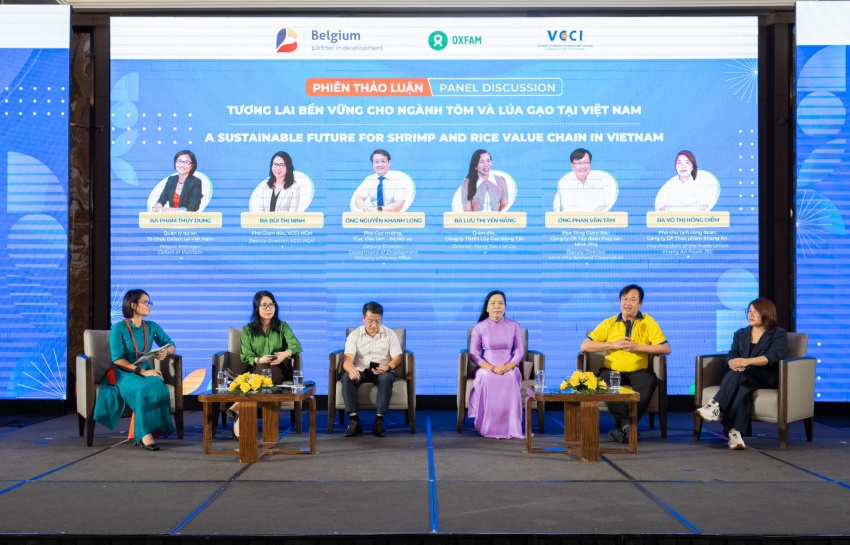 |
| Photo: Oxfam in Vietnam |
"In addition to food safety and traceability, companies must satisfy requirements covering environmental performance, factory security, and social responsibility," Tam said. "Meeting these standards requires considerable resources, but it is essential for accessing markets with stringent requirements."
However, meeting such requirements requires more than investment in machinery, quality control procedures, and certification systems. Working conditions and employees’ capabilities must also improve, as workers are directly responsible for maintaining product quality every day.
At Minh Phu Ca Mau factory, Nguyen Ngoc Han began her career peeling shrimp. After two months, she was promoted to quality control. Six months later, she became a team leader, followed by a promotion to deputy production manager. Since May, she has served as production manager.
Han’s career progression illustrates the opportunities that can emerge when workers receive training and are entrusted with greater responsibilities. Many initiatives to improve productivity and working conditions at the factory have also originated with the people performing the work themselves.
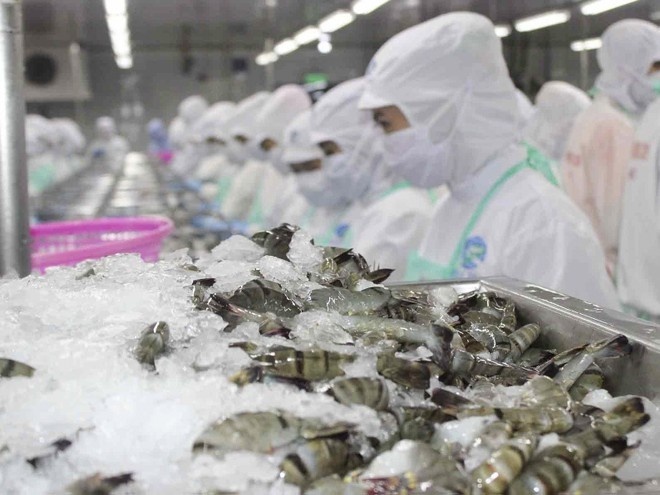
Previously, workers used two separate tools to peel shrimp and remove their digestive tracts, with the tasks sometimes divided between two people. A redesigned tool combining both functions has made the process faster, reduced pressure on workers’ wrists, and eased hand fatigue during repetitive tasks.
"This seemingly small change has improved workers’ experience while helping increase productivity. We can work more efficiently, and productivity has also increased," Han said.
Alongside improvements to their tools, workers are encouraged to attend training courses on Kaizen, waste identification in production, 5S workplace organisation, and occupational safety and health. These programmes help them go beyond simply following procedures to identify risks, propose solutions, and actively contribute to a safer working environment.
"The training had strengthened her confidence as a manager and helped her recognise that the voices and ideas of female workers were receiving greater recognition," Han said.
Improvements in workplace practices have been accompanied by changes in employee welfare policies. Nguyen Thi My Tho, a worker at Minh Phu Ca Mau factory, said her working hours were reduced from eight to seven hours a day during pregnancy. Her night shifts also ended before 10 pm, while her salary remained unchanged.
After giving birth, she received an additional hour each day to breastfeed her child. Her husband was also granted one week of paid paternity leave to help care for the family. “Wives need their husbands’ support during and after pregnancy,” Tho said.
These adjustments have helped female employees better balance work and family responsibilities, demonstrating how human resource policies can be tailored to workers’ practical needs. For Tho, the stability and support provided by her employer have also encouraged her to remain with the company for the long term.
From the company’s perspective, deputy general director Tam said Minh Phu had worked with experts from the Vietnam Chamber of Commerce and Industry’s Ho Chi Minh City Branch (VCCI-HCM) to assess existing practices, identify gaps in management, and develop improvement plans tailored to the factory’s needs.
Rather than applying a standard set of solutions to every business, the experts conducted assessments using an enterprise diagnostic tool, analysed the findings, and then recommended appropriate measures. This approach enabled the company to identify the problems that needed to be addressed most urgently.
"One example was a training programme on communication and interpersonal skills in the workplace. Initially, the company planned to organise three to five sessions. After recognising the programme’s value, however, it expanded the number to 20 sessions," Tam said.
Nearly 3,000 Minh Phu employees and managers had received direct training from VCCI-HCM experts over four years of collaboration. Developing management capabilities and preparing the next generation of leaders have been important in helping the company operate large-scale production facilities.
For rice businesses, the challenges lie more heavily in investment resources, the organisation of raw material supply chains, and the ability to maintain stable supplies that meet market requirements. Luu Thi Yen Hang, director of Hong Tan Rice Company, said the business was gradually developing coloured rice, organic rice, and products certified under the Sustainable Rice Platform, while exploring further-processed rice products to increase added value.
"However, shifting farmers from conventional cultivation to safer and organic farming practices is far from straightforward. Businesses must persuade farmers to change established habits, invest in seeds and agricultural inputs, provide cultivation guidance, and commit to purchasing their products," she said.
For small and medium-sized enterprises, the challenge is compounded by limited organic production volumes, while international buyers expect reliable supplies across successive orders. Constraints involving storage facilities, packaging, and access to export markets also increase investment pressures.
Through its participation in a programme jointly implemented by Oxfam and VCCI-HCM in recent years, Hong Tan received support to improve its management systems. The company obtained ISO 9001:2015 certification and subsequently developed its food safety management system in line with ISO 22000:2018.
"For the business, these certifications and standardised procedures provide a foundation for strengthening product quality, building customer confidence, and gradually expanding its market reach," Hang said.
What the stars mean:
★ Poor ★ ★ Promising ★★★ Good ★★★★ Very good ★★★★★ Exceptional
 Tag:
Related Contents


Latest News




More News
- EuroCham confidence index holds at 78.3 despite operational hurdles (October 16, 2026 | 17:27)
- SCG and Prime Group add value to the ecosystem (October 15, 2026 | 15:55)
- Project readiness key to unlocking green finance (October 15, 2026 | 12:35)
- Sovereign AI and human oversight key to secure digital government (October 15, 2026 | 12:32)
- MEXC Ventures partners with Corelia Academy: Bringing digital asset education closer to Vietnamese students (October 15, 2026 | 09:00)
- Global design expertise meets a more sophisticated Vietnam market (October 15, 2026 | 09:00)
- Vietnam growth nears double digits, UOB raises forecast (October 14, 2026 | 17:39)
- Smart factories need skills, finance and trust to scale (October 14, 2026 | 17:33)
- Sanofi-Aventis Vietnam appoints new head of Vaccines and country lead (October 12, 2026 | 17:21)
- Measurable outcomes a must for businesses (October 12, 2026 | 09:27)






 Mobile Version