
Monetary issues to put cat amongst pigeons


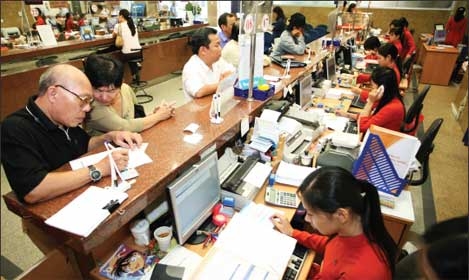 |
| Securing commercial bank loans are still a distant dream for many firms |
Over the past months, the government and banks have worked to lower lending interest rates and promote enterprises’ investments. However, the results have been modest and analysts claim the annual lending interest rates for short and long tern loans remain high, fluctuating between 11 and 16 per cent.
Le Xuan Nghia, vice chairman of the National Committee on Financial Supervision, said there were still administrative barriers hindering the fall in lending interest rates. “These are bottlenecks not only for the banking system, but for the whole economy,” said Nghia.
He said the open market money supply during the last three months had provided sufficient money, but under interbank market lending constraints many banks could not access the abundant and cheap capital. As a consequence, banks are finding ways to mobilise money by raising deposit interest rate, explaining why interest rates have not reduced as expected.
Besides, stipulations in Circular 13 dated May 20, 2010, effective on October 1, 2010 regulating the ratio of lending and mobilised funds, also raised concern about the future scarcity of credit. “If this is to continue, it will negatively impact on future stable economic growth,” Nghia said.
The economy in the first half of this year expanded 6.16 per cent year-on-year and the government is expected it will grow at least 6.5 per cent for the whole year. International institutions like Standard Charterted Bank, Barclays Capital, the World Bank and the Asia Development Bank forecasted the country’s economic growth would be around 6.5-6.8 per cent this year.
Cao Sy Kiem, member of the Consulting Committee for National Monetary Policy, said the economy could further expand if the monetary policy “is more flexible” to push credit growth. According to the State Bank, credit growth from January to July 31 was 12.97 per cent, while the government targeted the growth at 25 per cent for the whole year. Kiem, also the chairman of Vietnam Association for Small and Medium Enterprises, said the low credit growth was partly caused by domestic enterprises still facing difficulty in accessing commercial bank loans.
The National Committee on Financial Supervision statistics show that investments from private sector in the first half this year increased only 9 per cent, much lower than the 54 per cent of the same period last year.
In a related move, Prime Minister Nguyen Tan Dung asked the State Bank to review Circular 13 to avoid a negative impact on the operations of banks.
Nghia said the requirement indicated the government had realised the unreasonable regulations within monetary policy.
What the stars mean:
★ Poor ★ ★ Promising ★★★ Good ★★★★ Very good ★★★★★ Exceptional
Latest News




More News
- Foreign fruits flood Vietnamese market (December 09, 2025 | 13:22)
- Vietnam’s fruit and vegetable exports reach $7.8 billion in first 11 months (December 05, 2025 | 13:50)
- Vietnam shapes next-generation carbon market (November 26, 2025 | 15:33)
- PM urges Ho Chi Minh City to innovate and remain Vietnam’s economic locomotive (November 26, 2025 | 15:29)
- Experts chart Vietnam's digital finance path: high hopes, high stakes (November 14, 2025 | 10:56)
- Vietnam’s seafood imports surge 30 per cent in first 10 months (November 10, 2025 | 19:35)
- Vietnam’s durian exports hit $1 billion milestone (October 30, 2025 | 17:41)
- Beyond borders: Sunhouse and new era of Vietnamese brands on Amazon (October 28, 2025 | 10:46)
- Record-breaking trade fair set to open in Hanoi (October 15, 2025 | 15:59)
- Timber sector seeks solutions to VAT refunds (October 14, 2025 | 18:58)









 Mobile Version