
Carbon market opens new avenues for green finance

On October 14 in Hanoi, VIR held a seminar on credit policy and the carbon market, where experts focused on discussing the links between credit policy, the carbon market, and the capital market, with a view to identifying solutions to mobilise financial resources for the green transition.
Nguyen Ngoc Canh, Deputy Governor of the State Bank of Vietnam (SBV), said the Party, state, and government had introduced key policies and guidelines in recent years to promote green growth, energy transition, and a low-carbon economy, supporting Vietnam’s commitment to achieve net-zero emissions by 2050.
“This transition requires substantial investment in technological innovation, changes to production methods, greater energy efficiency, and greenhouse gas (GHG) emissions reduction,” Canh said. “Alongside funding from the state budget and capital and money markets, market-based mechanisms, including the carbon market, are needed to mobilise additional resources and create economic incentives for businesses to proactively reduce emissions.”
“By establishing emission allowances, measuring emissions reduction results, and determining transaction prices for emission allowances and carbon credits, the carbon market creates a mechanism for converting emissions reduction results into economic value. This gives businesses additional incentives and resources to continue investing in the green transition, rather than relying primarily on bank credit,” he said.
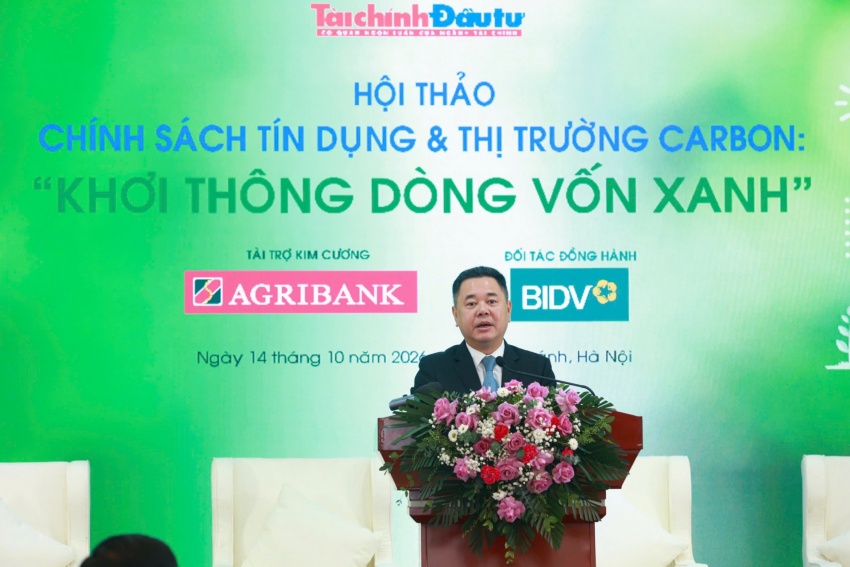 |
| Nguyen Ngoc Canh, Deputy Governor of the State Bank of Vietnam. Photo: Dung Minh |
The government issued Decree No.29/2026/ND-CP on the domestic carbon exchange in January, establishing the legal framework for the organisation and operation of the market and the trading of GHG emission allowances and carbon credits. The initial pilot market has been established with a scale of more than 511 million tonnes of CO2, equivalent to the emission allowances allocated to facilities in three major emitting industries, including thermal power, iron and steel, and cement for the 2025-2026 period.
The pilot phase will run until the end of 2028, before the market transitions to full mandatory operation from 2029. Commercial banks will participate in the market as settlement banks, with BIDV serving as the sole settlement bank during the pilot phase.
From the banking sector’s perspective, Canh said it was important to clearly recognise the respective roles of green credit and the carbon market in the green transition.
“First, green credit provides capital for investment and technological innovation, creating resources for the development of green industries and sectors and thereby generating emissions reduction results. The emissions reductions achieved by projects financed with bank capital, in turn, provide the foundation and commodities for the development of the carbon market,” Canh stated.
“Conversely, an effectively functioning carbon market will enable businesses to generate revenue and maintain stable cash flows from emissions reduction results to support their production and business activities, while improving their credit quality. Businesses will also be better positioned to purchase carbon credits to meet the stringent standards applicable to imports and exports,” he added.
Regarding green credit, Canh explained that the key consideration was not merely whether funds had been disbursed to a project classified as green, but also whether the borrowing customer had demonstrated measurable results in energy savings, emissions reduction, and environmental protection.
“Measurement, reporting, and verification of emissions reduction results, together with the trading of emission allowances and carbon credits on the carbon market, can provide additional information for monitoring the environmental performance of projects. This, in turn, can help credit institutions assess the effectiveness of capital utilisation and strengthen the management and supervision of green capital flows,” he said.
 |
| Overview of the seminar. Photo: Dung Minh |
In practice, the banking sector has proactively implemented various measures in recent years to promote green credit and direct capital towards industries and sectors that deliver environmental benefits and reduce GHG emissions.
The SBV has gradually refined the policy framework and issued orientations and guidelines on green credit and environmental and social risk management. It has also encouraged credit institutions to develop strategies and internal processes, as well as introduce credit products aligned with green growth objectives. This is particularly important in the context of developing green and low-carbon financing channels.
Speaking at the event, Canh said that since green credit was first introduced in 2017, the sector had expanded in both credit scale and the participation of credit institutions. As of the end of June this year, outstanding green credit had exceeded VND 856 trillion, up 9.87 per cent from the end of 2025. Average annual growth exceeded 20 per cent over the 2017-2025 period, with lending concentrated primarily in agriculture, forestry, fisheries, and biodiversity conservation, which accounted for more than 31 per cent, and green energy, which accounted for nearly 28 per cent.
Outstanding loans that had undergone environmental and social risk assessments exceeded $240 billion, representing more than 31.33 per cent of total outstanding credit across the economy.
“This result reflects the banking system’s commitment and efforts to support the green transition of businesses and the economy. When the carbon market operates effectively, emissions reduction results can be converted into financial resources for the businesses themselves. Accordingly, the development of the carbon market can help ease pressure on green credit resources,” said Canh.
“Rather than relying predominantly on their own capital, the state budget, or bank credit to finance their transition needs, businesses will have additional opportunities to generate resources from their own emissions reduction results. In the long term, this will help diversify financing sources for the green transition, reduce dependence on bank credit, and enable credit capital to be allocated more efficiently,” he said.
 | Carbon exchange adds new component to green finance ecosystem The newly launched domestic carbon exchange offers a market-based mechanism for emissions reduction, with its success hinging on integrating carbon pricing with green credit and capital markets to mobilise investment at scale. |
 | VIR workshop explores credit policy and carbon market development Vietnam needs a robust financial ecosystem to turn carbon market opportunities into concrete green investments, Pham Van Hoanh, VIR's editor-in-chief, said at a policy workshop on credit policy and carbon markets in Hanoi. |
 | Green transition requires realistic roadmap The green transition has become an unmistakable trend, but its implementation requires a roadmap that reflects practical conditions and economic development needs. |
What the stars mean:
★ Poor ★ ★ Promising ★★★ Good ★★★★ Very good ★★★★★ Exceptional
 Tag:
Tag:
Related Contents


Latest News


More News
- VPBank and Western Union enhance digital remittance experience (October 13, 2026 | 15:44)
- Eximbank’s next chapter: Richa Goswami on purpose, relevance and trust (October 13, 2026 | 10:52)
- Vietnam and Luxembourg sign MoU to strengthen financial cooperation (October 13, 2026 | 10:20)
- Vietnam seeks stronger cooperation with Fitch Ratings to improve sovereign credit rating (October 13, 2026 | 10:07)
- Nam A Bank named in top 10 largest listed banks in Southeast Asia (October 13, 2026 | 09:46)
- Citi appoints Michael Zezas as global head of research (October 12, 2026 | 17:23)
- From carbon value to greener capital (October 12, 2026 | 09:15)
- From cost advantage to ecosystem strength (October 12, 2026 | 09:00)
- Corporate treasury on the cusp of AI transformation (October 12, 2026 | 08:00)
- Vietnam strengthens global credit standing with R&I upgrade to BBB (October 09, 2026 | 16:56)


Latest News





 Mobile Version