

OCB targets green credit at 10 per cent of loan portfolio

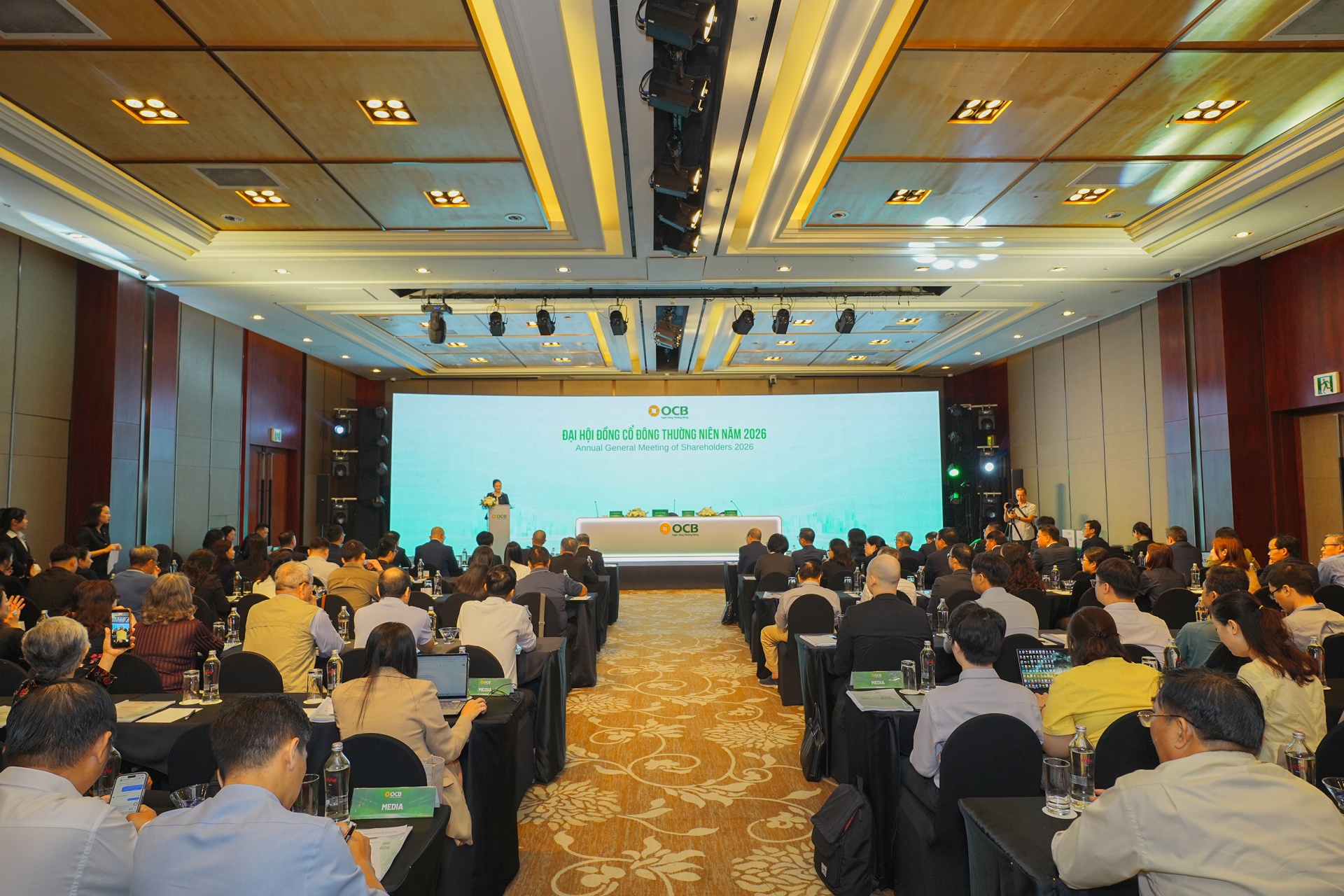
The green development strategy was presented to shareholders during the bank's annual general meeting on April 15. By the end of 2025, OCB's green credit portfolio had climbed to more than $840 million, a rise of over 10 per cent from 2024, representing 10.7 per cent of total credit.
 |
Renewable energy remains the primary focus, accounting for 49.5 per cent of the green portfolio. Sustainable water management follows at 17.4 per cent, green buildings at 16.6 per cent, and sustainable agriculture and forestry at 14.5 per cent, with clean transport comprising the remaining 2 per cent.
From 2026 onwards, OCB intends to maintain this ratio at approximately 9-10 per cent of total loans, above the industry average, while extending eligible sectors to include energy efficiency and sustainable farming.
CEO Pham Hong Hai stated that green credit remains a central operating priority.
“On the foundation of strategic cooperation with International Finance Corporation (IFC) and international financial institutions, OCB is progressively completing its green bank governance framework,” Hai said. "The bank is strengthening the integration of environmental, social, and governance (ESG) criteria into credit activities and risk management."
OCB has secured long-term capital and technical assistance from international backers, including IFC and Germany’s DEG.
Hai noted that OCB will grow these ties to vary green capital sources and eventually use instruments like sustainability-linked loans as the market matures.
The IFC green banking advisory programme has been a key factor in bettering governance, helping OCB increase its number of eco-friendly ventures.
“Our bank is consistently monitoring cash levels to align with Basel III standards in a broader effort to meet international safety requirements,” he noted.
The green strategy sits alongside wider financial targets, with pre-tax profit aimed at $278.4 million this year, a 39 per cent surge on last year’s $200.8 million.
Total assets are targeted at $14.17 billion, while deposits and credit are projected to grow 14 per cent and 15 per cent respectively.
Chairman Trinh Van Tuan told shareholders that the strong targets rest on a meaningful improvement in asset quality following a difficult cycle.
“From 2022 to 2024 OCB’s business activity slowed due to the impact of changing monetary policies, which affected the bank’s operating results,” Tuan said. “Non-performing loans (NPL) are concentrated mainly among retail customers with collateral, and peaked in 2024, while the NPL ratio among corporate customers remains very low. In 2025, NPL control and debt collection saw significant improvement, reflected in debt recovery growth that doubled compared to the previous year. This forms the basis for OCB setting an ambitious plan for 2026.”
During the meeting, shareholders approved a plan to issue 399.46 million new shares at a 15 per cent ratio to existing shareholders from equity reserves, lifting charter capital from $1.07 billion to $1.23 billion.
The proceeds will support lending, tech investment, and product development. Japan’s Aozora Bank is expected to remain the bank’s sole major shareholder at 15 per cent, while OCB intends to issue convertible bonds in the near future to fill the remaining 10 per cent foreign ownership limit.
 | OCB takes next step in AI integration Southern lender Orient Commercial Joint Stock Bank (OCB) and FPT Corporation signed off on the Data Analytics Modernisation Project, using Oracle ExaC@C Database 23ai, in Ho Chi Minh City on January 10. |
 | Outlook brightens for bank stocks in H2 As bank stocks continue to trade below their book value, the sector is seeing growing optimism for the second half of the year (H2). |
 | Four Vietnamese banks join $5.6 trillion green finance alliance Four Vietnamese banks have joined the Alliance for Green Commercial Banks, signalling a major step in advancing sustainable finance in the country. |
What the stars mean:
★ Poor ★ ★ Promising ★★★ Good ★★★★ Very good ★★★★★ Exceptional
 Tag:
Tag:
Related Contents









Latest News




More News
- From loans to women’s economic empowerment (October 06, 2026 | 17:58)
- VIB named Outstanding Retail Bank 2026, targets transaction banking (October 06, 2026 | 10:52)
- FTSE upgrade paves way for stronger stock market development (October 05, 2026 | 18:44)
- coLoan to empower women through inclusive green finance (October 05, 2026 | 18:42)
- Techcombank CEO: AI no longer a tool but a new operating foundation (October 05, 2026 | 18:11)
- Banks sustain profit growth as funding costs squeeze margins (October 02, 2026 | 22:22)
- Nam A Bank delivers strong breakthrough in 2026 (October 02, 2026 | 19:00)
- Policy credit builds sustainable livelihoods from the grassroots (September 29, 2026 | 07:48)
- VIB deploys Front Arena treasury and foreign exchange trading system on AWS (September 28, 2026 | 16:46)
- Nam A Bank receives $60 million loan from FMO (September 28, 2026 | 12:37)


Latest News






 Mobile Version